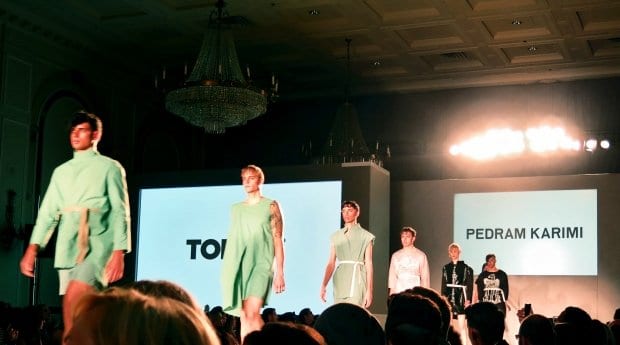
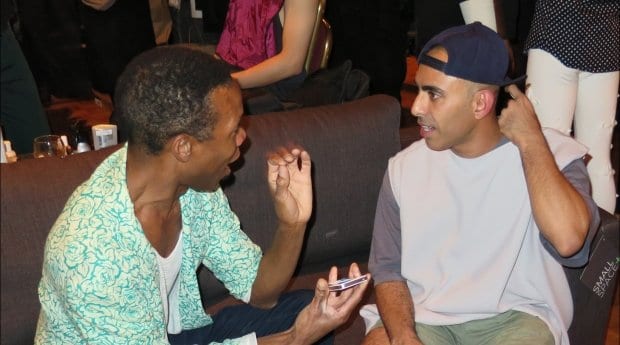
Designer Pedram Karimi, right. Credit: Rolyn Chambers
Pedram Karimi’s collection begins with a black, knee-length belted tunic. Next up is a cream-coloured variant, unbelted, with a lowered back panel. These are worn, pantless, by male models. My mind is racing.
Then out struts a female model in an almost identical ensemble . . . but carrying an oversized clutch. My mind is fitting the pieces together. From there, Karimi’s collection turns raw. Male models appear wearing loose-fitting, almost draped, sacklike toga creations with unfinished, frayed seams. Some are matched with knee-length shorts, but most are worn alone. The entire collection is very androgynous.
Feminine. Unfinished. Frayed. These three words swirl in my mind.
With all the “homophobia” and ”femme-phobia” allegations that launched a thousand tweets (and several critical articles), one wonders if the organizers of TOM even saw Karimi’s collection before it proudly pranced down the runway. The short answer: no.
“I don’t think I actually showed anything to the organizers to begin with,” Karimi says. “The line wasn’t finished yet. Honestly, these were the pieces I wanted to put in the show from the beginning. My design is a more Middle Eastern way of dress. It’s a loose interpretation of the tunic men wear there, but instead of keeping them ankle length I’ve decided to raise them up to the knee.” It’s like the little black dress of tunics . . . for men.
“You can wear my designs as was presented on the runway, but most will choose to wear them with shorts or pants underneath. I wanted a woman, a tomboy girl, in my show because I’m not just menswear. My style is genderless.”
“I also read about the femme-phobia stuff,” Karimi says, “but I was too busy getting ready for my show. It’s unfortunate that we have to think in those terms. Just because you don’t wear pants doesn’t mean you’re a woman.”
 Why you can trust Xtra