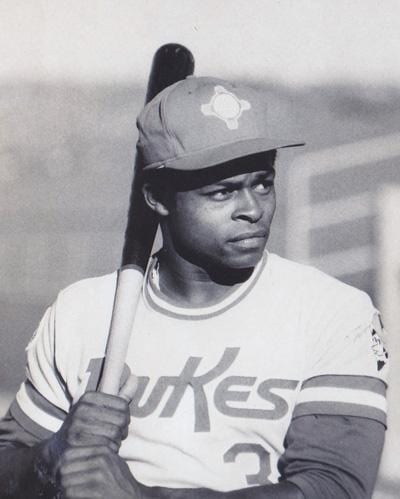
Professional sports may be one of the final frontiers for gay people, but even before Harvey Milk was assassinated, there was an openly gay man in major league baseball. His name was Glenn Burke.
In 1982, Burke came out publicly, three years after his career ended because he refused to hide his sexuality. He is the subject of a new documentary called Out: The Glenn Burke Story. It captures his life, sports career, coming out and tragic death at age 42 in 1995 from AIDS.
In 1976, Burke began his career with the Los Angeles Dodgers. Touted to be the next Willie Mays, his winning personality made him the life of the party. In Out, Burke is remembered as outspoken, outrageously funny, handsome and the inventor of the high five.
At first, no one suspected Burke was gay. A teammate noticed some seemingly close personal friendships between Burke and mysterious men who showed up at games. Burke’s personality was so magnetic and he was such a powerful athlete, people chalked it up to his charisma. But as more male suitors showed up after games and he dodged setups with women, people started to whisper. Teammates struggled to accept it while management tried to hide it. When Dodgers general manager Al Campanis offered him $75,000 to get married, Burke responded, “I guess you mean to a woman? I’m not going to do that.”
Rather than live a lie, Burke befriended Dodger manager Tommy Lasorda’s gay son, Tommy Jr. The senior Lasorda was so enraged the Dodgers traded Burke to the Oakland As, then one of the worst-performing teams in the league, where coach Billy Martin called him a “faggot” in front of his teammates. After a knee injury, the As sent Burke to the minors in Utah. Martin refused to call Burke back up to majors and he retired. He sought community in the Castro in San Francisco but struggled to make a living, fought with drug use, became HIV-positive and died surrounded by a close group of friends and family.
Burke played in the big leagues for just three years. In Out, Billy Bean, who famously came out after eight seasons as an outfielder in the major leagues, says Burke was good enough to have played 15 or 20 years.
Out producer Doug Harris was an old friend of Burke’s. They met when Burke was considered the best athlete to come out of Berkeley, California. In an interview with Xtra, Harris says Out triggers heavy discussion about the issue of gay people in professional sports and the level of acceptance other professional athletes have toward a potential teammate coming out.
“The players had no problem with it. They loved him as a person despite his sexual orientation. He was a part of the team. They were upset, sad, pissed off when he was traded. That was the beginning of the end of his career. And that’s where his downward spiral began,” says Harris.
The film ends with these words: “Since Glenn Burke played his final game in 1979, 6,552 players have appeared in the major leagues. Not one has come out as gay during his career.” But Harris says Out is not intended to call on closeted professional athletes to come out publicly.
“The film is just a statement,” he says. “Someone’s sexual preference is their business. Glenn was openly gay. He didn’t hide it. Did he come out publicly? No. Did he have to? No. Glenn was comfortable with who he was. Other people weren’t comfortable with it. People shouldn’t have to be pressured to come out publicly. But if they don’t want to, that’s fine.”
Harris points to attitudes changing in the sports arena, particularly NBA management. For example, Phoenix Suns CEO Rick Welts came out publicly and the NBA fined two players this year for using the word “faggot.”
“You have the NBA doing a series of PSAs promoting tolerance towards gay people. The stage is being set. Maybe this could happen,” says Harris.
Out: The Glenn Burke Story from Rod McCullom on Vimeo.
 Why you can trust Xtra