The AGO’s Toronto Now space is a curious little gallery. It’s a single room that faces onto Dundas St, just off Frank Restaurant. It looks like a typical tiny storefront Queen West gallery (although those kinds of spaces have long since disappeared from the Queen West strip, but I digress). It’s intended to provide a space for the work of young, contemporary local artists at the AGO, to keep the museum, and by extension, the museum’s public, current.
It’s a very smart move that allows the AGO the kind of flexibility and community focus that few institutional art spaces in this city have. It’s fitting, then, that the latest artist to inhabit Toronto Now is Will Munro, someone who was Toronto Now for most of his adult life and remains so even after his passing.
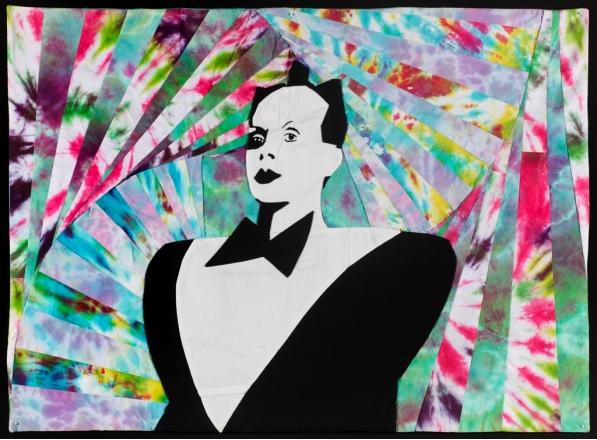
Curator Michelle Jacques focuses largely, but not strictly, on the textile aspects of Munro’s practice. Munro’s textile collage works line the south wall: his portraits of Klaus Nomi and Leigh Bowery, his Black Fag poster (an homage to hardcore punk and drag legend Vaginal Crème Davis), each cobbled together out of Sally Ann underwear and T-shirts.
Jacques also includes a single screenprinted mirror piece, a dreamy close-up of David Bowie in his Ziggy Stardust phase. She has also included bits of ephemera: Hidden Cameras- and Klaus Nomi-inspired turntable beds, clothing (a jacket made out of photocopies and packing tape, a T-shirt autographed by Runaways singer Cherie Currie) and a collection of YouTube clips culled by Luis Jacob and Kevin Hegge.
Given the drastic limits of the space, Jacques does an excellent job of coming to grips with who Munro was. There’s not enough room to devote any space to issues of influence and legacy, and the works are too few for this to read as any kind of retrospective, any mention of which is very wisely avoided. So Jacques narrows her focus to the porousness of Munro’s works and tastes: his art, his parties, his DJing all bled into one another, and Jacques exposes that through the common denominator of music.
The cluster of YouTube clips — bits of documentaries like Paris Is Burning and Maestro, clips of Bowery and Nomi, concert footage of Bowie and The Runaways — are not only a fun ride in and of themselves, they neatly do the job that didactic panels nearly always fail to do: they provide greater insight into Munro’s art and the web of influences from which it sprang.
Instead of projecting Munro’s work into the future, tracing influence and commonality, the work in the Toronto Now space traces Munro’s own influences and commonalities. Munro’s work, among other things, tries to forward a kind of queer persona and ontology, a way of being gay in the world, learned from a specific line of forebears.
Aesthetically, Munro always wore his heroes on his sleeve. The nighttime rebellious fun of club culture, the alien new-wave eccentricity of Klaus Nomi, the aggressive performative genderfuck of Leigh Bowery and Vaginal Davis, the girl-gang roughness of The Runaways: they all sing of queer as outsider, but not marginalized. Rather, the fag that emerges out of Munro’s work has no patience for mainstream culture’s fickle tolerance; to paraphrase another queer icon, the not-quite-so-punk Mama Cass, they’ll make their own kind of music.
Will Munro: Total Eclipse runs until Sept 26 at the Art Gallery of Ontario, 317 Dundas St W. ago.net
An event to celebrate the exhibition’s opening will take place on Saturday, August 7 at the AGO. Featuring DJ sets by Kevin Hegge and Adrienne Kammerer, the event will run from 8-11 pm and is open to the public.
 Why you can trust Xtra