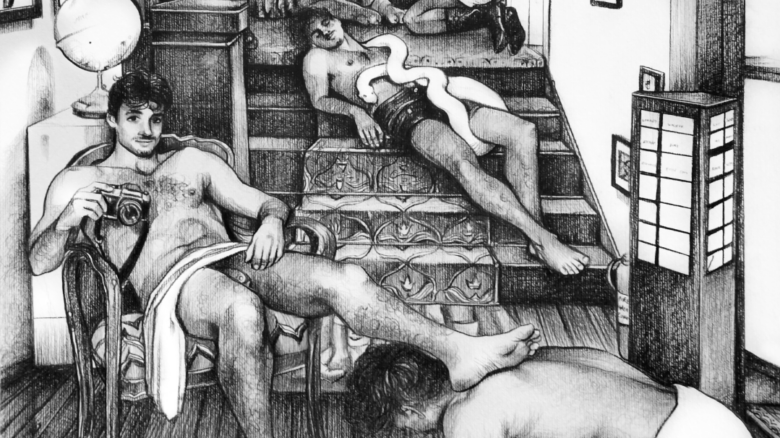
Jasper Johns and Robert Rauschenberg.
There’s a new exhibit at New York’s Museum of Modern Art (MoMA) featuring artists Jasper Johns and Robert Rauschenberg, but does it put the creators of Pop Art in the closet?
Critic Mark Joseph Stern has pointed out that the Johns and Rauschenberg exhibit closets the two artists by not disclosing their sexuality and by describing the couple, who were lovers while collaborating on the collection the show covers, as nothing more than “friends.”
From slate.com:
The painting contains one of Johns’ famous Americans flags reversed and coated in thick, dark paint, occluding the iconic image with gloomy tones. Johns painted his first American flag soon after meeting Rauschenberg, and completed In Memory during their break-up. Accordingly, the piece is often interpreted as an illustration of a relationship tarnished, smothered, and increasingly obscured by the passage of time.
Advertisement
While those two works are not on display in “Johns and Rauschenberg,” several of the installation’s paintings could be rewardingly subjected to similar analysis. MoMA gives us no such gifts, though, skating over the true nature of the two men’s relationship and, at one point, actively denying it, really, by referring to Johns as Rauschenberg’s “friend.”
Even a brief reference to the artists’ sexuality could clue savvy viewers into keener investigation of these droll, elliptical works—or, even better, complete the installation’s narrative. MoMA tells us that Johns’ and Rauschenberg’s collaboration led them away from abstract expressionism, but it fails to explain how they discovered Pop Art. That genre, birthed by these two artistic giants, was built upon rejection of societal norms including hyper-masculinity and heternormativity.
 Why you can trust Xtra