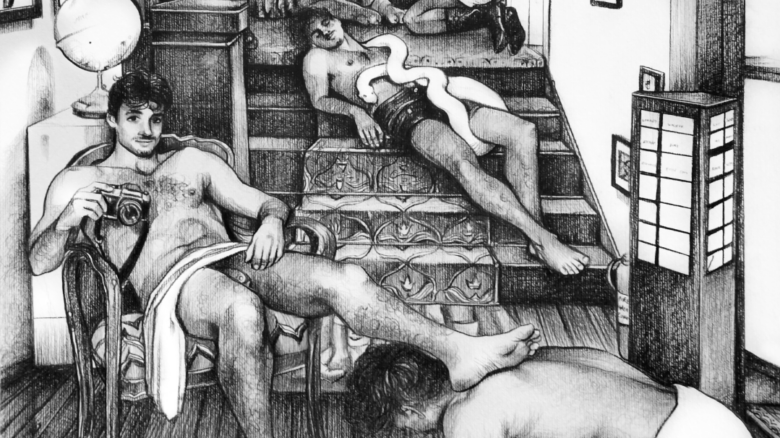
Funny, isn’t it, how the same people who sneer at plastic-covered furniture hide the TV?
It’s gotten so that you don’t actually have to attend a middle-class housewarming in this city. If it’s a fag couple living downtown, you can predict the layout in advance. All the “good” (aka designer) furniture will be in an open concept living room on the main floor. And the poor lonely TV will be relegated to the smallest room with the tattiest furniture, usually a small den at the front of the house.
The homeowners may spend more time in that small room than anywhere else in the house, but you’re not supposed to know that. You’re supposed to be impressed by the living room, the public room, the room that in your grandmother’s time was probably “reserved for company.”
It’s the sort of thing that shouldn’t surprise but does. Once upon a time gay lib was populated by leftist radicals angrily storming the doors of convention; now we’re the people of the front parlour.
It seems like only yesterday that editors ranted about identity politics. It was a way of locating yourself, of staking a place in the social structure without invoking the traditional markers of class, education and religion. Such was the power of gay solidarity, the idea that we were all in this struggle together, that most folks overlooked class barriers.
That’s all gone now. The triumph of bourgeois belief is complete. It’s a triumph that began in the mid-1980s when the gay middle class began to emerge from the shadows and lawyers took over the movement. It reached its apogee, of course, with gay marriage, the ne plus ultra in social respectability, fitting in, proving you’re just as good as (ie just the same as) everyone else. Marriage isn’t a justice issue, it’s a social ladder. Other signs of the shift, however, have been with us for some time.
A woman once wrote to Fab magazine to complain that not all female-bodied people identified as female, and she sounded heated and personally involved in the struggle. But at a larger, social level, it seemed like the last gasp of a once great initiative. Identity won’t cut it anymore. Now it’s about granite countertops, stainless steel appliances, restaurant-grade ranges. In a word, it’s about lifestyle, cash, class.
Class has always informed the way we see ourselves and, even more important, the way we want to see ourselves. Several of the iconic stories of gay life would be impossible to imagine without the abrasive divisions of class. Think EM Forster’s Maurice and his servant-lover or Christopher Isherwood and his German rent boys. Or even Virginia Woolf and the much maligned servants who, even more than the supportive husband and the fabled room of her own, gave her the leisure to write.
But on this side of the pond, class has always lurked in the shadows. Gay men were prepared to overlook it in the search for a good lay. Canadians as a whole found it an affront to naïve notions of equality.
But of course class exists and its distinctions affect all social interactions. With few exceptions, most of the bars and coffee shops Toronto divide strictly along class lines. If that’s not often acknowledged, it’s mostly because we prefer talking in code.
Years ago, people used to refer to Colby’s, now home to Five, as “sleazy.” It took me ages to figure out what they meant. Surely, the bar was no more raunchy than any other place in town? But as it turned out, we were speaking different languages. I was talking sex, while they were talking race and class. What they meant by “sleazy” was “not our kind of people.”
Acknowledged or not, the class struggle wages on. Downtown, condo owners with 4am flights to New York conflict with people having 3am street parties. They live in the same neighbourhood, but operate in different worlds.
Elsewhere, middle-class notions of respectability operate almost unchallenged. I was at a very polite wedding reception recently when one of the guests happened to mention that he’d once dated one of the husbands. Not exactly an unusual event in the annals of gay society, but he was roundly castigated for mentioning it. Not the right day, how inappropriate, how déclassé.
If we’re not careful, this sort of prissiness could carry over into our sex lives. Historically, the middle class has been the one most closely tied to sexual convention. The aristocracy have power, money and position; the poor have the next best thing — nothing to lose. Both groups, though for different reasons, can do pretty much what they want. It’s the middle class who, inhabiting an inherently unstable position, cling most vociferously to conventional notions of propriety.
So don’t be surprised if the next time you’re at some place like the baths the behaviour has subtly shifted. Next thing you know we’ll have guys running back to their cubicles to cover the video monitor before the company arrives.
 Why you can trust Xtra