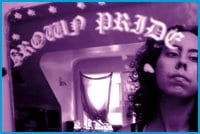
The last year was a tumultuous one for Leah Lakshmi Piepzna-Samarasinha — she broke up with her longtime partner, quit her job and got back in touch with her estranged family — and the writer and spoken-word artist worked it all out on paper.
“I sat at my kitchen table and just began to write,” says Piepzna-Samarasinha, 32. “I wrote about going from a white partner to having sexual relations with other queer and trans people of colour. I had adventures. I had heartache. But I also grew up.”
Those stories are the basis of her first one-woman show, appropriately titled Grown Woman Show, playing this weekend at the Alchemy Theatre. The show uses storytelling, spoken word, performance art and visual installation to tell, as she puts it, “fearless true stories about the inside of our brave, broken open hearts, the families we come from and the ones we create as queer girl of colour survivors searching for that magic love-fuck family connection in an insane universe.”
In Grown Woman, Piepzna-Samarasinha speaks openly about her own life, including being an incest survivor at the hands of her white mother, a queer girl of Sri Lankan descent in a predominantly white culture and a “brown high femme diva who loves and partners with butches and trans men of colour.”
Piepzna-Samarasinha came to Toronto 10 years ago looking for a community where she would fit in. She was born and raised in blue-collar Worcester, Massachusetts, then moved to Brooklyn, New York for school.
While her family was part of the reason she moved to Toronto — “I wanted to put an international border between myself and my parents” — she also never felt at home in the Big Apple.
“I felt isolated in New York, but in Toronto I found a community that I could more easily access,” she says. “I was searching for radical and queer Sri Lankans and South Asians and, in the mid-’90s and still today, Toronto is at the forefront. It’s the it-spot if you are queer and South Asian.”
Piepzna-Samarasinha says she learned even more about fellow queers of colour when she started dating them.
“I’ve discovered that when I’m partnered with other queer people of colour, we understand each other in ways that we can’t with white people. There’s this intense feeling of, ‘I know you,’ that’s not even always verbal.
“For example, last year I was dating this Arab trans guy. A week after we separated, Lebanon attacked Israel and war in Sri Lanka started up again… so we were both on the phone and the ‘net trying to reach family. We comforted each other. We were both hurting at the same time, and we understood that.”
Perhaps the most shocking issue Piepzna-Samarasinha delves into, however, is being a survivor of incest and how it not only affected her but the rest of her family as well.
“People tell me that it’s so brave of me to be talking about this, and I guess it is, but it’s almost at the point when I don’t even notice it anymore,” she says. “But I chose to be really open about it because of the way violence is so normalized in society. It’s important that we talk about surviving, and not just talking, but showing what survivorhood looks like.”
The incest at the hands of her mother led to an estrangement from her father. Their reconciliation is detailed in Grown Woman Show. “I needed to show that 10 years later, I’m grown. I’m not the same person I was.
“The title is about waking up last year, being 31, and thinking, ‘What do I do now?’ I was so busy surviving, I forgot I had survived,” says Piepzna-Samarasinha, “and now that I’m grown, I get to decide what kind of relationships I want to have. I get to stand on my own two feet. I’m no longer running from something, but rather, I’m deciding where I want to go next.”
 Why you can trust Xtra