Sex. It’s just everywhere these days: film, music video, magazines, the internet . . . hell, even the Catholic Church has gotten in on the action with that studly hunk of beef they elected pope. But with this ever-increasing deluge of photo-shopped bodies and incredible genitals, it seems that our idea of what the human body actually looks like is becoming more and more skewed.
“I feel that I almost want to empathize with the men who are watching this stuff or engaging with sex that is so removed from a real person,” says visual artist Teresa Ascencao. “My interest is about the lack of communication, the lack of true pleasure and the lack of true bodies in what we see every day. And I believe these things are due to the distortions of what we’re being told that sex is supposed to be.”
Ascencao is one of the artists taking part in The Sex Show, an annual exhibition courtesy of Gallery 1313. The series offers artists of all milieus a chance to share their own feelings about this most basic of human compulsions, be it through film, photography, sculpture or painting. As one would expect, there’s a healthy variety of views represented.
“Artists are obviously very sexual, like everybody else,” says gallery curator Phil Anderson. “So I thought it would be interesting to see how artists were using sexual content in their work.”
Now in its fourth year, The Sex Show draws online submissions from all over the country, offering Anderson a peek into the figurative pants of Canadian creators. Choosing participants is a long process, but there are always pieces from artists like Ascencao that fit the bill perfectly.
“I like Teresa’s work because it often possesses a strong statement,” Anderson says. “It can be pretty graphic imagery, strong and provocative, which makes me curious as to where she’s coming from and where she’s going with it.”
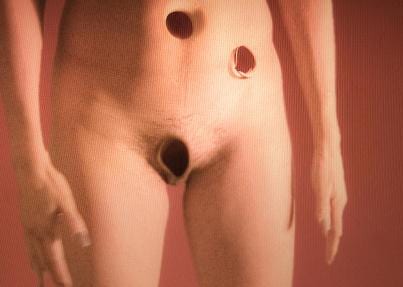
Pieces like Ascencao’s arresting photograph Candy TV are intensely personal for the artist, who admits to some hesitation in sharing such intimate creations with a wider audience.
“This is work that I don’t normally show,” she says. “I actually use this kind of stuff in my sketchbook to propel me into issues that I want to raise in my work. These pieces are very emotional reactions to how I feel sexuality is portrayed in the mainstream media.”
Candy TV is certainly provocative: the smooth skin of a woman’s abdomen and pelvis is interrupted by large holes that Ascencao Photoshopped onto her own body. It’s beautiful, grotesque and almost intrusively intimate; powerful work from a woman coming to grips with her own sexual presence in society.
“Seeing that image is so significant for me,” Ascencao says. “It’s a big healing exercise, almost a coming out, as it were, with my own body in public.”
 Why you can trust Xtra