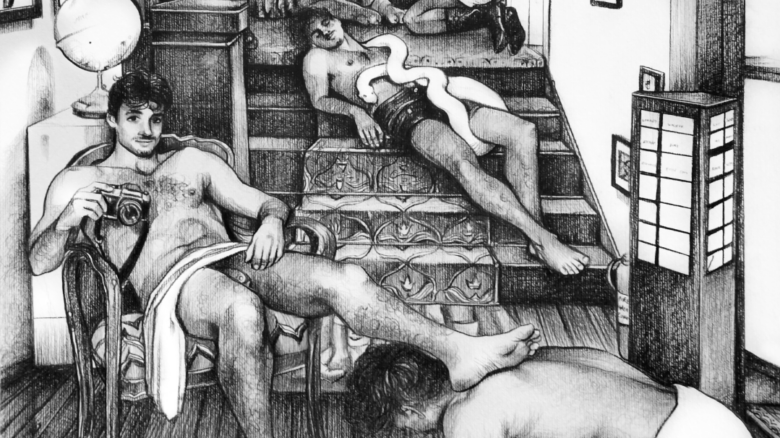
The dividing line between art and entertainment can be hazy. We go to galleries to look, chat and to pass the time. For some of us, looking at art is no different than puttering around on the Internet, looking for a bit of fun. For Toronto-based multimedia artist Johannes Zits, his artistic practice, at least lately, is woven together with on-line photo rummaging and YouTubery. His latest exhibition, Digital Twist: New Works On Nakedness, is largely comprised of found/borrowed/stolen digital photographs and video stills that explore different incarnations of public nudity. From playful free spirits running through a library, to a defiant streaker being hauled off of a soccer field, the images are about bodies and how they are mediated.
In these prints, images of naked bodies are clear and unobstructed, while the surrounding clothed people are heavily pixelated, to the point where there are large flat squares of colour throughout. These flat areas are an exploration of formal elements of colour, composition and space. These squares, Zits says, “represent my love/hate relationship with formalism and minimalism. I see these squares as being sort of vacuous, meaningless and aggressive.” They correspond to colours found elsewhere in the photographs and act to disrupt expectations of continuity.
The idea of “digital democracy” is being tossed around readily these days, so making art based on Internet photos and video stills is timely. “I see the photos as being more of a collaboration, as a form of sharing,” says Zits. “People on YouTube are sharing their videos. People that are taking the streaking photos are sharing them on their websites.” This strategy challenges traditional ideas on authorship. How can these images belong to Zits’ since they aren’t his in the first place? There is no clear answer. Although he didn’t take the photographs himself, he has manipulated them and changed their context.
The name Digital Twist refers to the way in which Zits reframes existing images, but it also refers to the performance piece he’ll be doing on opening night. In the simplest of terms, the performance is a big naked game of Twister. The performance begins by participants painting each other in colours inspired by French artist Yves Klein. Then the game begins. Throughout the performance, the paint transfers from one person to another, and also to the board. The piece is a performance and a spectacle, but it will also create temporary incidental paintings in the process.
Much like Zits’ previous work incorporating magazine photographs of figures and interior spaces, Digital Twist relies heavily on the idea of collage. Although not immediately evident, these works owe their existence to images and ideas that came before. Whether it be references to art historical movements, technology or cheeky exhibitionists, Digital Twist is a response — and an offering. It builds upon the history of body-based art, and asks viewers to reconsider ideas on public nudity.
The opening reception for Digital Twist at Spin is from 7:30pm to 10:30pm on Thu, Mar 8, with a performance at 9pm. There is a naked reception (men only) from 8pm to 11pm on Fri, Mar 16. All TNT!MEN members, friends and adventurous newcomers are welcome. RSVP to info@spingallery.ca.
 Why you can trust Xtra