Credit: VQFF
Welcome to Dry Lake, a well-named and unpromising town located near a Navajo reservation in picturesque New Mexico. Poor and ramshackle, the dusty area and its downtrodden inhabitants have seen better days.
It’s a place, according to the opening voiceover of Drunktown’s Finest, that people are meant to leave yet rarely do.
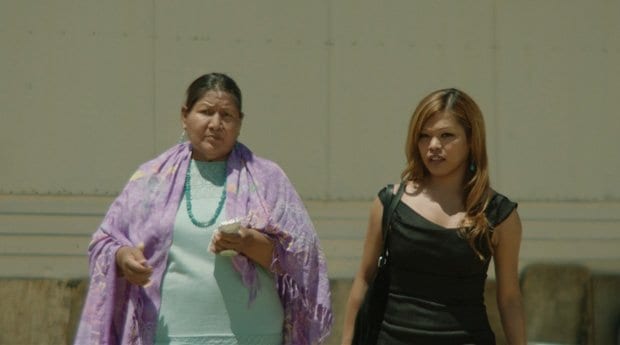
For her third feature, director Sydney Freeland zeroes in on three Navajo teens. Trans actress Carmen Moore plays Felix John, a two-spirit woman and part-time prostitute whose Facebook page identifies her as Felixia, a “sexy tranny” who dreams of hitting the big time in New York City as a model.
Luther Maryboy (aka SickBoy) has joined the army in a vain attempt to escape trouble. It follows him nevertheless.
And Nizhoni, adopted by a Caucasian couple when her own parents died in a drunk driving accident, is about to begin college in far-off Michigan. Locals refer to her “an apple” (“red on the outside, white on the inside”), and she yearns for a meaningful connection with the culture of her birth.
Because the opening minutes appear so loaded with bad portents, watching the taut plot unfold feels nerve-wracking and similar to a horror movie: the question isn’t if something terrible will happen, but what and how soon?
Freeland’s story follows the trio over a period of a few summer days. In keeping with a bleak view of American teen lives (seen in Spring Breakers and Kids, for instance), their routines centre on parties, fistfights, quarrels, schemes and Glocks. This is especially true of SickBoy, whose noble attempt to provide for his family-to-be is undermined by his volcanic anger and attraction to criminal shortcuts.
Likewise, Felixia’s naive fantasy of becoming a model mixes uncomfortably with the recklessness of her sex work.
These kids seem adrift and, the absorbing story implies, lost, neither fully fitting into American culture nor benefiting from the remnants of Navajo teachings.
Despite the dark omens, Freeland offers these kids a lovely glimpse of a future that doesn’t end with violence, incarceration or death. Instead of a miserable fate, her story sets up possibilities for different, better futures.
There’s still the probable outcome, yes. But there’s another distant hope that offers these kids oppressed by history and poverty the chance to eke out a happier life than the one Dry Lake has so far shown them.
Drunktown’s Finest Sun, Aug 17, 7pm, International Village 88 W Pender St. Director in attendance
 Why you can trust Xtra