There are artists whose work is promiscuous, tackling a vast array of subjects, moving like a hummingbird from one conceptual preoccupation to the next, sometimes in the same piece. And there are artists who are fixated, ruminating over one subject or theme throughout a lifetime of art production.
Daniel Barrow is shaping up to be the latter. Over the course of his ever-burgeoning career, which has thus far seen him twice nominated for the Sobey Art Award (among other accolades and achievements), he has, with an almost obsessive singlemindedness, worried the idea of melancholy, buttressed by a love of camp and a deep predilection for melodrama. His work — with the sole exception of the amazing video compilation Winnipeg Babysitter (a paean to the prairie public access offerings of yore) — plays in a decidedly minor key. Usually, he sits behind his trusty overhead projector, manipulating layer upon impossible layer of transparencies, narrating his tales of sad young lads, freaks, castoffs and other social misfits (and the dreadful fates that befall them) in his trademark tone: hushed, sibilant, deadpan.
Barrow’s newest show, Emotional Feelings, at the Art Gallery of York University (AGYU) is an exhilarating ramp-up of his work. His gallery shows, while not as direct and engaging as his performances, have always been excellent — usually, he takes the opportunity to display intimate, collaged drawings. For Emotional Feelings, he has managed to marry the best of his narrative work while expanding his static 2D work to epic proportions.
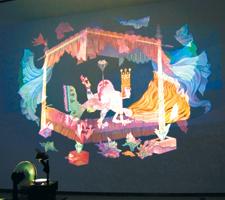
The show consists of four projections, although even that is too simple a word to describe what’s going on. The two rooms of the AGYU are strewn with paraphernalia: a plethora of overhead projectors (naturally), DVD players (one of the projections has an animated component), various fans set astride shallow bowls of water. It’s an impossibly complex installation job, made all the more wondrous and magical by the results.
The four images hovering on the walls are of a corpulent rococo monarch fucking a mermaid on a four-poster bed (gallery-goers can animate his rutting); a stream of people falling to their doom, viewed through fluttering, parted curtains; a box of tissues diarrhetically spewing Kleenex (again, viewers can choose the box’s print); and a skinless man holding his epidermis aloft like a flapping overcoat.
As the double-whammy redundancy of the show’s title suggests, Barrow is after mood, and he achieves it in spades. The images are gorgeous, rendered in his trademark effete line, and they each have a biting melancholia to them. What makes the show so incredible is the vast gulf between the means and the ends. As I said, the means are scattered around the gallery: ungainly, outmoded, clunky things, archaic boxes of metal and plastic and wood. But Barrow turns them on, affixes his drawings and emotional feelings, adjusts them to and fro, turns on his special effects —here, nothing fancier than blowing fans over water to create the illusion of shimmering movement — and voilà! He makes them sing, and they sing the saddest, most beautiful songs.
 Why you can trust Xtra