“The artist has this responsibility: if we have an audience we have to speak out,” says multidisciplinary artist Keith Hennessy. In 1982, motivated by his activist impulses and creative drive, Hennessy dropped out of business school at McGill University in Montreal and hit the road to be a juggler in an anti-nuclear street performance duo. When he found himself in San Francisco, his long-held passion for dance and political action pushed him into the city’s emerging modern dance scene, where he flourished.
“Despite all kinds of queer impulses as a young man, I didn’t act on them until I was in my 20s, and that was in San Francisco under the context of AIDS,” he says.
One breakthrough performance in his work with various dance troupes was also his first explicit artistic expression of his sexuality. Entitled Saliva, the piece was a boundary-pushing dance performance held under a highway overpass that served as a ritualistic reclamation of the gay male body and bodily fluids, and it garnered Hennessy national attention.
“I started to explore my connection to my body and how body liberation was connected to sexual liberation, and I wanted to participate more in the evolution of queer performance,” he says of Saliva. “There was a section of nudity in that piece and there was a section that was very leather fetish; I was wearing a leather jacket and only a jockstrap and boots.
“I knew from the beginning I was never going to be the kind of professional dancer who mastered a certain technique,” says Hennessy, who describes himself as a performance artist influenced by the language of dance. “I came of age in a time where artists were less focused on virtuosity and more on personal expression or conceptual integrity.”
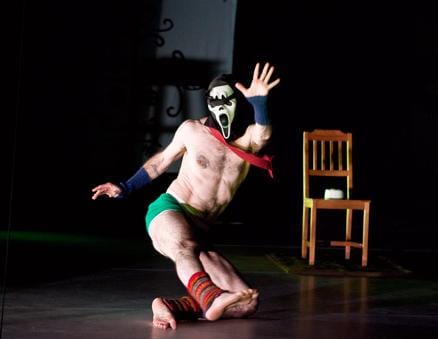
Crotch (All the Joseph Beuys references in the world cannot heal the pain, confusion, regret, cruelty, betrayal or trauma…) is the intriguing title of the piece he’s bringing to the Rhubarb Festival. Developed at an arts retreat in rural Germany, Crotch is inspired by influential German artist Joseph Beuys, the politics of art history and Hennessy’s interest in the relationship between artist and spectator. “On one level it’s about Joseph Beuys, on another it’s about my divorce, and on another level it’s actually a really mysterious and weird hour in the theatre and none of us really know exactly what I’ve made,” he says.
Originally intended as just a solo exercise, Crotch has gone on to be Hennessy’s most toured and acclaimed piece; he describes it as a career-spanning patchwork of his performance styles. “It’s improvised dance, and now it’s a karaoke song, now it’s an installation piece where the audience comes onstage to look at objects and so on,” says Hennessy, who does everything from slathering his genitals in lard to sewing himself to volunteers during the piece. “Rather than it being a fusion, each thing stands on its own and adds to the overall experience.”
Hennessy is also presenting a free workshop for queer performance artists as a part of Rhubarb, called Performing (queer) Failure, a concept that excites Hennessy academically and artistically.
“At this point failure is almost a cliché in the art world, but there are some people starting to analyze and theorize failure. The kind of failure I’m looking at is that queer artists are artists of failure because normative society sets up these ideals for us that we never meet,” he says. “In the gap between the real and ideal there is this room to move and have some kind of self-created or community-created ideals. We’re always struggling to meet some ideas of success that are taught in university classes or acknowledged by arts funding or institutions, but those things are part of the neo-liberal state we’re in protest against, so maybe we need to be failing a little more.”
The Deets:
Crotch
Keith Hennessy
Fri, Feb 17 & Sat, Feb 18 at 9:30pm
Rhubarb Festival
Buddies In Bad Times
12 Alexander St
buddiesinbadtimes.com

 Why you can trust Xtra