Contest open: city nails down Bank St public art process

Village bike rack design winners to get $1500 each; city sets May 22 deadline

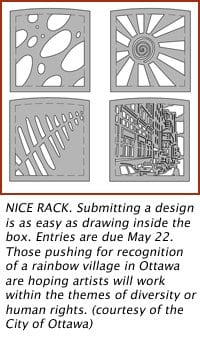
A requirement that bike racks must “reflect the community” is as close as gays got to a recognition from the City of Ottawa in its call to artists. Nonetheless, the queer community will be able to make comments on proposed designs at a public meeting, according to documents released Apr 11.

Anyone living within 150 km of Ottawa — both established artists and scene newcomers — can submit up to two drawings for consideration. Entries will be judged on artistic merit, durability and “timelessness” of design. Finalists will be presented at an open house in the second or third week of June.

Winning designs will be cut from steel to make bike racks, part of the city’s first “functional art” program. Up to 30 designs will be chosen to spruce up 90 bike racks between Laurier and the Queensway.

The project is part of a redevelopment strategy spurred by the closure of Bank St starting this spring to replace ailing pipes below the street’s surface. That process has already been completed for the part of Bank St that lies between Wellington and Laurier.

Download the submission package (PDF files):

Marcus McCann

Marcus McCann is an employment and human rights lawyer, member of Queers Crash the Beat, and a part owner of Glad Day Bookshop. Before becoming a lawyer, he was the managing editor of Xtra in Toronto and Ottawa.

Read More About:
Politics, Culture, Power, Arts, Quebec, Ottawa, Canada

Keep Reading

Bentley Robles

Bentley Robles wants a brotherhood of gay pop stars

The yellow-haired singer talks rising stardom, Zara Larsson and dating while gay-famous
Vivek Shraya being kissed by a man

Vivek Shraya is hot, blond and hitting the dance floor

The Toronto multi-hyphenate’s new album, “VIVICA,” shirks respectability politics for a sensual, high-gloss exploration of queer and trans desire
Morphine Love Dion, Dawn and Morgan McMichaels

‘RuPaul’s Drag Race All Stars 11’ plays it safe for the first bracket—until the very last minute

Already, we see the consequences of only two queens moving forward from each bracket to the semifinals
The cover of Alice Stoehr's Again, Harder. The book has black letters on a lilac background. In the middle of the cover is a red rectangle with a black line drawing of it. The drawing is of two figures entangled; they have human bodies but animal heads. The same image serves as the background behind the image of the book cover.

‘Again, Harder’ captures being part of an in crowd made up of those on the outskirts

Being trans can be a vital way to connect. Author Alice Stoehr illustrates how it can also be the extent of connection
Advertisement