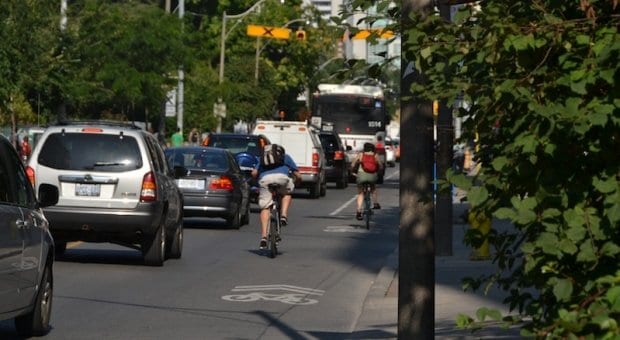
Toronto will get its long-awaited second separated bike lane when the first segment of the Wellesley-Harbord “cycle tracks” are installed in late September, says Daniel Egan, the city’s cycling infrastructure manager.
The new lanes come two years after city council voted to remove bike lanes from Jarvis Street against the wishes of many in the community, sparking protests.
The initial phase of installation will see separated lanes placed on Wellesley Street from Parliament to Yonge streets. The remainder of the route, covering Wellesley Street West, connecting through Queen’s Park, and along Hoskin and Harbord streets to Ossington Street, will be installed next year.
Most of the route already has painted bike lanes installed, but physically separating the lanes has been a priority for Councillor Denzil Minnan-Wong, who chairs the public works committee at city hall. The city’s first separated cycle tracks were installed on Sherbourne Street last year, from Bloor to King streets, and are scheduled to be extended to the waterfront next year.
But the cycle tracks on Wellesley won’t look like those on Sherbourne, which in some places are separated from traffic by a rounded concrete curb and in other places slope from the sidewalk to the road with no obstacle preventing cars from driving or parking on them.
Instead, the tracks on Wellesley Street will be separated from traffic by flexible plastic bollards that will create a “wall” to discourage cars from driving onto the tracks.
“We could put the curb on Sherbourne because the street was scheduled to be rebuilt last year. There’s no budget to rebuild Wellesley completely,” Egan explains.
Still, rough areas of Wellesley, particularly east of Jarvis Street, will be patched over by road crews before the new tracks are installed, he says.
Wellesley Street West, from Yonge to Queen’s Park, is scheduled for reconstruction next year, at which point cycle tracks will be installed.
Around Queen’s Park and along Hoskin and Harbord to Ossington, the proposed design for the cycle tracks puts both directions of travel on the same side of the street, which will be a first for Toronto, although it’s common in other cities, including Montreal and Vancouver.
All parking will be removed from Wellesley Street as part of the project. A city report says that there’s ample supply of parking in nearby lots, although it is also considering adding more on-street parking to side streets. Egan says the city could not release detailed drawings for the new lanes as the contracts have not yet been signed for construction.
Along with the Wellesley cycle tracks, the city will also install separated cycle tracks on Bloor, from Sherbourne to Castle Frank and over the Prince Edward Viaduct, as well as bike lanes, sharrows (shared lanes) and contra-flow lanes on Bay, Shaw and Bayview this year.

 Why you can trust Xtra