Comic book conventions may not be traditionally known for their openly queer content, but one panel organizer at this weekend’s Ottawa Comiccon aims to change that.
Sophie Delmas has gathered a panel of comic book fans to answer the age-old question: where are the queer superheroes?
“I have time to talk about all the queer superheroes in one hour,” Delmas says with a laugh. “That’s how many of them there are.”
Delmas first conceived the panel for the Montreal anime convention Otakuthon. Although panels at comic conventions typically feature celebrities, fan panels are more common at anime-centred events, she notes.
Delmas says she has twice as many queer superheroes to discuss this weekend than she did three years ago but says homophobia still runs rampant in comic culture.
“There is clearly homophobia in the comic community. The first place you see it is in the comics themselves,” she says.
The theme for the Marvel Comics portion of Delmas’s panel is titled “Wow Wolverine, you sure kill lots of gay characters, huh?”
“He does kill all the gay characters, but there is a version of him that is gay, which I find hilarious,” Delmas says.
DC Comics recently rebooted its entire universe. By pushing the reset button, almost all the gay characters disappeared.
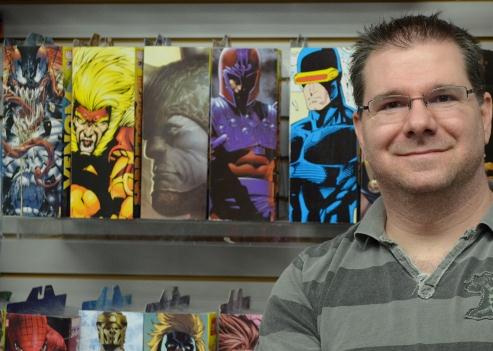
Rob Spittall is the owner of the Comic Book Shoppe on Bank Street. In February, he removed works by homophobic writer Orson Scott Card from his shelves, and he says that although it is unfortunate that DC essentially erased much of its queer content with the reboot, it is DC’s treatment of the new Green Lantern’s relationship that he finds most disappointing.
“In the new universe they made Allan Scott [the Green Lantern] gay and then killed his fiancé seconds after proposing. I don’t know if it’s deliberate or not. I read the issue and all of a sudden, an explosion, right after he says, ‘Will you marry me?’ How can you have a gay character if you’re not going to explore the relationship between the two of them?” Spittall asks. “You want to explore the reality of it all. When DC did that, it was a really big disappointment to go through.”
Spittall adds that Marvel deserves credit for continuing the storyline of Northstar, a gay Canadian superhero who was the first major character to utter the phrase “I’m gay,” in 1992.
Both Spittall and Delmas further cite Batwoman as a touchstone for queer comic book fans.
“I am going to talk about Batwoman. Especially since her history is hilarious,” Delmas says. “She was created back in the ’50s because people were like ‘Batman and Robin, they’re so gay.’ They created her to be like, ‘No, no, look a love interest,’ but now she’s a lesbian.”
Delmas promises the panel and its audience will be homophobia-free and inclusive, despite objections from critics who hide behind their computer screens.
“On the internet the homophobia in the comics community is insane. It’s mainly just people being like, ‘We really don’t need gay superheroes.’ It’s the same comments we hear about ‘why do we need black superheroes?’ There are black people who read comics and there is an insane amount of LGBT people who read comics.”
 Why you can trust Xtra