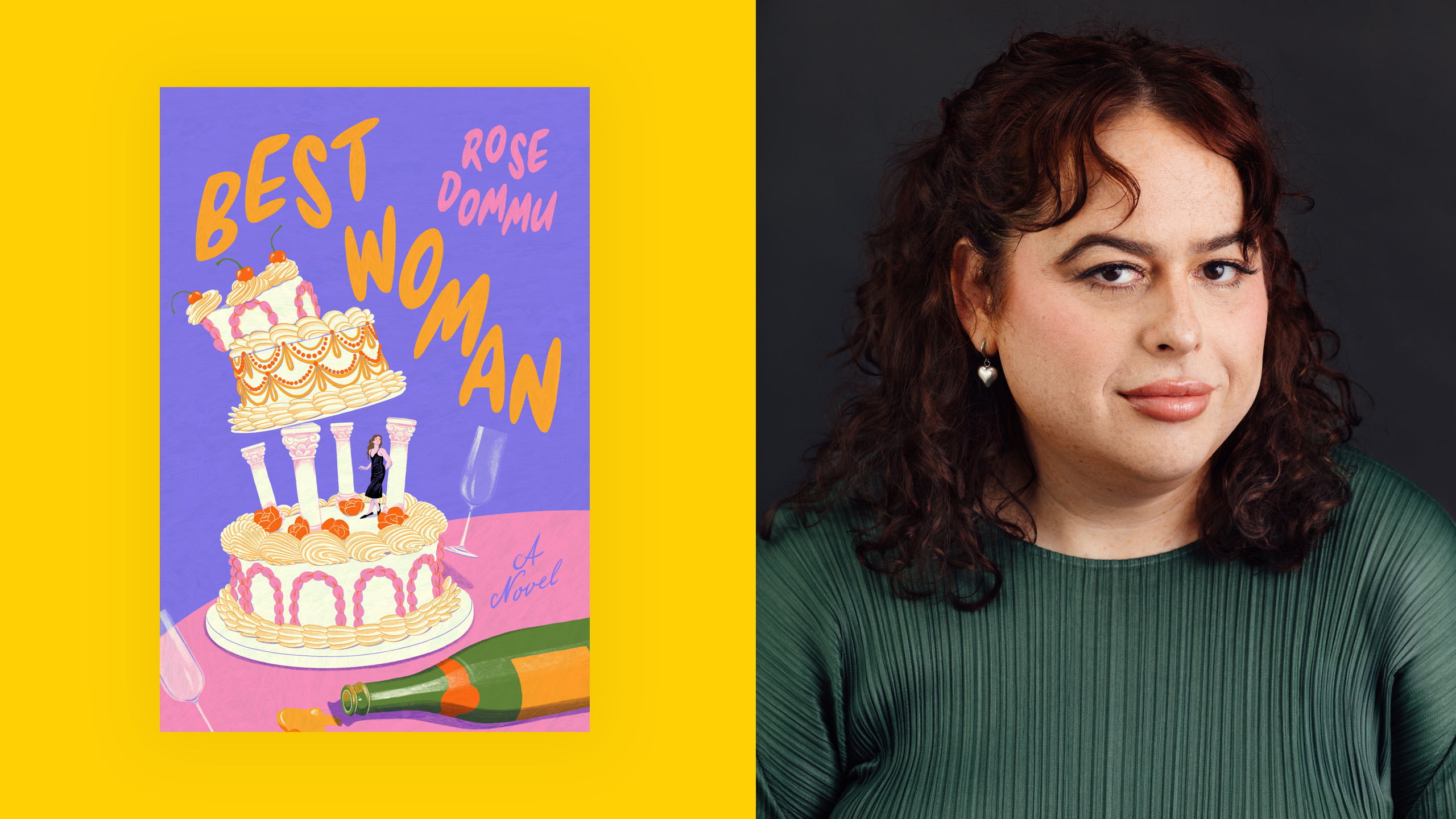
As a trans woman, Julia Rosenberg is pretty happy about being the “best woman” to her brother, who is about to be married in their tumultuous but endearing home state of Florida. Better yet, Kim Cameron, her adolescent crush, will be the maid of honour. But when Julia and Kim go out to plan their walk down the aisle together, their waiter accidentally misgenders Julia. Kim misinterprets this mistake as one in a series of obstacles and humiliations in this one trans life, this poor soul who must be having such a hard time, what with the political climate. Julia lets her believe this, but takes it further by insinuating that she isn’t looking forward to the wedding because her family isn’t accepting of her trans identity (in reality, they’re pretty supportive). A little sympathy makes her more appealing in the eyes of Kim (and the world), and besides, hasn’t she always felt sort of at odds with her perfectly adequate family? “There’s what people say and then what they think, what they believe, deep down inside,” she thinks. Who knows what their psyches could be hiding?
Armed with a queer family attached to her hip, a hometown hookup that’s always down for a good time, and a brother whose happiness truly lights her up, Julia is on track to have an extraordinary weekend—complete with Kim’s constant flirtation. But when she’s humiliated on the wedding night by a stray comment from her mother and has to re-evaluate her family’s view of her, she wonders if fabricating a half-true story wasn’t another form of wilfully sidestepping her self-worth. Rose Dommu’s devourable and quippy debut novel, Best Woman, is an exploration of trans identity through a troublemaking lens. Just like the romantic comedies it takes inspiration from, it’s a romp full of painfully true moments.
Dommu spoke with Xtra about poor trans representation, media literacy and the power of contradicting yourself.
Congratulations on your debut novel! How does it feel now that it’s out?
Surreal. I’m literally sitting here with a stack of the books next to me. It’s wild. I started writing it a little over three years ago, and I’ve been living with the story for a little longer than that. The fact that it’s finally gonna be out here for people to read is just wild. I’m looking forward to not being a debut novelist anymore, and to have my first book under my belt.
When you say “living with the story,” were you trying to figure out a way to write it, or wanting to sit with it?
Well, I’ve wanted to write books since I was a child. At some point over the past decade, this story started percolating in my brain, and I knew that if and when I was going to write a book, this would have to be it. It did take me a while to actually start it—it sounds so stupid, but so much about writing is thinking about writing, letting the story simmer in the back of your mind. I had a corporate job a couple years ago and decided to leave it, and that summer I had nothing to do, so I decided to start writing. It really was about waiting for the story to be ready enough where I could actually start writing, then having the time and space to do so.
You wear your influences on your sleeve, and directly reference rom-coms like My Best Friend’s Wedding. What makes these movies so alluring to you?
I’m a person who loves structure, so I love that romantic comedies have these pre-existing formulas that we all recognize, these archetypes and things we expect. Because of that, they’re so easy to subvert. I also love romance. I guess I’m seen as a cynical, pithy or jaded person—that’s how I present online or in my previous writing, but I’m actually very earnest. I’m a double Cancer, I’m very emotional, and I do believe in love, as corny as it sounds. Romantic comedies are the perfect combination of all the things I enjoy—humour, romance, people making really confusing decisions in the name of love. They’re a space to play with character and morality and identity. They’re such a fertile breeding ground for stories. Every new pop-cultural generation, we get foundational romantic comedies, even though they’re a bit of a dying art. I think maybe that’s part of why I was drawn to it—they have somewhat fallen out of favour. I want them back!
What kind of books were you reading that influenced Best Woman, either directly or indirectly?
You know, when I was writing, for the most part, I stayed away from contemporary romances, because I didn’t want to be too influenced. That summer, I was reading a lot of queer period romances, which I started calling “codpiece rippers.” There’s a reason why so many of our great modern rom-coms are based off of or sending up some kind of classic literature. Clueless with Emma or Bridget Jones’s Diary with Pride and Prejudice. I love those stories that take place in a world with so many rules, and I love seeing the ways in which characters break them or try to work within them. It makes me want more gay romances! One day I might write my own, I just have to do a lot of research.
To use a technical term, I enjoyed how Jewy the novel was—I identified a lot with this chaotic Floridian family. Did you pull from some of your own family to fictionalize?
Maybe! There are definitely characters who were inspired by people in my real life. There’s only one that is copy-paste, which is the grandfather. He’s such a singular person and I wanted to immortalize him. More than any one person being a one-to-one version of someone from my life, I took little pieces. Whenever someone in real life has an interesting character quirk, I’m always filing that away. Dana, Julia’s mom, doesn’t drink water, only diet soda. Every day she goes to the McDonald’s drive-through. That’s something a friend of a friend’s mom who I met does, and years ago, when I found that out, I was like, “That’s such a good, specific detail, I have to use that in a character.” And it made perfect sense for Julia’s mom.
I really enjoyed that Julia was a narrator who made mistakes around quite serious topics, like lying that her family wasn’t actually accepting of her transness. Did you always want her to be sort of dastardly?
Oh, absolutely. I’m not right all the time; no one I know is. When I started writing, it was really intended to be a send-up of the romantic comedies I grew up loving, especially My Best Friend’s Wedding. The Google doc I started writing in was called My Best Trans Wedding. In that movie, Julia Roberts is a bad person. She makes horrible decisions that hurt other people and herself. We’re still at the advent of trans people being represented in literature, and for the most part, when they are, they don’t get to be flawed people, or bad people. Whether my characters are cis or trans, I want them to be able to be extremely flawed. I really was drawn to the idea of writing a narrator who was hard to root for. You just want to scream at her. Julia feels like a little sister to me, who I just want to shake and say, “What are you doing?”
I’m so concerned about the state of media criticism. I feel like a lot of younger people only want to see depictions of characters whom they are totally aligned with and who make completely right and just and moral decisions. That’s so fucking boring. Anything I can do to work against that, I will do.
Speaking of, I read a Goodreads review that said Julia’s deception wasn’t the right “representation” currently, but I think if anything, stories of trans people making mistakes and learning from them is exactly what we need.
Yeah, you depict people as they are, not as you want them to be. There are a lot of trans people who are assholes. I count myself as one of them. As I said, we have so few depictions of trans people in the media, but for the most part, they’re saintly, perfect victims, or they’re really annoying, cringe or whatever TERFs and conservatives imagine us to be. We just need a depiction of the entire spectrum of trans personhood. There are a lot of trans people who kind of suck. That, to me, is good representation. Let trans people suck!
Torrey Peters is great at that. Trans people start a pandemic in her book.
She’s so good, and Gretchen Felker-Martin, Harron Walker in her essay collection. Trans people aren’t a monolith, and a lot of us are very annoying.
Does Kim have to reckon with her own complicity in Julia’s plan? I mean, Julia’s sob story did make her appealing.
Absolutely. Let me say this—Julia shouldn’t have done what she did. However, Kim opened the door for it. In that first interaction they have at the Cheesecake Factory—I’ve been waiting my whole life to set a scene at the Cheesecake Factory—when the waiter misgenders Julia, Kim really comes in hot. That’s something I wanted to explore, because it’s something cis people really don’t know how to deal with, when someone gets misgendered in front of them. I don’t think there’s a right answer—it’s not my job to educate cis people on what they should do in those circumstances—but what Kim does is very telling. Julia, whose priorities are not necessarily in the right place at this stage in her transition, sees an opening. This girl has all of a sudden walked out of her past and is a living embodiment of everything she wanted to be and feared she never would be. In her eyes, it’s the ultimate validation—this lesbian who I was attracted to in high school, who I knew deep inside would never be attracted to me, if she could be, it would prove everything right. I am the best woman. I think Kim’s complicity is about her well-meaning overcorrection that opens the door for Julia’s shenanigans.
I thought it was so interesting how Julia doesn’t seem to accept her family’s acceptance as enough—“I am the one expecting a deadname around every corner,” she thinks. Why do you think it’s hard for her to let herself be loved?
I almost think it’s because she hasn’t faced any outright resistance from her family to her transition. She was likely waiting, at every point, for someone to be like, “You’re dead to me, I hate you.” When that didn’t happen, she didn’t know what to do. It’s a very nuanced place to be, because again, we’re so used to seeing stories of trans people in fiction or real life whose families disown them—that’s a reality. But there are ways in which people can accept you, but still not really get you. That was a disconnect that Julia didn’t really know how to name or talk about. She has these examples in her life, like [her friend] Daytona, who did have that cut-and-dry cutoff from her family. In a way, Julia almost wants it. She wants a way to name this unease that always lingers, something to point to and say “Aha! That’s what you really thought of me the whole time.” It’s not that she wants to be oppressed, but wants someone to own up to the vibe she’s smelled for the past years.
And that happens—her mother does actually make a very public mistake, one that humiliates Julia in front of the entire wedding. But later when they talk about it, her view is very mature—she can’t erase her mother’s memories of her pre-transition, nor does she want to. “I understand how necessary it is to have people in my life who’ve known me for all of it, known every version of me,” you write. Tell me a little about this idea.
It’s so much easier to cut someone out of your life, make them the villain, make yourself the hero, than to accept that relationships are messy, people are messy and people don’t get everything right. Julia loves her mom, and so many times through the novel we learn about all of the ways in which her transition brought her and her mom closer. I think she’s presented with the choice to either make her mother the villain, and invalidate all of that, or accept that these two things can be true: her mother does love and accept her, and a part of her mother will always see her as the son she raised. And Julia doesn’t know how big that part of her mother is. If Julia’s mother were to completely excise that from her memory or their relationship, so much of that relationship wouldn’t exist. On the more personal side, it’s very much something I experienced. Early in my transition, I really wanted to exclusively be known to people as the current version of myself. But that eradicated so much of my history, and now it’s so refreshing to have friends from middle school and college. It’s nice to see that mirror of yourself and realize that even though you may not have been presenting the way you thought you should, people still saw you.
You write, “Transness is nothing if not a series of contradictions.” Did you learn anything new about yourself through this character?
I think I learned what we were talking about, which is that history is important. It was very surprising to me when I knew I wanted to write this book that this was the one, and not something so different from my own experience. I guess it is, on its face, surprising that a trans person would want to dig into their history and family the way Julia does and the way I did, considering that some of this is pulled from my life. Julia would never have become the version of herself we meet in the book without all of her experiences, good and bad. And that is a contradiction. Mainstream trans and queer discourse is so much about the now and the future and progression. But I don’t think we should throw away what got us here. It’s the same reason it was important for me to set the novel in Florida. I’m from there. I always wanted to write about Florida. It’s a bizarre state. It’s very politically charged, because it’s backward and regressive and there’s terrible shit happening there to queer and trans people, but that doesn’t mean we should throw it away. Those people still live there, and have to make their lives there. They can’t just move somewhere else. So it’s important for me to tell stories that are about those contradictions.

 Why you can trust Xtra