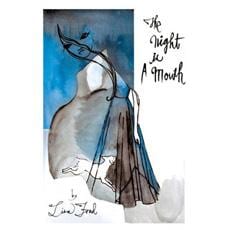
The first collectionof short stories by Torontonian and regular Xtra contributor Lisa Foad, The Night is a Mouth (from Exile Editions), opens with a television Emergency Broadcast System test pattern, setting the tone for the whole book: both dangerous and colourful, full of repetition and fragmentation.
The stories deal with runaways and ghosts, sex and vomit, parties and families, but most of all the fucked-up lives of girls. It is not a book for those who like their narratives firmly planted in literary realism, but instead for those who might enjoy prose poetry of the grotesque, broken and glittered.
The main figures of the stories are a series of tormented young women — a grown-up runaway in “Lost Dogs,” telling her story to her unnamed lover; Edie in “June,” a young girl secretly jealous of the attention her creepy father gives her older stepsister; two roommates in the title story “The Night is a Mouth,” hemmed in by clogs in their toilet, sink drain, tear ducts and (as the one K says) in “our ability to swallow. Our capacity for satiation. Our willingness to want and be wanted.”
At times their travails can seem a bit too familiar, as they are recurrently abused by men without providing any new perspective. In fact, the strongest story in the collection centres around not a young woman, but a monstrous family, a creeped-out version of the Addams Family in “Here there Be Monsters” (which appeared in an earlier version in Exile: The Literary Quarterly). Here a ghostly father gives his tumorous son a pack of strip-club matches while his wife grows a set of fish lips. As Foad writes, “The hideousness is bewitching.”
The Night is a Mouth is relentlessly dystopic: all families are dysfunctional, all romantic relationships doomed, all food destined to find its way back out of the stomach through the throat. Yet Foad does have her moments of humour. In “Here there Be Monsters” the ghostly father shouts because, “post-mortem, he can’t project like he used to.” A sign in “Violent Collections, Anxious Supplements” promises “Uncensored VIP couch dancing. Welcome Molson Indy fans.” K in “The Night is a Mouth” engages two young evangelicals in an exchange of double-entendres. When Foad’s fascination with language works, it works. Occasionally, though, the repetition and poetic rearrangement falls flat and becomes redundant or confusing. For example in “Lost Dogs” the narrator’s “from the knot that’s our legs and arms, you disentangle” adds nothing but pretension to what could be a straightforward image.
The city in The Night Is a Mouth is a dangerous one, full of cobwebs and collapsing buildings. Men are mostly interested in sex. Women likewise, although often in more conflicted ways. Even the sofas and windows are anthropomorphically sexual. The characters sell sex in back alleys, strip clubs and through the windows of their own apartments. And while some of it is sexy, none of it seems like much fun. Still, the title story ends with some hope, as roommates Gold and Kay stand in the ruins of their apartment building and “the night looks like new.”
 Why you can trust Xtra