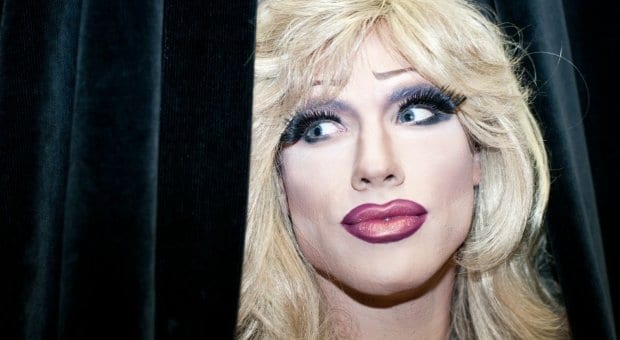
Recently, you may have seen a woman with long blonde hair, too much makeup, huge hands, muscular arms and a big, bouncin’ Adam’s apple gingerly picking through the produce section of your local grocery store. If you did, it could easily have been Nathaniel Bacon preparing for his role as Hedwig in the Lower Ossington Theatre’s upcoming production of the musical Hedwig and the Angry Inch.
When the operation Hedwig is forced to have in order to escape Communist East Berlin is botched, he (referred to by female pronouns after the operation) is left with “not a penis, not a vagina, but an inch-long mound of doll-like flesh” and a lot of confusion as to whether she’s a woman or a man. When she performs in run-down venues, telling her sad story in song, neither she nor her audiences quite know what to make of her.
As part of his efforts to understand how his character must feel when people look at her, Bacon went around the city in drag for a day. “My original instinct was to stick around the Village, but the director said, ‘What you should do is go anywhere but the Village. Go places you don’t feel safe, and walk around and see what it really feels like to be judged by people who are not used to seeing someone like you,’” Bacon says. “It was incredible how people looked at me differently.”
Hedwig didn’t want to become a woman, doesn’t know whether she is a woman, but the character is usually thought to be a trans woman. Trying to make sense of his character’s complex gender, Bacon has spent a lot of time in conversation with transgender friends. “Hedwig is usually defined as trans by default, but I try not to define her too specifically,” Bacon says. “A huge theme of the play is ideas of gender and boundaries and her trying to decide where she fits on that boundary; is she a man, is she a woman, is she in between, and is that okay? At its core, the musical is a celebration of diversity. It’s all about how unnecessary most of our societal boundaries are and how we’re happier when we just acknowledge we’re beautiful in our differences.”
Bacon is a cisgender gay male. While the role was written for a cisgender man, Bacon is aware that some people may object to him playing a character most consider to be a trans woman. “To me, the thing is that actors are not the people they play. Ever. So you might as well get angry at someone for playing a 30-year-old when they’re only 25. And I understand it’s a totally different subject and means a lot to people — and rightly so — but actors are supposed to inhabit the skin of people who are different from themselves,” Bacon says. “I guess it’s a lot like when gay actors are angry that straight actors play gay roles. If you take the reverse situation — should I not be allowed to play a straight person? Because I’d have a problem with that. You can’t have it both ways.”
Hedwig and the Angry Inch runs Thurs, April 17–Sat, May 10 at The Lower Ossington Theatre, 100 Ossington Ave. lowerossingtontheatre.com

 Why you can trust Xtra