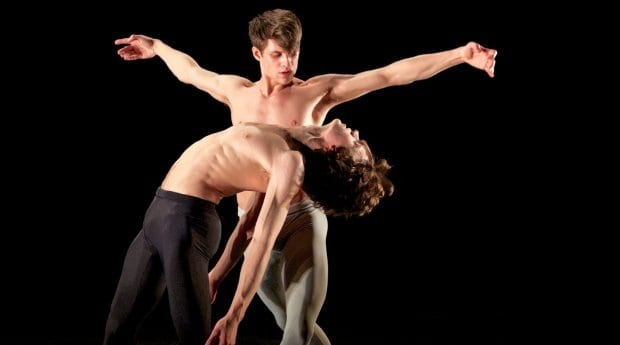
As a gay male choreographer, Joshua Beamish has a hard time understanding why contemporary ballet hasn’t dealt with same-sex relationships in more romantic terms.
In his new work burrow, he is looking to fill that void.
“In contemporary dance it is common to have male-male duets, but not with a romantic consideration,” says Beamish, who is the founder and artistic director of MOVE: the company, a Vancouver-based contemporary dance company.
“In the context of big ballet, gay male relationships are very minimally represented, and they usually follow a very hetero-normative format,” he says. “With burrow I was interested in seeing how I could use the ballet vocabulary to tell a gay story.”
Originally created for the Royal Ballet in London, burrow is as much a personal story as it is Beamish’s desire to create works that reflects the experiences of gay men.
“Burrow is very much informed by my last relationship,” he reveals. “I’ve been in a five-year pattern of unrealized relationships that have played themselves out before they actually became something.”
It is that pattern that Beamish explores in burrow, as two dancers play out their relationship from start to finish.
“Towards the end of burrow, as the relationship begins to unravel, you definitely see a consideration for each other, even as that relationship is dying,” Beamish says. “Their connection may be disappearing, but I didn’t want to demonize any one of the guys and make it seem one was a bad guy. I wanted it to be a complex portrayal because, as with most relationships, there are always two sides to why something does or does not work.”
In burrow Beamish represents the various stages of the couple’s relationship in both solo dances and in the pas de deux. “The solos are very different, and I play a lot with focus, where I have them looking at each other as they dance separately or side-by-side or interwoven,” he says.
Even as Beamish looks to create dance works that better reflect his life as a gay man, he admits that it isn’t as simple as replacing a male-female duo with two men.
“In contemporary ballet men’s movements are usually much more dynamic, and filled with much more machismo,” he says. “So when you put two men together the power it creates can be aggressive, combative or violent. As a result it is much more difficult to find a sensitivity between two men. With burrow I wanted to create something that was more typically represented in a female-male dance.”
Joshua Beamish’s dance company MOVE will present burrow as part of its 10th anniversary celebration on Thursday, July 2 at 8:30pm at The Vancouver Playhouse, 600 Hamilton St, Vancouver. Tickets $42.75 available here. For more information check MOVE’s Facebook page or go to joshuabeamish.com
 Why you can trust Xtra