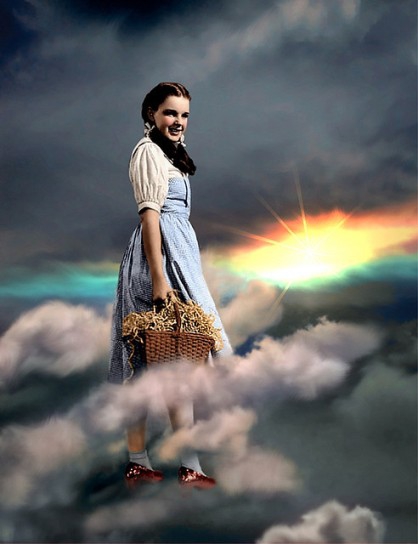
The New York Times recently printed an interesting piece about Judy Garland’s relevance to younger generations of gay people. Robert Leleux writes about his experience of taking a friend to see the play End of the Rainbow, about the last days of Judy’s life, and about how his friend didn’t know anything about Judy Garland or her gay legacy beyond her being the singer of “that train song.”
“I have this theory that because of the holocaust that was the AIDS epidemic and its annihilation of the previous generation of gay men, the faith of our fathers risks extinction. Today, Judyism, like Yiddish, is little more than a vague cultural memory,” Leleux says.
It’s a quick read, and it left me thinking that if we forget or neglect Judy Garland, we’re not just losing one of the greatest stars of all time, we’re losing a part of ourselves. There was a time when gays had to use secret codes like “friends of Dorothy” to identify themselves and others like them. A time, not so long ago, where only through a bawdy, glamorous and self-destructive diva could we be free. I fear that if we forsake that, we’re losing more than we realize.
So turn on Judy at Carnegie Hall and sing along! Because some friends should be forever.
 Why you can trust Xtra