A place to hang out, cruise, draw on colouring pages and learn how to take a better thirst trap. Queer and trans archives offer all of this. They also gently and lovingly store our communities’ collective history, which is also pretty important. Don’t get me wrong, for academics like me, our entire job relies on the tender loving care provided by archivists. Though queer and trans archives have always been community spaces, the dumpster fire of our current moment throws into sharp relief both the importance of being in-community, and how these archives are places where we connect with past and present community. One of the first times I cried while researching was in the Transgender Archives at the University of Victoria, when I found a personal ad from the 1970s written by a trans woman from my hometown. It was a sacred experience to see that in London, Ontario (a place not known for its acceptance), and decades before me, a trans woman could live a full life. But my experience is not unique!
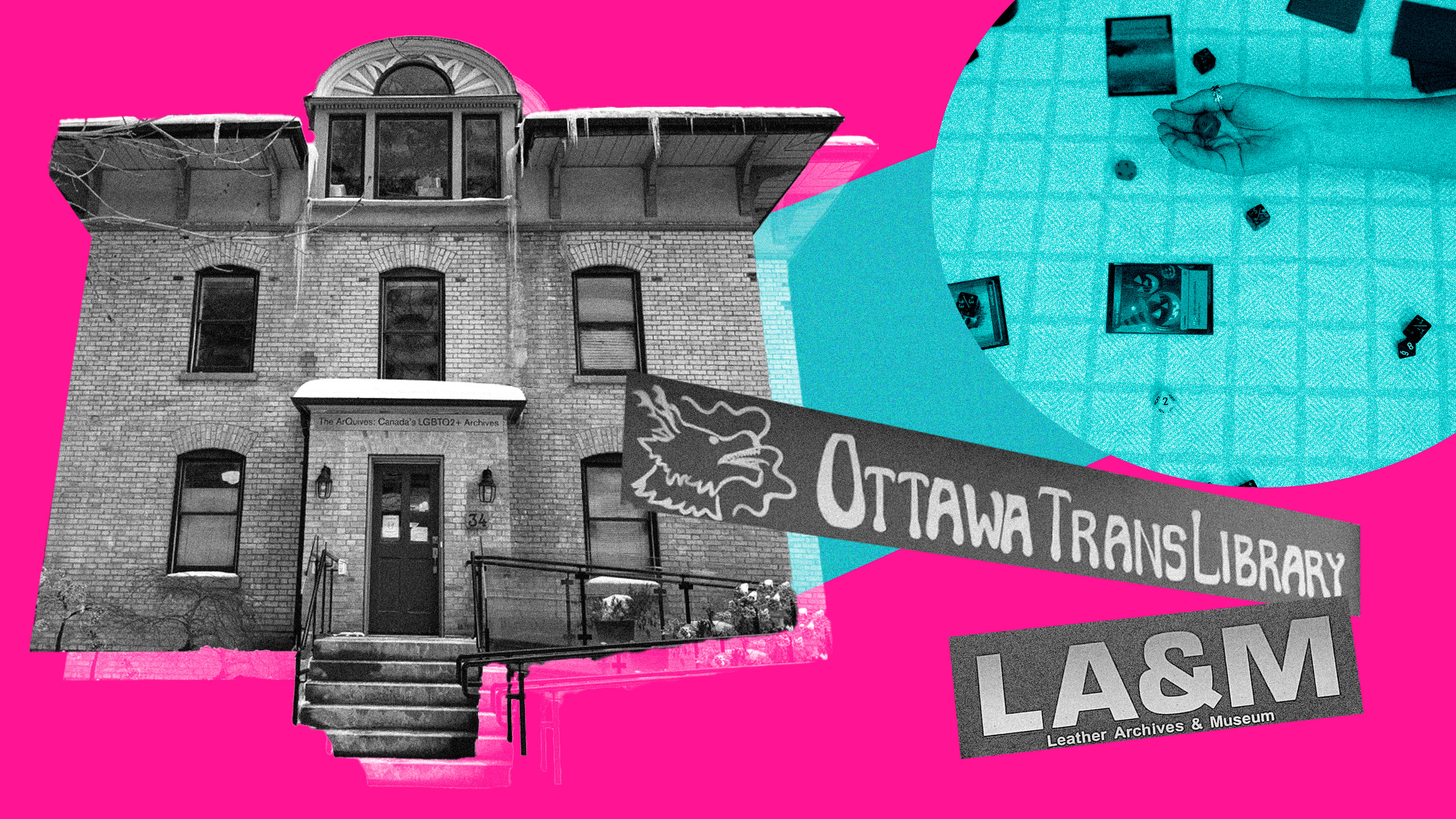
This desire for past and present connection has long motivated queer and trans folks to hold on to any glimpses of queer life. Since at least the mid-1800s, LGBTQ2S+ folks have scrapbooked any reference to queer or trans life we’ve found. When public and institutionalized queer archives emerged in the 1970s, they did so under humble circumstances. In 1973, gay and lesbian writers started Toronto’s ArQuives, now the national LGBTQ2S+ archive for Canada, out of a cupboard within the office of what would become Pink Triangle Press (Xtra’s parent company). Rachel Corbman, a coordinator at the legendary Brooklyn-based Lesbian Herstory Archives (LHA) notes that after its founding in 1973 or ’74 (depending on which of the founders you ask), the LHA spent its first two decades in founder Joan Nestle’s Upper West Side apartment (back when it was affordable, Corbman adds).
Despite the less precarious situation LGBTQ2S+ historical preservation (with grim and increasing exceptions) is currently in, this fierce devotion to caring for our history continues to motivate archivists. Raegan Swanson, the executive director of the ArQuives, emphasizes the importance of by-community, for-community archives. “Since forever, libraries, archives and museums have completely ignored queer and trans voices, and this is a spot that, while not perfect, has only ever cared about queer and trans voices,” she says. “That is all that we do, and that’s all we ever will do.”
Swanson’s quote would certainly resonate with Ms. Bob Davis. A trans woman elder, community historian and founder of the California-based Louise Lawrence Transgender Archive, Davis converted her garage into an archive after decades of collecting trans history. Jules Gill-Peterson used some of this renovated garage’s records in her book Histories of the Transgender Child, which is frequently cited by activists fighting against losers who act as though trans kids are a modern pathogen.
Queer and trans archives help us resist false narratives about the past that people use to try to erase us in the present. They also provide us with examples of past icons to inspire our present fight. Joshua Burford and Maigen Sullivan run Invisible Histories, a Birmingham, Alabama-based community archive of Southern queer and trans history. These two dynamos and the organization they run are a blazing middle finger to the still-common myth of the American South as a bigoted monolith. When I asked Sullivan what she would say to queer and trans folks anxious about the threats facing us, she immediately gave me the name of a Mississippian: “Eddie Sandifer. He’s a white gay man, and he funded civil rights work and LGBTQ2S+ liberation by robbing jewellery stores. He did the real kind of mutual aid liberatory work that we talk about now in the 1950s, ’60s and ’70s in rural Mississippi. Any time anybody gets afraid, I want them to think about Eddie Sandifer. I want you to find those badasses in your local history, and to pull off the power of their legacy.”
In addition to their critical role providing the “ingredients” used by historians, these archives also help people find their community. Though it is sometimes forgotten, a key role of community archives is that you can meet others like yourself in them. Librarian Lain Joron of the Ottawa Trans Library is aware of this quiet power. For those who might not encounter other trans people in their day-to-day life, Joron notes that “you can just walk into the Trans Library now and you will just see a trans person every day here.” Community archives are also places that can help you be trans. In addition to vital information on how to transition, many archivists I spoke with mentioned that their archives have change rooms, so visitors can wear more affirming clothes while they visit the archive.
Being able to engage with community spaces like queer and trans archives, depending on your social battery, is another great aspect. Mel Leverich, an archivist at the Chicago-based Leather Archives & Museum (LA&M), spoke of how the archive’s library space is always free and open to the public, and it’s where people can simply hang out, colour or do homework. This is in addition to the LA&M’s role as one of the largest archives of leather, kink, BDSM and fetish history.
Archivists also highlighted how queer and trans archives are community spaces that are quiet and sober, which some queer and trans people often call for (in fact, the LA&M hosts a weekly recovery group). In addition to these more low-key offerings, the LA&M like other community archives also has a packed calendar of film screenings, workshops (like How to Take a Better Thirst Trap), trivia nights, academic talks and socials.
Beyond stuff happening in the archive, these organizations often partner with other queer and trans groups for events. The Fredericton-based Queer Heritage Initiative of New Brunswick (QHINB) is one such example. It plays a critical role in facilitating queer life in a region often (incorrectly!) seen as having none. As archivist Meredith J. Batt explains, since Monarch Night Club is the only gay bar in the province, the community relies on pop-up events, so the QHINB often works with other Fredericton queer organizations to put on events like the city’s queer prom.
Besides official events, queer and trans archives are informal places for us to socialize with one another. When Corbman and her partner eloped, the witness for their wedding was somebody they met at the LHA. The Leather Archives’ bathrooms even have bulletin boards to put up personal ads, and Leverich tells me they’ve seen plenty of visitors flagging. And I know I’m not the only trans academic who has found friends and hookups while reading meticulously archived old documents.
These aspects of community archives are wonderful parts of living a queer life. I’ve clung to them even more closely given the era of rising anti-queer, transphobic and transmisogynistic fascism we’re in. Our archives are a microcosm of queer community. Whether in an office cupboard, or in a multi-floor building, we are scrappy, and we yearn for connection. No matter the form of the archive, it will continue to exist, and so will we.

 Why you can trust Xtra