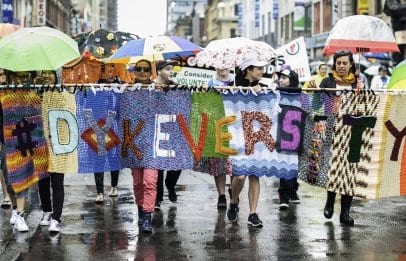

It may have been pouring rain in Toronto on June 27, 2015, but that did nothing to dampen the spirits of those marching in the annual Dyke March.
Some even thought it made the event all the more fun.
“Most of us are used to dancing in the rain anyways,” says Ido, who is a part of Rainbow Sisters, a group for for Caribbean, African and black women who identify as lesbian, queer, bisexual or trans. “So it’s all good.”
She said Rainbow Sisters was there to express their freedom, and to be happy and have fun.

But along with the dancing, drumming and bicycle riding that happened during the Dyke March as it made its way down Yonge Street, there were many reminders that Pride is still political.
The honoured group at the year’s Dyke March was No More Silence, a network of groups and people aiming to stop the murders and disappearances of Indigenous women. Members of the group led marchers, some carrying signs of those that they had lost — members of the reported 1,182 missing and murdered Indigenous women.
Alex Cywimk, who carried with him a picture of his dead sister, Sonya Cywink, says that participating in the Dyke March is one way of raising awareness of the intolerance and violence faced by Indigenous women. “The more people that become aware of the issue the sooner society can start changing.”

Rhoma Spencer, who marched with Women’s Health in Women’s Hands, noted that it is the only organization, probably in all of Canada, that provides healthcare for undocumented women and trans people of colour. She said that continuous agitation is needed to ensure better medical coverage nationwide for refugees.
It was also an opportunity for some people who had only recently come out to show their Pride. Both Jenna Parry and Michelle Mudge were walking in the march for the very first time.
“I’m gay and kind of recently coming out, so I’m really excited to embrace that, and get out into the scene,” Parry says. Mudge noted that there seemed to be more of a political bent to the Dyke March as opposed to the Pride parade — though Mudge plans to go to both.

The march ended in Allan Gardens where a small group braved the last of the rain to listen to several speakers. “I want to thank you for coming out, standing in the rain and standing up for what we believe in,” said a speaker in a purple Pride Toronto shirt.
“All our lives matter — happy Pride!”
Photos by Krystle Merrow

 Why you can trust Xtra