Adam Proulx’s Baker’s Dozen picks up where “Rub-a-Dub-Dub” leaves off; according to Proulx, after the conclusion of the classic nursery rhyme, the Baker is found dead in the tub, the Butcher (his husband, as it turns out) is accused of the crime, and the Candlestick Maker is mysteriously absent.
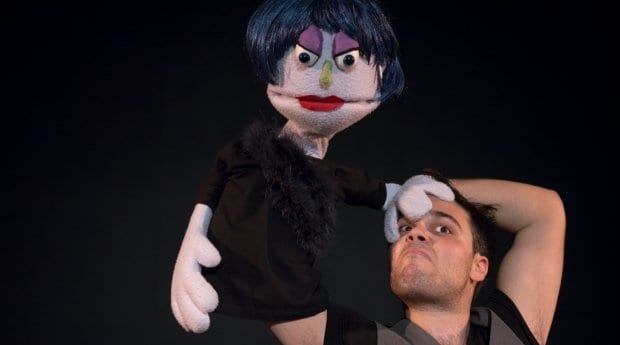
The cast comprises Proulx and the various puppet characters he presses into service as jury members at the Butcher’s trial. Impressively, the many characters are actually one puppet, whose appearance Proulx alters while the lights are down (incidentally, if anyone’s looking for a play to take a date to, the frequent light-lowering provides ample opportunity for make-outs). When they come up, not only do the puppets look different, but he’s equipped them with distinct personalities and voices.
Distinct, but stereotypical. All the jury members give their perspectives on the case, recounting what they’ve learned and speculating on how the crime could have taken place. Their perspectives are informed by whatever stereotype they inhabit, from the hillbilly to the dumb blond to the kindly old codger. At first glance, these characters are amusing if a bit predictable and offensive. Then, just as it’s about to get tiresome, Proulx gives each character greater depth, toying with our expectations and tossing aside the stereotypes.
Challenging our expectations of the various characters is quite deliberate. In fact, each character (at least those with any dialogue) is brilliantly crafted and possessed of humour and insight as different from the others as up is from down. Some of the puppets reflect on each other, and some even interact with Proulx himself. And their takes on the case intelligently explore a range of subjects, from homosexuality to criminology to lactose intolerance.
A “claque” is a group of people whose job it is to cheer or clap loudly during a performance in order to give the impression that the performance is doing really well, or to encourage other non-partisan audience members to express their enthusiasm. I was seated in front of someone involved with the production, who seemed to have taken it upon herself to be a one-person claque — quite unnecessarily, given that the audience was thrilled with the performance without the aid of her startling guffaws.
Baker’s Dozen runs until Sun, July 13, at Theatre Passe Muraille Backspace, 16 Ryerson Ave. fringetoronto.com

 Why you can trust Xtra