“Did you ever memorize my name? Did you figure out how to say it right?”
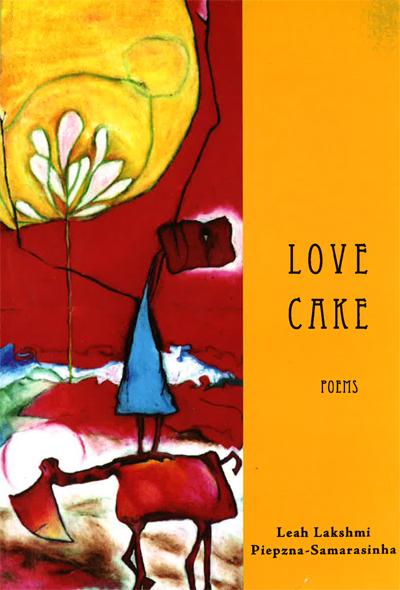
Leah Lakshmi Piepzna-Samarasinha asks this question in her new poetry collection, Love Cake. If you’ve been around the Toronto queer scene during the past 14 years, you should know her.
When Piepzna-Samarasinha arrived in Toronto in 1997, she quickly became known for her poetry and activism around issues of race, gender, sexuality, class and abuse. She published and performed widely, led the queer and trans youth writing workshop Pink Ink, programmed the Asian Arts Freedom School with Gein Wong, and from 2004 produced Browngirlworld: a performance series for queer and trans artists of colour. In 2006, TSAR released her first book of poetry, Consensual Genocide.
Piepzna-Samarasinha moved to Oakland in 2007. She has since earned an MFA in creative writing and co-edited an anthology, The Revolution Starts at Home, about abuse within activist communities. Yet she didn’t stop working with Toronto queer and trans communities of colour – or writing brilliant poems.
Love Cake opens with Piepzna-Samarasinha trying to hold on to love during the wars that have intimately affected her and her loved ones. She paints in vivid lines the painful connection between the political and the personal. Her style is open verse with almost no punctuation, yet every breath and pause is clear.
Piepzna-Samarasinha unfurls her beginnings in central Massachusetts: a world of poverty, toxicity and resistance. Cut off from her Sri Lankan roots, she learns cooking from library books and her language from anyone who will help. Of several moving poems to her father and her grandmother, the poems to her grandmother are particularly gripping. The poet sees a version of herself in what she can uncover of her father’s mother and mourns her grandmother’s loss of freedom. What’s missing from history, Piepzna-Samarasinha fills in:
I’ve made you up
warrior woman
tough old bird
I’ve made you what I needed you to be
and what I dreamed
Love Cake explores Piepzna-Samarasinha’s formation through location, circumstance, family, lovers and friends. In these poems, we see the poet’s relationships, breakups, her refusal to settle for less than good love. Piepzna-Samarasinha writes of her abuse by her white Irish mother, how she cut her out of life, and her decision to do the same with an abusive lover years later. We witness Piepzna-Samarasinha’s return to Sri Lanka, her struggles with racism and classism, her longing for community.
Many poems in Love Cake feature Piepzna-Samarasinha’s trademark long lines, lines that insist on telling without breathing or cutting prettily to fit on the page. In some of the more recent poems, she begins to play more with punctuation, using jarring full stops in the middle of lines. Some pieces also turn fully into prose, and then turn back again. There’s a refusal to be pinned down to one form of expression, an insistence on telling history and dreaming the future in exactly the ways they demand.
Through this strong collection Piepzna-Samarasinha shows herself to be a true people’s poet. She examines her own life but always with a focus on how she fits into the world, how that world fails us, and how that world can be changed. Piepzna-Samarasinha writes fearlessly, jumping into difficult and taboo subjects. She writes of disability, colonialism, femme identity, abuse, loss, the mistrust she has of white lovers. There is pain in these poems, but also hope. Piepzna-Samarasinha is committed to telling, and in telling is transformation.
“the work of a poet: to document, to sing
to remember, insist
to incite, to call: peace, peace.
…
I have insisted on the precise blue of the sky, the endless waves licked by flame
I have insisted on all words and colour available
I have insisted on memory”
 Why you can trust Xtra