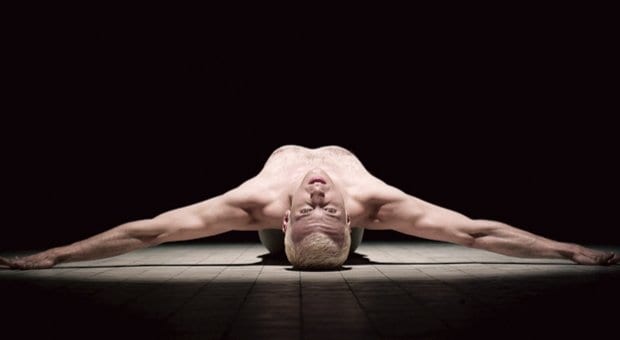
Simon Vermeulen’s project Der Untermensch (which translates to “the subhuman”) didn’t start out as an exploration of gay persecution under the Third Reich. The Montreal-based choreographer’s dance film began as a physical exploration of paranoia and fear, but without a specific context. Vermeulen had documented the performance on video, and when he shared it with director Kays Mejri in the hopes of developing a larger work, their collective wheels began to turn.
“He immediately saw something very prison-esque in the gestures, and we began to layer in the story together,” Vermeulen says. “We wanted to bring a sense of the historical references but also to keep it abstract so it could be open to interpretation.”
Though he had some knowledge of the history of gays under the Nazi regime, once the film’s context became clear, Vermeulen embarked on an intensive research process, combing books, articles and films for reference points.
“I’m constantly trying to understand what makes gay people so special and so hated at the same time,” he says. “I have a really strong sense of being part of a larger gay history, and I’m always trying to strengthen my understanding of it. But I probably didn’t know half of what I know now before starting this research.”
Shot over three days last July in the grungy Bain Saint Michel (a former Montreal public pool, now used as a performance space), the work features Vermeulen and two other dancers, naked save for a pair of grey underwear. Working in a space without air conditioning during a record heat wave hardly sounds like an appealing prospect, but Vermeulen remembers nothing but exhilaration.
“Honestly, those were probably the three most beautiful days of my life,” he says. “I’m surrounded by the crew, under the lights in the heat, with the makeup artist wiping sweat off between takes, and it was thrilling and fucking crazy at the same time. There was a lot going on in my personal life at that point, and it became a chance to just let this raw emotion out and capture it on camera.”
Though the film has an obvious queer read, with elements like the near nudity, a pair of glass high heels and occasional bursts of thumping club music, it also could be speaking about AIDS, bullying, suicide or any of the other oppressions the community has experienced. And despite its historical focus, the work feels eerily current.
“When we started working on the piece, we were thinking about history,” Vermeulen says. “A year and a half later, when you look at what’s going on in Russia, it feels like we’re actually talking about the present. There were about 80 gay bars in Berlin before Hitler came to power, and then he ordered all of them closed. The police just came in, arrested everyone and deported them to camps. I don’t think people consider the fact that this could happen again, but that’s exactly what’s going on right now.”
Mon, Sept 9, 10pm
Tues, Sept 10, 2:45pm

 Why you can trust Xtra