It’s hard to know exactly who to blame. It may have been Chicago serial killer John Wayne Gacy. Perhaps it was Stephen King’s made-for-TV movie IT. Or maybe it’s just the result of collective childhood trauma. Regardless, the fear of clowns is nearly as common as that of spiders, heights and public speaking.
“Clowns don’t adhere to conventional social constructs, which is part of what can make them scary for some people,” says writer/performer Virginia West. “They’re a bit like toddlers, switching rapid-fire between different emotional states. The best ones are totally unpredictable, which can be intimidating.
“But as a performer, it’s also very freeing,” she adds. “You have to get out of your head and allow yourself to react to everything in the moment. It could be someone in the audience sneezing or a plane flying overhead. Once you’re on stage, anything can happen and you just have to go with it.”
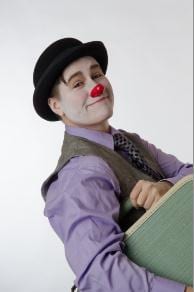
Even if you’re the coulrophobic type, West’s performance in Dapper’s Big Day is unlikely to send you screaming for cover. Alternately humorous and sad, it follows the trials of a genderqueer clown trying to get dressed for his wedding day. Female-bodied but male-identified, Dapper struggles to fit into clothes not designed for him. The jacket doesn’t accommodate his breasts. Without a package, his trousers hang uncomfortably empty. Performed entirely without speaking, Dapper communicates through the universal vocabulary of the body.
“We’re all familiar with the language of clothing and how we use it to read other people,” West says. “As children, that’s how we’re taught to tell girls and boys apart. Audiences are familiar with their own bodies and the clothes we are quote-unquote supposed to wear, as well as the problems that come up when we don’t conform. It’s interesting to perform the piece for queer audiences because it always hits so close. I’ve seen people come to tears.”
West’s no stranger to gender nonconformity. Though female identified, she falls well on the butch side of the gender spectrum. Aside from the day-to-day confusion she encounters (“I love it when people don’t know whether to call me Sir or Ma’am,” she laughs), gender also had an unintended effect on her performance work.
“I was doing a lot of improv and I would often jump into a scene as a cop or a mechanic,” she says. “Because of the way I look and the fact I tend towards assertive characters, I would often automatically get addressed by a male pronoun.”
Though it’s served her career, West is well versed in the complexities of real-world gender nonconformity.
“I have a lot of butch friends who’ve had to deal with huge aggression,” she says. “Guys who get into this kind of chest-bumping kind of thing, wanting to put them in their place and show them who’s the real man. I’m lucky I haven’t really had to deal with that, because I have the luxury of being short. Even though I’m butch, I’m not intimidating. I just look like someone’s little brother.”
Dapper’s Big Day is Sun, June 2, 3pm, at the Theatre & Studio, Unit 102, 367 Dufferin St. torontofestivalofclowns.com
 Why you can trust Xtra