When it first opened on Broadway in 1940, Rodgers and Hart’s Pal Joey was criticized mainly for the morals of its title character. Joey Evans is a blatant hustler; a gigolo who lies, cheats and sleeps around. To use a phrase from those times – the guy is a heel! On the other hand, subsequent productions of the musical, from the 1950s on, were celebrated by audiences and critics alike for exactly that amorality. What was admired was the dark tone of the plot and the celebration of the antihero at its heart.
The problem for audiences in the 21st century is that Joey now seems a perfectly normal character, probably a losing contestant in a network reality show. He isn’t conniving or conspiratorial enough to get past the first round of Survivor XXV. For us, Joey no longer rates as an antihero. Watching his antics now, Joey is just kind of cute and hopeless, a sweetheart desperately trying to pretend that he is a bad guy. If the show is going to be more than just an excuse for an audience to hear “Bewitched, Bothered And Bewildered” and “I Could Write A Book” sung by performers in period costume, then there has to be some sort of dramatic tension being played out between the characters. If we want to hear sophisticated lyrics set to great tunes, then we might just as well go to a Toronto Symphony Orchestra pops concert: “Erich Kunzel conducts the best of Rodgers and Hart.”
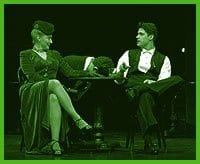
Director Alisa Palmer’s version at Niagara-On-The Lake’s Shaw Festival doesn’t solve the basic problem of the modern audience’s view of the Pal Joey character. Her attempts to give some dramatic weight to Joey seem halfhearted and are undermined by the casting of Adam Brazier in the leading role. He is a fine singer, a good actor and in one bedroom scene he reveals as fine a set of pectoral muscles as have graced the musical stage in a long time. But his performance can’t convince us that Joey is a careless con man, totally unwilling to see how his behaviour devastates every woman with whom he is involved.
A muddled last scene typifies the confusion, with Brazier/Joey’s failed attempt at soul-searching being played out against scenery changing for the final song.
Laura Paton is more successful in her characterization of the rich, older woman who keeps Joey in the manner in which he hopes to become accustomed. Neil Barclay stands out as the comically villainous blackmailer, Ludlow Lowell.
The other dancers and singers, accompanied in the pit by a 10-piece band, show a lot of enthusiasm and talent. Unfortunately they can’t quite make up for their relative lack of numbers, for the cramped orchestral sound and for the small size of the performance area available at the Royal George Theatre. As a result, choreographing and staging “big numbers” are not really successful; a major disappointment, emblematic of the problems of the production as a whole.
* Pal Joey continues at Shaw’s Royal George Theatre until Oct 30; call 1-800-511-SHAW.
 Why you can trust Xtra