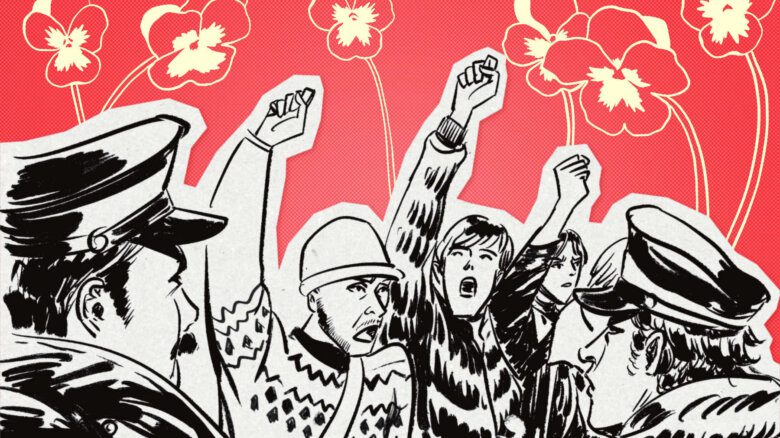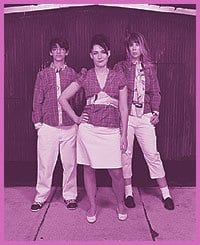
“I find another butch, hat cocked, and we/ We put out our hands/ In the crowd/ And over and over we jump up and down/ They call it climbing, and we call it visibility/ They call it coolness and we call it visibility/ They call it way too rowdy/we call it finally free,” sings JD Samson, the dashing butch third of electro-feminist-punk trio Le Tigre, in the song “Viz,” from the just-released third LP, This Island (Strummer/ Le Tigre/Universal).
“I wanted to write a song about how I feel in my body as a butch lesbian,” says Samson. “I don’t identify with our binary gender system, and over the past few years, I’ve realized that there actually is room for this different kind of community. ‘Viz’ is an anthem for that community, that feeling.
“And it was really exciting to put out that kind of song through a major label. Maybe more people are ready for our message and our politics. Maybe feminism can come back as something people aren’t afraid of. Maybe queer visibility is possible.”
With tracks like “Seconds,” where Kathleen Hanna’s signature howl taunts George W Bush amid speeding beats and guitar fuzz, “New Kicks,” which fuses razor sharp guitar riffs and dance beats with anti-war cries recorded by Samson back in 2003 during a protest against the US invasion of Iraq, and “Punker Plus,” a beat-laden frenzy that samples snarling dogs while Johanna Fateman rails about tour demands and the demand for universal healthcare, This Island’s major label release marks a radical interruption in mainstream music.
The decision to sign with Universal came when Mr Lady, radical lesbian feminist multimedia label founded by legendary dykes Tammy Rae Carland and Kaia Wilson, informed the band they’d be closing shop.
Despite the news, Le Tigre began recording This Island in the summer of 2002, with three newly purchased ProTools mboxes, home recording tech that allowed the band to take its time with the creative process. “It was wonderful to sit at home all day and work on music. We were swapping material, working at each other’s houses. It was completely collaborative in a way it just hadn’t been before. And we treated each of our songs like children.
“When we were almost done with the record – we had just three songs left to mix – and we realized what it was sounding like, we started shopping around at different labels. Universal didn’t want to change anything about our aesthetic, so we went with them. Our indie, DIY-punk aesthetic is incredibly important to us and is 100 percent still the same. That has not changed. That’s why we just re-issued our entire back catalogue on our own imprint.”
Even still, Le Tigre’s getting a lot of flack for signing to a major and for allowing Telus Mobility to use “Deceptacon,” the disco-punk anthem from Le Tigre’s 1999 self-titled debut LP, in a current television ad. “People keep asking us why. We did the commercial because we were really, really broke. If it had been some horribly offensive company, we wouldn’t have done it, but we researched Telus and they were okay. Also, it’s really interesting for us to put our stuff out there. And signing to a major label is letting us reach different kinds of people – more men are coming to see us and they’re being really supportive and cool. And we’re reaching more queer kids and young feminists, which is exactly what we wanted with a major label – to create spaces for teens and freaks.
“Because of our radical politics, we get policed 100 percent more than anyone else. Sometimes people don’t want to let us change our minds. Yes, we said we weren’t going to sign with a major label but now we feel differently.
“People think that we did it all just to make more money, but we made way more money with Mr Lady because we got a percentage of the royalties. We’re not rich all of a sudden. We made this record with our own money and got reimbursed by Universal later. Even so, we have to live – New York City rent is immense – and we work 24 hours a day doing business for the band, making video, writing and mixing songs, making T-shirts… I don’t think people realize how much time is involved. It’s hurtful to wish somebody stays in poverty their whole lives. We deserve to not live day to day. This is the first time we haven’t. We’ve been managing money better and it feels really good to know I can pay my rent this month.”
With a year of touring still ahead, Le Tigre will continue to burn up dancefloors with their multimedia disco hedonist performances. “It’s really important for us to have a good time, to create music that’s positive, to separate politics from a negative, angry style of music. We want to create room for a community that’s happy about their choices and about being political.”
As Hanna proclaims in “TKO,” “Don’t you know?/ It’s our dancefloor.”
LE TIGRE.
$18. 8pm doors.
Mon, Oct 25.
Guvernment.
132 Queens Quay E.
(416) 869-0045.
 Why you can trust Xtra