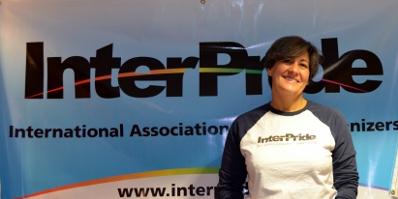
Founded in 1982, InterPride, an international association of Pride organizers, has grown exponentially in its 30 years of existence.
The organization strives to increase the capacity of Pride groups, raise awareness about inequality and effect positive change through education and outreach.
Although it’s a small organization, at any given conference or annual general meeting, InterPride members represent up to 70 million people, co-president Caryl Dolinko says.
The organization co-presented the recent Fierté Canada Pride conference in Ottawa, hosted by Capital Pride. Dolinko calls the gathering of 70 Pride organizers “inspiring.”
Although it is not InterPride’s specific mandate to assist persecuted queers around the world directly, Dolinko says it will provide support whenever there is an opportunity. Its solidarity fund is specifically for Prides operating in hostile environments; the organization receives many requests from Ugandan gays, Dolinko says.
To access monies from the solidarity fund, individuals must prove they are an actual Pride group.
“We’re not talking Pride like a New York City Pride parade down Fifth Avenue,” Dolinko says. “Whether it’s a small gathering of LGBT people or they’re talking about LGBT issues, we will consider that a Pride organization because that’s what they can do in that capacity there. Then we are able to assist financially, to provide some funding and have them come to our AGM, [where they] learn best practices and share what they are going through so we can all better educate our community.”
North Americans can sometimes lose perspective about the struggles of gays and lesbians living in less open countries. Dolinko recalls InterPride’s 2007 AGM, held in Portland, Maine, when the video “Prides in Conflict” was shown. Type-A personalities who indulge in loud conversations are the typical AGM attendees, Dolinko says, but when “Prides in Conflict” began, the room fell silent.
“I believe it changed the way I view the world, and our privilege. It changed the way a lot of Prides are actually doing things, in terms of the focus on human rights and equality for LGBT people everywhere,” Dolinko says. “It became a global focus knowing that the folks in Croatia that are fighting — the folks in Serbia, the folks in Uganda and Moscow that cannot have rights. Our visibility, by marching on the streets, parading and showing up at our festivals, makes their plight a little bit easier because our visibility is our strength.”
Dolinko now has her sights set on InterPride’s October AGM in Montreal. The gathering will welcome more than 300 Pride delegates who will have access to workshops and networking sessions spread over four days.
The organization’s noticeable growth will only increase in coming years, Dolinko says.
“Our reach is going to broaden and our advocacy is going to be spread out a lot more, so we’re really going to be able to make a difference,” she says. “Being an activist doesn’t mean you have to sit and do work all the time. It just means showing up and doing community work in your city.”
Prides in Conflict – Pride Events in Central & Eastern Europe Pt. 1 from San Francisco Pride on Vimeo.

 Why you can trust Xtra