Ed Savage tears up as he spots posters for Pride week in store windows.
“The support is overwhelming,” says the Halifax parade coordinator. “Anyone who participates or watches the parade doesn’t understand the struggle it takes to put on.”
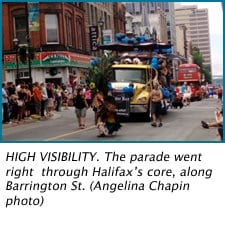
This year marks a milestone for Halifax’s pride committee: they secured the most visible parade route, going through the downtown core for the first time in 20 years.
“We used to weave the backstreets,” says Savage, who’s marshalled the parade for four years. “It’s important for Halifax to know we’re just as deserving as anyone else.”
This year’s route is the same path taken by the city’s biggest parade, November’s Holiday Parade of Lights. It goes across Barrington St — Halifax’s downtown hub — and up Spring Garden Rd — a main street leading into Barrington.
“It’s the most natural and ceremonial route,” explains Hugo Dann, the chair of Halifax Pride week. “The architecture of Barrington is gorgeous. It’s the heart of the city.”
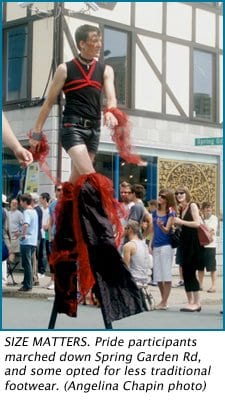
Savage was part of the Pride committee team in 2003 that got the parade down Spring Garden, and across two blocks of Barrington. Though the route was an improvement, it missed the places that make the street significant to the gay community. This year, the parade marched from the opposite direction, starting at the military base, covering six blocks of Barrington St, and going up Spring Garden. It went past Halifax’s gay landmarks: the pride flag raised at Province House, gay bar Reflections and sex shop Venus Envy.
Savage commends the city for their support, acknowledging the inconvenience of closing off downtown. “We’re cutting the city in half at two in the afternoon,” he says, adding the parade stops buses and cuts off traffic.
Savage worked with the downtown business commission, who canvassed all Barrington businesses to make sure they supported the parade route. He says though he encountered negative attitudes, he’s not willing to chalk it up to discrimination.
“It may be because of who we are, but sometimes people are just following the rules,” he says. “Any parade is a nightmare to put on,” says Savage, who also had to answer extensive questions from the events taskforce to prove the parade was deserving of the route. “We’re big and colorful and loud because we’re an expression of people who’ve been oppressed for so long.”
The parade has evolved from a march in 1988 where participants wore bags on their heads for fear of persecution to an event with 108 floats that brought just under 45,000 people to the downtown core.
“The location was key,” says Jeanne Chesnutt, a parade watcher who pointed out that last year, the turnout was much smaller. “Barrington is Halifax.”
The parade lasted two hours, splashing Halifax with Samba music, drag queens, and hose-firing firefighters. It ended in a celebration at the Garrison grounds at the historic Citadel hill.
“It’s emotional because it’s so big,” says Savage. “Things like the parade make coming out easier and to turn the corner and see thousands of people watching is very moving for me.”
 Why you can trust Xtra