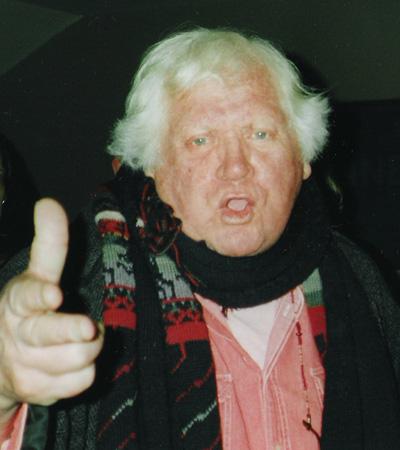
When Ken Russell died on Nov 27, queer cinephiles knew they’d lost a major ally. Though not gay himself, Russell’s strange, fantastical films were loaded with queer images and same-sex trysts. His contributions to the big screen were seen as so significant, he earned an entry in Ray Murray’s 1996 book Images in the Dark: An Encyclopedia of Gay and Lesbian Film and Video. Murray wrote that Russell “has more gay sensibility evident in his movies than most gay filmmakers, even if the images are not always politically correct.”
I had a chance to talk to Russell when he came to Montreal last year to accept a lifetime achievement award at the Fantasia Film Festival. He was warm and genuinely honoured by the award. “I have a lot of fun at film festivals,” he told me.
Russell began his career working as a photographer in the ’50s but soon moved into documentary filmmaking, ultimately landing a position at the BBC. There, he made numerous unconventional docs on various historical and cultural figures, including dancer Isadora Duncan and composer Richard Strauss. He directed several features – including one of Michael Caine’s Harry Palmer spy movies, Billion Dollar Brain (1967) – before creating an international sensation with Women in Love in ’69. With a screenplay by gay upstart Larry Kramer, this DH Lawrence adaptation was immediately noted for its sexual frankness (including a lengthy, homoerotic nude wrestling scene between stars Oliver Reed and Alan Bates) and its intelligent treatment of the source material. Russell was nominated for an Oscar for his direction, while star Glenda Jackson won for her lead role. American censors demanded the nude wrestling scene be trimmed for the version to be distributed in North America.
His career got more varied and strikingly diverse. A biopic called The Music Lovers (1970) had iconic (and then-closeted) actor Richard Chamberlain playing a gay Tchaikovsky. He made the landmark musical film Tommy (1975), which starred Roger Daltrey, Elton John, Tina Turner and Jack Nicholson. His most commercial film was undoubtedly Altered States (1980), his only foray into sci-fi.
But Russell’s most controversial film was undoubtedly The Devils (1971), in which he delved into religious hysteria and fascism. Oliver Reed stars in the film as a 17th-century priest who ends up in a huge fight with the church over his more open and liberal beliefs. The film set off a firestorm of controversy, with a small army of critics denouncing it as deplorable. The explicit depictions of torture and sex (including some nun-on-nun hanky-panky) led the studio, Warner Bros, to refuse to release it uncut. The film has yet to be released anywhere on DVD, though there are versions available online.
Russell had legendary clashes with people in the business, though many have defended him, saying he is simply an artistic genius protecting the singularity of his vision. In one notorious incident, he took issue with a critic on British TV. Shortly after its release, Alexander Walker called The Devils “monstrously indecent,” and Russell responded by smacking him over the head with a rolled-up newspaper on live TV.
“I don’t pay much attention to them,” Russell told me, when I asked him about the critics. “I just think I’m smarter than they are. So who cares?”
The recurring gay themes in Russell’s work led some to speculate about his sexual orientation. As well as his themes, motifs and queer characters, Russell often worked with queer writers and artists. As well as Kramer, he gave a young Derek Jarman one of his first gigs as a production designer on The Devils. In one interview, Russell recounted how a close friend had called him a latent homosexual, to which he replied, “Fine, maybe I am. Who knows. I don’t think anyone knows themselves. We can all pretend, but I have no idea what I am. I’m me!”
When I asked him about the quote, he said, “That was a bit of a joke. But maybe there’s an element of truth to it. I mean, you’re bringing it up now, so there must be something to it.”
With my final question, I asked him if there’s one filmmaker he truly admired. Without hesitation, he answered “Derek Jarman.”
 Why you can trust Xtra