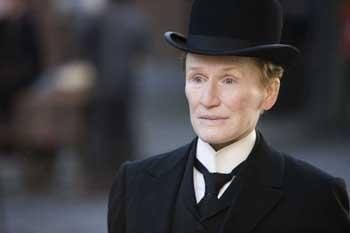
In one of those rare cases when reality lives up to the hype, Glenn Close’s performance in Albert Nobbs is every bit as good as you’ve heard it is. Set in harsh 19th-century Ireland, the film, directed by Rodrigo García, is the story of Nobbs, a woman forced to pose as a man in order to make a living.
What’s lovely about Close’s work in this film is that – unlike Dustin Hoffman’s in Tootsie or Charlize Theron’s in Monster – it’s not the makeup doing the acting. Close delivers a tender, compassionate, gentle and understated study of the vulnerability of a character desperate to keep a secret. It’s an even greater tribute to Close’s skills that, despite the frostiness Nobbs must adopt to keep outsiders distant, her character remains likable, earning empathy from audiences. It’s a performance that has earned Close a Best Actress Oscar nomination.
While the story touches on issues that likely speak to trans audiences, it’s not necessarily a film about trans people. Nobbs’ maleness is more of a role than an identity, so she takes little comfort in it. Still, it becomes so ingrained that when a confidante asks her birth name, she appears to not recall it.
This film is more about cruelty directed at women in a society with a rigid class system that doesn’t allow people to get ahead. Characters are repeatedly treated horrifically because they are women, because they don’t have money, or both. Not surprisingly, it’s a dang bleak picture.
The film is based on the 1918 short story “The Singular Life of Albert Nobbs,” by Irish novelist George Moore. It was further adapted from the acclaimed 1982 stage production in which Close also starred. She loved the role so much she teamed up with award-winning novelist John Banville to write the screenplay. You can certainly feel her passion for the work. She is in almost every scene, and you can feel the agonizing pressure on the character in every frame.
After decades in the business, Close is probably still best remembered for the ludicrously misogynistic and reactionary 1986 film Fatal Attraction. Her character in that film was essentially a hysterical HIV analogy. The makers of Fatal Attraction thought they were being sexually provocative and open-minded, but the real message was simple repression: fool around on your sweet, boring wife and things will end badly, bloody badly. Albert Nobbs is radically different, of course, but each movie offers a take on sexual repression.
Meryl Streep is also up for a Best Actress Oscar for her high-profile act as the ultimate drag king, Margaret Thatcher, in The Iron Lady. But I’m hoping Close will get the nod. Streep may generate more press, but Close simply delivers a better performance.
 Why you can trust Xtra