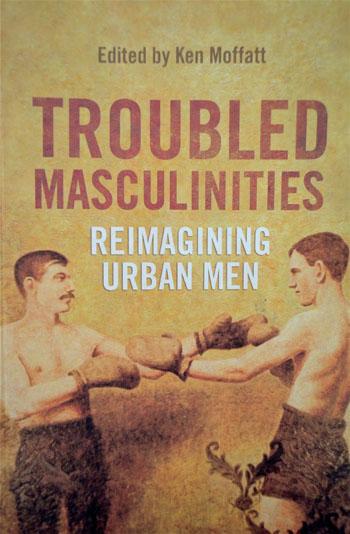
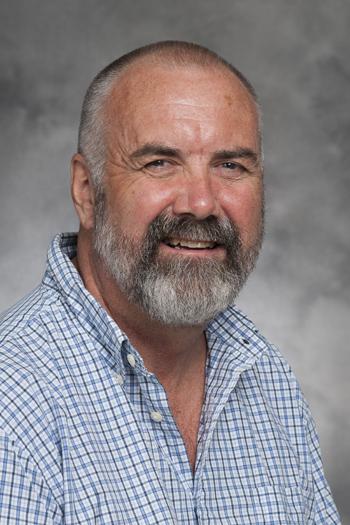
Ryerson professor Ken Moffatt is editor of Troubled Masculinities: Reimagining Urban Men.
Journalist and professor Ken Moffatt has assembled an important and playful collection of nine essays for his new book, Troubled Masculinities: Reimagining Urban Men.
Moffatt approaches masculinity from a humanist perspective and is influenced by his passion for queer art, a love of gay communities, and a belief in the importance of exposing oneself to a multiplicity of experiences. The pieces in Troubled Masculinities focus on Toronto. One essay explores the city’s famous Vazaleen club events that were curated by the late Will Munro; another examines the work of Toronto artist Daryl Vocat.
“I wanted to put my interpersonal politics out there,” asserts Moffatt. “I love being a gay man. I love men, but I despise the way masculinity is constructed . . . Troubled boys and troubled men are usually thought of as inherently bad,” he says. “They’re outside society. The point of the book is to just take it back and say, ‘These are troubling masculinities. They are intentionally troubling and they should be troubling because really the trouble isn’t the boys and the men; the trouble is the masculinity, and the hegemonic sense of it.’”
For Moffatt, hegemonic masculinity – the rigid code that dominates any gender expression outside a prescribed version of what is normal and healthy – must be fought and challenged.
Trans activist Jake Pyne once told Moffatt, “No expression of gender is bad, as long as it’s not hurting anyone.” It’s a statement that seems to have guided Moffatt and his collaborators through the process of assembling the book.
“Gender is practice,” says Moffatt, citing feminist theorist Judith Butler. If this is true, he adds, then it is possible to change one’s gender, but dominant maleness pretends one can’t. “To be a dominant man, you’ve got to be a man. You’ve got to buck up, and you’re not going to change and everyone adjusts around you.”
He sees a dichotomy in Toronto.
“On the one hand there is as strong and dominant a male class as there has ever been, which is prepared to use whatever force it needs to stay in power,” he says. “On the other hand is this incredible possibility of the moment. I think that’s what I’m trying to capture in the book.”
He credits the emerging visibility of trans identities with “opening up gender again” and, he says, this is something from which we can all benefit.
 Why you can trust Xtra