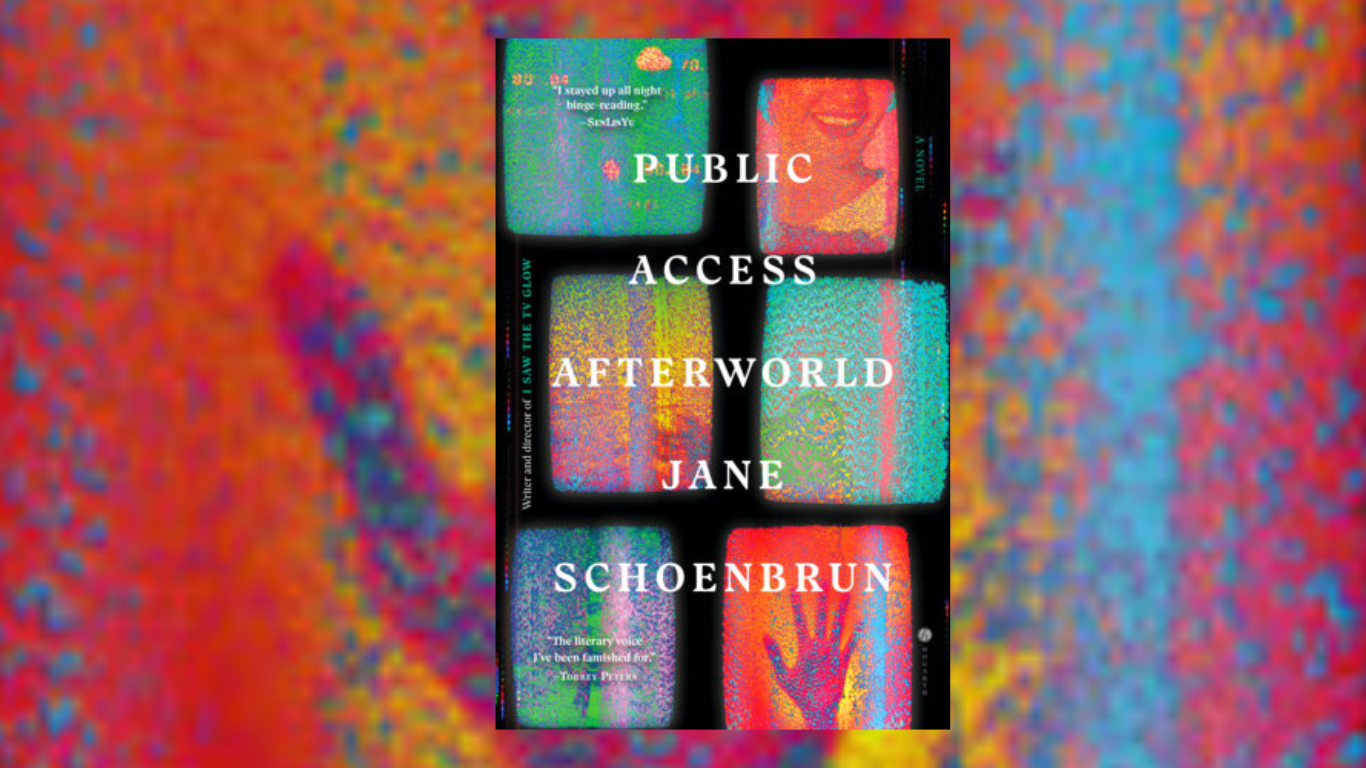
“The battle for the mind of North America will be fought in the video arena,” goes the proverb from enigmatic professor Brian O’Blivion in David Cronenberg’s cult film Videodrome. The debut novel from trans auteur Jane Schoenbrun, Public Access Afterworld, elaborates—quite generously— from there. The sprawling, time-and-universe-traversing work offers the symbolic density expected from the writer and director of films I Saw the TV Glow and Teenage Sex and Death at Camp Miasma.
Public Access Afterworld follows two protagonists as they seek to uncover a vast interdimensional conspiracy involving a secret realm inside analogue television static called, obviously, the “Public Access Afterworld.” The first is Bethany Peters, a young trans woman who kind of sucks, who begins working as a content moderator at a YouTube-esque corporation. In between chaotic attempts to sabotage her relationship with very nice but very milquetoast boyfriend Abel, Bethany comes to discover the ways in which the C-suite of pseudo-YouTube is involved in this strange realm. The other protagonist is David Sawyer, an awkward, nerdy teenager who stumbles upon the realm with his equally television-obsessed best friend, Erin. There’s also a ghost-makeup-wearing teenage vlogger whom Bethany tries to rescue from extreme emotional dysregulation; an on-the-lam accused serial killer running a cult based around the titular afterworld; a depressed movie monster trapped in a Sisyphean bind of endless resurrection through shitty remakes; and, briefly, Robert Oppenheimer himself. The battle in the videodrome takes all kinds of warriors.
Public Access Afterworld feels less like a stand-alone book and more like the creation of a mythology. Or, rather, the expansion of one, because of how the novel plays off of Schoenbrun’s films. The book is highly referential, and the biggest references are to Schoenbrun’s previous work itself: the novel establishes itself as a kind of connective tissue interlinking all of the director’s films, a key to unlock the hidden cohesive message within their body of work. Here are the same awkward teenagers making themselves sick on television as in I Saw the TV Glow, the same internet-conspiracy-chasing outcasts as in We’re All Going to the World’s Fair, but everything is pushed to weirder limits. Within this world’s philosophy, the screen is not just a form of entertainment but a dangerous portal to other dimensions, and the audience needs to move beyond their passivity in order to actualize themselves in a way that is more spiritual than psychological.
As Schoenbrun’s world view is pushed to more elaborate lengths, transness, too, becomes fully explicit. Although the writer-director has become known for the trans subtexts in their films, transness previously remained on the level of the allegorical, a secret way to read the films if you were in the know. Much of this novel, to the contrary, features at-length discussions of transition and transphobia.
There is a pointed contrast between the novel’s two protagonists. David, clearly resembling I Saw the TV Glow protagonist Owen, is a cult television superfan who is mired in passivity, afraid to take action in his own life and instead attempting to live vicariously through the people around him. Then there is Bethany, a self-described hater of television who is terrified of being trapped in a subpar life; the kind of person who flees from a sweet boyfriend out of a fear of spending every night of the rest of her life watching prestige television on the couch. Evidently, it’s Bethany who is the hero of the story and David who is more of a second-rate antihero. Their respective relationships to the screen aren’t coincidental, but rather indicators of these positions. Within this world, the hero has to be someone who rejects television.
@xtramagazine There were no trans characters in films released by major studios in 2025. That’s according to GLAAD’s Where We Are in Film study, which examined LGBTQ2S+ representation across 225 films released by 10 major studios in 2025. Not only did none of the tracked films include a single trans character but LGBTQ2S+ representation declined overall. Of the 225 films tracked, only 20.4 percent contained LGBTQ2S+ characters, a decrease from the 23.6 percent inclusive films counted in 2024. Representation has been trending down across the board. LGBTQ2S+ characters are not only in fewer films but they’re also getting less screen time and have less narrative significance. GLAAD president and CEO Sarah Kate Ellis warned that the overall decline in LGBTQ2S+ characters on screen will have long-term impacts. “If the industry doesn’t prioritize investing in films with LGBTQ2S+ characters, it risks losing a generation that will go elsewhere to find entertainment that does include our community.” We break down what you need to know from the annual report. #lgbtqnews #film #glaad #filmnews #lgbtq ♬ original sound – Xtra Magazine
Within Public Access Afterworld, obsession with media is presented as something negative; characters like David are depicted as people who are disassociated from themselves and their agency, making themselves sick with their maladaptive relationships with film and television. Those who are the most obsessed with the screen have the opportunity to enter the Public Access Afterworld, and create TV shows themselves—they become trapped in a supernatural type of exploitation where they’re completely cut off from their true selves. It’s an interesting motif coming from a writer who’s spent the last half decade working in film. When Public Access Afterworld depicts interdimensional television creators as lobotomized dreamers with tubes stuck down their throats, Matrix-style, the contempt seems less like it’s coming from an industry-hating artiste and more like it’s from someone who has seen the inner workings of the circus.
The whole thing reeks of an indictment of the entertainment industry. Schoenbrun themself, while working within the industry, frequently criticizes its processes. “I love television. I love American movies. And I also want to destroy them. I see them as prisons as much as they’re spaces of emancipation,” they said in an interview with Vulture this summer. In other interviews, they’ve described profit-seeking contemporary entertainment as “sinister,” or “tools of control.”
There’s a love-hate relationship with the screen that’s present in all of Schoenbrun’s work. As much as their films betray the enduring love of a film nerd, with myriad references to horror franchises and late-night broadcasts, their protagonists’ obsession with cult TV shows or campy slashers isn’t exactly portrayed as something that’s good for them. Public Access Afterworld goes further: its characters’ love for the screen is something beyond unhealthy, a precursor to literal spiritual imprisonment.
The comfort that television provides is, at its base, one of escape. As a classic Calvin and Hobbes comic strip puts it: Karl Marx, who thought that it was religion that was the opiate of the masses, hadn’t seen anything yet. David’s friend Erin berates him in one of the novel’s most revealing moments: “You like to watch, don’t you … because that’s all you can do.” Late pop cultural theorist Mark Fisher’s theory of interpassivity explains how we outsource our critical faculties to our media, so that we no longer have to take action; all we have to do is watch. It’s under these circumstances that No Other Land wins Best Documentary at the Oscars while Western governments continue to support the dispossession of Palestine, or the star-studded Don’t Look Up becomes one of Netflix’s most-watched films while our near-total inaction on climate change persists. While the heroes on the screen take action, we, like David, are free to remain passive.
Because Public Access Afterworld is a hero’s journey—Schoenbrun has said that they wanted to create a work on the scale of Lord of Rings or Harry Potter (which may also explain the book’s near-600-page length)—its movement is one toward the righting of injustice. The central tension of the story presents us with a choice: we can remain in passivity, comfortably seated in our positions as audience members to forms of entertainment that are upheld by exploitative systems. Or, the book argues, there is another possibility: we can make something of ourselves that is higher than that. We can dismantle the scaffolding of these systems that both restrain and sedate us, and create something more real. This could mean actualization on an identity level, through transition, for example—that’s the easiest reference point. But it could also mean actualization on a more existential level.
Within gnostic theology, we are thought to be living in an ignorant, hollow state of separation from the divine world we actually belong to. It is only through careful mining of profound inner knowledge that we can move toward our true nature. What would it mean to see the world clearly in its brokenness and to acknowledge our ability to move toward something better?
Maybe it would mean transitioning. Maybe it would mean the reformation of the entertainment industry. Or maybe it would mean the destruction of all exploitative systems designed to restrain and impoverish us, whatever they might be. Public Access Afterworld seems to argue that the power to radically reach for better ways to live is within each of us. All we have to do is take hold of that inner power. Until we do, at least there’s television to keep us satiated.

 Why you can trust Xtra