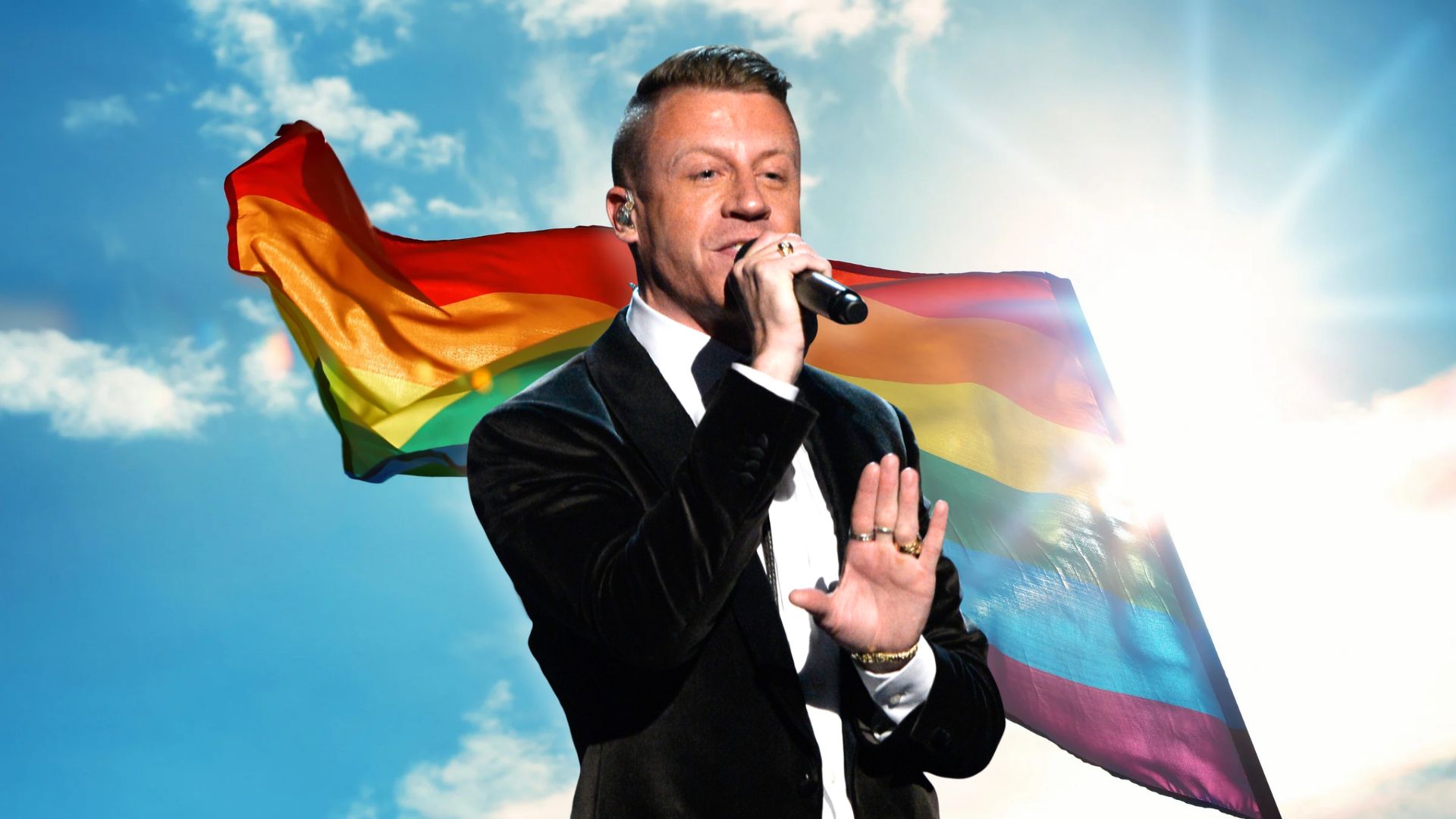
Rapper Macklemore was recently dropped from opening for Ed Sheeran’s current tour after making pro-Palestine comments during his set at a concert in New York. The decision allegedly came after pressure on Sheeran from billionaire Robert Kraft, who owns the New England Patriots football team and Gillette Stadium, where Sheeran was set to play. Other NFL owners reportedly threatened to cancel the shows altogether unless Sheeran dropped the rapper from the tour. And it’s also worth noting that Kraft happens to have a long history of monetary support for the state of Israel.
The situation sparked a wave of controversy, as every single other opener (and Sheeran’s own backing band!) have dropped out in solidarity with Macklemore. Public opinion is certainly with the rapper, as people are rediscovering that the guy behind “Thrift Shop” is actually pretty legit. In this current Macklemore resurgence (dare we call it a “Mackle-moment”?), it’s worth revisiting the rapper’s famously cringe “love is love” opus and acknowledging that it actually might be good.
Yes, in the midst of everything going on with Macklemore and Ed Sheeran, I’m here to bravely defend “Same Love.”
Picture this: it’s the summer of 2012. You’re about to head into your senior year of high school. Obama’s in the midst of a re-election campaign. Glee just finished its third season (though it pales in comparison to the previous two). You have blunt Zooey Deschanel-style bangs you cut yourself and are spending your summer working as hostess at chain Italian restaurant in Red Deer, Alberta. You’re thinking about how they’re gonna catch Joseph Kony. You don’t have the slightest inkling yet that you might be queer, let alone trans.
Then Macklemore & Ryan Lewis’s “Same Love” debuts on the radio. This white-boy rapper who we all knew for singing about wearing your granddad’s clothes in “Thrift Shop” is here to heal the world and proudly proclaim that love is love and his gay uncles should be allowed to get married. The song features lesbian singer-songwriter Mary Lambert on the chorus, crooning about how a female lover “keeps her warm.”
Seventeen-year-old you immediately downloads the full album, The Heist, upon its October release (to your fourthth-generation iPod Touch), and “Same Love” by far gets the most replays out of any song. The next year, when Lambert releases the full-length version of her verse, “She Keeps Me Warm,” that too enters the iPod rotation. A few short years later, you will come out for the first (but not the last) time.
“Same Love” was a critical and commercial success at the time, hitting number one on a variety of charts and getting 4x-certified platinum in the U.S. It even got a Grammy nomination for Song of the Year, paired with a performance at the Grammys telecast where Queen Latifah legally married 33 couples live on stage and Madonna showed up to sing “Open Your Heart.”
There’s no denying the cultural impact that “Same Love” had upon its release back in 2012, particularly for a generation of burgeoning queer kids like me who had never had a musician, let alone a straight one, so clearly and simply express support for gay marriage. However, in the ensuing years, the song and its lead artist have become the butt of many jokes.
There’s the fact that he’s a white guy from Seattle, and then there’s that opening line that would go on to be memeified for years to come: “When I was in the third grade, I thought that I was gay, cause I could draw, my uncle was and I kept my room straight.” In more recent years, the track has come to represent a certain level of Obama-era cringe—a simpler time, where saying “love is love” was considered activism. One viral Tweet encouraged him to “Mackle-less,” while a new generation of TikTokers discovered the track and rightfully clocked it as cringe. It was even parodied in the 2016 film Popster: Never Stop Never Stopping with the track “Equal Rights (Not Gay)” featuring P!nk.
But in revisiting the track, and considering Macklemore’s continued vocal activism—most recently in support of Palestinians—it’s clear that the song has actual impact. When it comes to actually doing activism and making change in mainstream music, Macklemore may be one of the best. And “Same Love” is part of that legacy.
Multiple things can be true. Yes, Macklemore is a white guy rapper named Ben from Seattle who is arguably most famous for a song about thrift shopping. His music isn’t for everyone, and not every song carries a deep political message beyond “I wear my granddad’s clothes/ I look incredible.” But the true heads know that he’s been doing this for years. Even before he was saying “Free Palestine” on stage or demanding marriage equality, back in 2005, he was rapping about white privilege and calling out then U.S. president George Bush on his debut album.
“Same Love” was released three years before marriage equality was legalized across America. A portion of proceeds from the song were donated to marriage equality efforts in Macklemore’s home state of Washington. The song was also used as a campaign song for activist groups working to pass Referendum 74 to legalize same-sex marriage in the state. Long after its release, Macklemore continued to donate proceeds from the song to marriage equality campaigns.
This song had a tangible impact on countless queer lives. And yes, it’s cringe in its simplicity. But its simplicity and lake of fear in calling out what is right and wrong is what makes it so powerful.
In his recent support for people in Palestine, the rapper has continued this work. In 2024, he released “Hind’s Hall,” a song in which he vocally supports pro-Palestinian protests on university campuses. All proceeds from the single went to the United Nations Relief and Works Agency for Palestine Refugees in the Near East.
“Macklemore also occupies a rare position: As he himself says in a “Hind’s Hall” verse, his status as an independent artist, as well as a white one, allows him to take a bold political stance,” writer Aja Romano wrote for Vox upon the single’s release. “Most artists would risk career-ending repercussions for speaking out, especially about such a polarized subject as Gaza.”
And he’s continued to use the song to speak out—his performance of it during a tour stop in New York was what prompted all of this mess with Sheeran. On Wednesday, after being dropped from the tour, the rapper said he would donate the $1 million he earned from the tour so far to six organizations directly supporting Palestinian people, and challenged Kraft to do the same. In response, both Sheeran and Kraft have both pledged an additional $2 million each to “aid in the region to fight this humanitarian crisis”—though it’s worth noting that’s pocket change for a billionaire like Kraft, and he did not note what his definition of support for the region is.
There’s a certain cynicism that meets any popular artist releasing an “issues” song, particularly for a group they themselves don’t personally represent. An immediate analogue is Taylor Swift’s “You Need to Calm Down,” which had a music video peppered with Queer Eye guys and drag queens, but very little substance in terms of actual activism. Fans christened it a “pro-gay” anthem, but it was also really about Swift’s haters, and the pop star has been famously unpolitical throughout her career.
In contrast, when you look at the lyrics of “Hind’s Hall” or “Same Love,” there is no subtlety to their messages, and those messages still resonate today and link these issues together into a coherent political perspective. Where other artists are dancing around issues and afraid to offend, Macklemore has been nothing but unapologetic in supporting the causes that matter.
Last weekend at karaoke for a friend’s birthday, I jokingly pulled up “Same Love” as my song. I initially started off laugh-singing the lyrics about loving drawing and being gay, but toward the end of the track, the tone shifted.
“When everyone else is more comfortable remaining voiceless
Rather than fighting for humans that have had their rights stolen
I might not be the same, but that’s not important
No freedom ’til we’re equal, damn right I support it.”
You have to hand it to the guy. A decade and a half later, he’s still out here doing the thing.

 Why you can trust Xtra