My partner Riley stands in front of the bathroom mirror, readying themself to go out. It’s our 10th Valentine’s Day together. We’ve promised our daughter, who is seven, a family date night at the movies. I could cross the distance between us in four steps, but I don’t. Instead, I watch them from the foot of our bed, a thick mattress seam cutting into my thighs.
“I know you didn’t mean to hurt my feelings,” I tell Riley, who has stopped fixing their hair to listen. I can barely remember what they’d said a few minutes ago, only that a passing comment had pressed on one of my insecurities, triggering an all-too-familiar drive to flee. “Maybe you should just go without me,” I say. Static from old traumas fills my ears like white noise. I am telling my partner to leave, but what I really mean is, Let me run from you. Leave me to tend to this wound alone.
“If that’s what you need,” Riley says gently. “But I would really love for you to come with us, and I know Sasha would too.” Their body is turned toward mine in a soft, open stance. They know not to approach me yet.
I pause. “I … I do want to come with you,” I say. “I just need a moment to myself.”
Riley nods. “I’ll go help Sasha get ready.” They close the door as they exit. I stay rooted in place, muscles uncoiling as the urge to run passes through me again.
After more than a decade in what I can easily describe as the happiest and healthiest relationship I’ve ever had, some people might think it strange that part of me is still looking for a way out. My relationship with Riley is a daily source of joy, satisfaction and pleasure. I love who they are in the world: kind, steadfast, playful and generous. I love growing with them and the freedom and security I feel in our relationship. Outside of marriage, Riley and I are about as materially committed as you can get. We have three children and two co-parents with whom we own a home. I have no doubt that Riley is the person I want to spend the rest of my life with. “I’m going to haunt you when I die!” I tell them gleefully, certain our love is strong enough to outlast me.
Yet when I’m acutely stressed or emotionally overwhelmed, a voice inside me shouts RUN!, triggering an animal impulse to bolt. In the past, this has looked like leaving the building. Early in our relationship, I ended up on the train home at midnight after working myself into an anxious frenzy over not being able to fall asleep at Riley’s. They woke the next morning to an apologetic note while I slept fitfully in my apartment on the other side of town, dogged by the shame of my hasty departure.
In 2021, when we got the keys to our new house on Vancouver Island, I spiralled into a panic so intense that I nearly backed out of the deal and bought a last-minute plane ticket home to the mainland. Commitment was scary, and I couldn’t get away from my feelings fast enough. I’ll never forget the hurt on Riley’s face or the sound of them crying through the bedroom door after I told them I was leaving.
That night, I sat alone in the kitchen long after they’d gone to sleep, berating myself for hurting my partner while also researching the quickest way off the island. I felt like I was being pulled in two directions at once: part of me wanted nothing more than to stay with Riley and the future we were building, but another part of me was frantic to escape. After several hours of this inner tug of war, I crawled into bed beside Riley, curling my still-tense body against their warm, familiar shape. It was the hardest night we’ve ever had. It took us until dinnertime the next day to feel settled again, and even longer for me to feel sure I’d made the right decision in choosing to stay.
The urge to run has quieted over the years. We’ve been living happily together since 2021, and I’ve never regretted my decision to move, even if our seven-person household feels a little crowded at times. These days, I’m more likely to leave the room, mentally check out or lose myself in work than I am to be shopping for flights at 2:00 a.m. What’s different is that, with time and practice, Riley and I have developed a shared understanding of my tendency to flee.
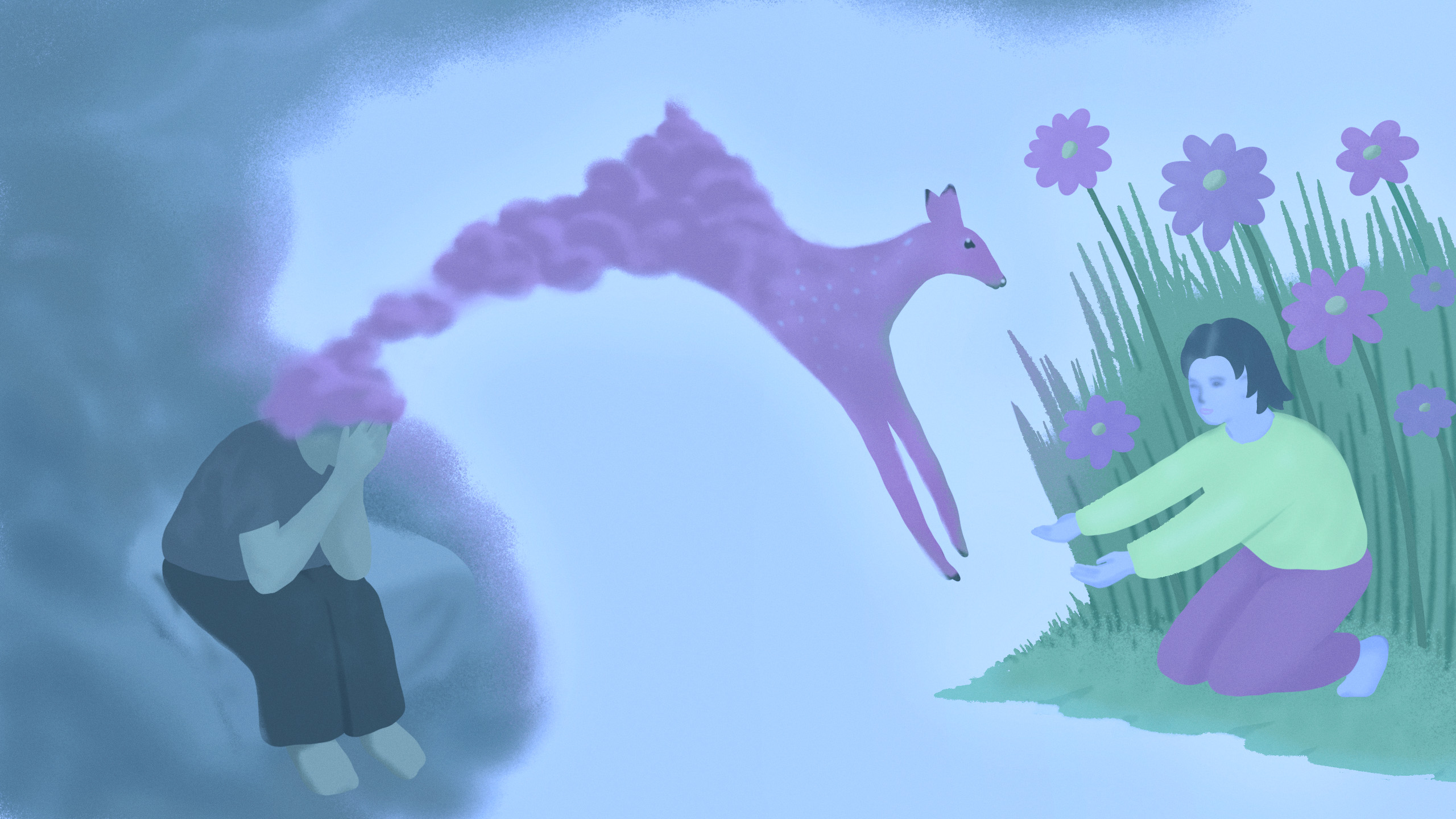
At first, dating me probably felt like befriending a frightened animal. I would come close, seeking connection, then shy away in fear, retreating into myself. Luckily, Riley has the patience of a triple Earth sign. Over time, we built a foundation of intimacy and trust. We’ve learned to meet my reactions with compassion instead of fear or blame.
Acknowledging how past traumas still live in my body has helped me understand that my reactions to Riley are often more about protecting me from something that occurred a long time ago than what’s happening in the present. In her book The Politics of Trauma, somatics teacher Staci K. Haines calls this “survival shaping”: the idea that, when we experience trauma, our bodies mobilize to protect us in ways that can keep parts of us stuck in the past. With the support of somatic therapists, I’ve practised slowing down, tuning into my body and noticing what’s arising in me, while grounding in what’s actually happening in the present. Sometimes, all I need to feel settled is a few minutes alone behind a closed door, or for Riley and I to acknowledge the part of me that’s readying to run.
Becoming more acquainted with my habit of leaving has made it easier for me to stay. It’s also made me more grateful for knowing how to run. Leaving is an instinctive and essential survival skill. The urge to flee is like a siren that goes off when I feel unsafe, prompting me to pay attention. It’s helped get me out of risky situations and unhealthy relationships. It is one of my most precious inheritances: my mother drove across the country alone when she was eight months pregnant with me to escape my father’s violence. Her courageous capacity for flight is the reason I was born into safety.
I’m not here to romanticize or valorize staying, or gloss over what keeps people trapped in harmful relationships. As a queer divorced person, I know that leaving is sometimes the most life-affirming thing we can do. How long a relationship lasts can’t be our only gauge of its quality. Yet as Riley and I enter our second decade together, I’m interested in what’s making it possible for me to stick around for the long term.
“We’ve come to tell the story of our relationship not as one about me habitually running from connection, but as one in which I’ve learned to stay.”
A big reason why our relationship feels safe is that Riley gives me room to change without pressuring me to “fix” the parts that want to turn away from connection. I wasn’t just wary of intimacy when we first started dating in 2015. I was convinced I was broken; certain my early life and past relationships had doomed me to being forever deficient in my ability to attach to a partner.
Moments like the one this past Valentine’s Day, when I am able to name what’s happening and to ask for some time alone to self-regulate, are the result of years of practice. So is my ability to return to Riley shortly after, feeling softer, more at ease and ready to connect. Healing isn’t linear, and I don’t expect to ever be “done.” Over time, our relationship has helped me learn to see myself through a lens of wholeness and capacity for change instead of as someone always looking for a way out.
Riley and I have come to tell the story of our relationship not as one about me habitually running from connection, but as one in which I have learned to stay. Today, as I look back on our first decade together, I see two people moving toward each other with compassion for our wounded places and the courage to face them, grounded in trust in our capacity for care and our ability to keep growing together into the next decade and beyond.
That Valentine’s Day evening, after Riley left the room, I stood up and stretched, loosening my neck and shoulders. Gathering my things, I made sure to choose a tote bag big enough to smuggle contraband seltzers for Riley and me and an orange pop for Sasha into the movie theatre. (Our family values include being gay and doing crime, and not paying $7 for a soda.)
I opened the bedroom door, calling out as I walked down the hall, “Are you ready for date night?”
“Yes!” Sasha exclaimed from the kitchen.
“Yes!” chorused Riley.
“Great, so am I,” I said. “Come on, Valentines.” I looped my fingers through Riley’s, smiling at them as our daughter led us out the front door and into the car. Instead of hiding alone or running away, we were leaving together, moving toward what I had always longed for: more connection, more joy and more love.

 Why you can trust Xtra