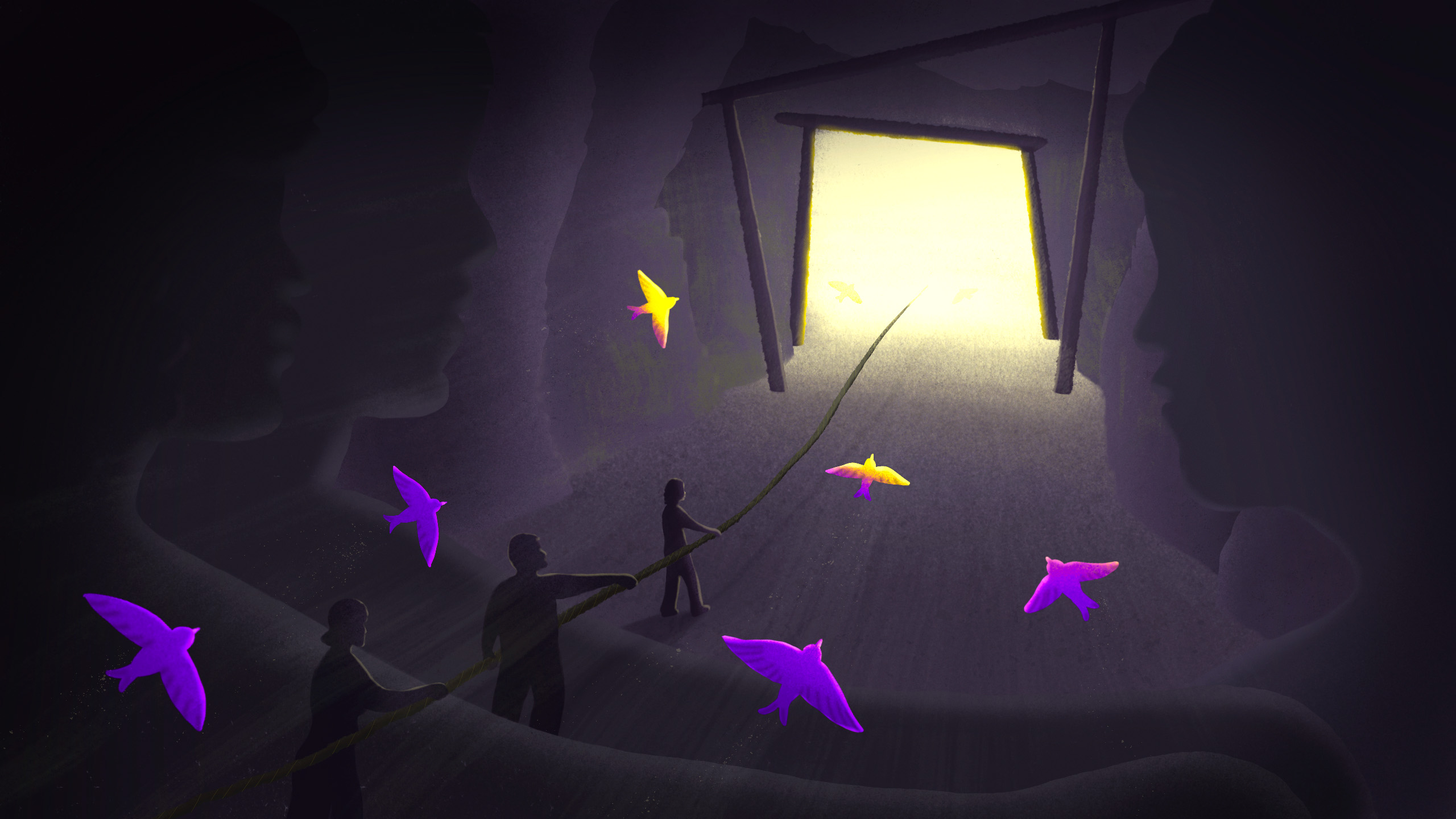
In 2018, I had a nervous, stunted conversation with my mom about gender. I had felt a growing closeness to her and wanted to be entirely honest about my life. I told her that I’d never felt like a man, that masculinity had always felt like an exam I was doomed to fail. To my surprise, she softened. She was confused but curious. We spoke about gendered expectations and femininity: how she felt the pressure to dress, look and act “feminine” whether she wanted to or not. Sometimes, she told me, she didn’t.
The discussion marked the starting point of a change in our relationship. It made me feel like I could trust her unconditionally with my innermost thoughts, and it was the catalyst for me lowering a barrier I had spent most of my life building around my feelings about my gender.
I was born in a working-class town in the North of England and raised by a single mom. For centuries, the men in my family have been coal miners and construction workers. By the time I was born, tyrannical Prime Minister Margaret Thatcher had decimated the coal-mining industry that had historically sustained my family. No mines for me, but still, the hope was that I would take up a trade, learn to build houses and plaster walls. I could sense from an early age that my life would look a little different from that.
As a kid, my mom and I were inseparable. Every Sunday, we would take the bus into town and go shopping at Primark, a fast-fashion mecca whose racks brimmed with bargains. Mom would try on a series of outfits—usually in almost-identical shades of hot pink—and seek my approval, which I gave willingly. I spent most weekends with my grandma, who had worked in a shoe factory as a teenager and made shoes for the iconic 1960s designer Mary Quant. I was never brought up to view femininity as weak, inferior or superficial. It was simply my norm, the result of being raised in what felt, at times, like a matriarchy.
The only male role model in my life was my grandad, who is still one of my closest friends. Unknowingly, he modelled a version of masculinity that has informed my own. My favourite anecdote is of him sitting in a café and overhearing a stranger bemoaning the first Pride parade in his hometown, rattling off that age-old classic: “The gays are shoving it down our throat.” Without missing a beat, my grandad stood up, walked over to his table and told him to fuck off.
I class my family as mostly progressive, but I was still reminded frequently as a child that my femininity was something to be mocked. I’ll never forget my shame at being caught dancing around my bedroom with a sweater on my head as a makeshift wig, pretending to be a Spice Girl. Mom and her boyfriend had burst into laughter, and I’d hastily pulled off the sweatshirt. Soon afterward, Mom sold my VHS copy of Spice World without telling me, as though she were banishing a bad influence.
My relationship with Mom’s boyfriend was always strained. Although she largely kept us separate, I grew used to him calling me a “poof” if I acted too girly or talked about my interests. I started dying my hair and experimenting with makeup, but every choice became an ordeal. “Why are you doing that?” Mom would say. “You’re a boy, why bother?” Tired of explaining, I started secretly buying drugstore makeup and trying it on with my best friend; those clandestine makeovers offered a moment of escapism.
These experiences with my family were painful. I learned that hiding the truest parts of myself was the easiest way to avoid arguments; that being honest about my femininity would be met with an eye-roll at best, a demand to man up at worst.
In retrospect, I understand that the women in my life encouraged me to tamp down my femininity because they knew how society responded to softness, how my personality would be mistaken for weakness. In my kinder reflections, I think that they were trying to protect me.
As a teenager, I felt alienated and anxious. I self-surveilled constantly, always conscious of how I’d be received by others. Soon after I moved to Birmingham as an eighteen-year-old and finally built up the confidence to present more femme, I was sexually assaulted by a guy who fetishized femme gay men. Sexually, I was treated mostly as a novelty or a kink; publicly, I was harassed and threatened almost every time I left my apartment. I wanted so desperately to confide in my family, and yet I largely kept these experiences to myself because I feared that, on some level, they would think I deserved it; that I was bringing this abuse on myself for failing, even in small ways, to conform.
I was in my mid-20s when I first learned about the term “non-binary.” For decades, I had felt like a failure at the tricky game of doing gender “correctly.” Understanding myself as non-binary gave me relief. I remember feeling lighter, the anguish of glimpsing my reflection starting to wane as I reframed my body not as “masculine” or “feminine,” but as simply mine. It was as though I were ascending to a new plane, levitating above a world of made-up rules and nonsensical systems like gender.
Around this time, I wrote my first book, The Art of Drag. I dove deep into pre-colonial histories of gender and discovered drag creatures and monsters, self-described freaks who built ethereal visual fantasies to disrupt the idea that gender is either/or. Incidentally, this work opened the door to early conversations about gender with my family. They read my articles, listened to first drafts and asked me questions about drag, gender and performance. I explained that drag, at its best, is like holding a funhouse mirror up to society.
My family was receptive and interested, and this positive response gave me an inkling that they’d similarly react well if I mentioned my own feelings about gender. So, I started opening up.
“In our conversations, I’ve learned that gender has felt like a prison to my family too.”
While my family was supportive when I came out as non-binary and has been since, I get the sense that they don’t fully understand the vast spectrum of transness. They know that I’m trying to explain something that is important to me, but it still feels like an alien concept to them. In every conversation, I grasp at the language to articulate my feelings around my identity, which are always evolving.
But in our conversations, I’ve learned that gender has felt like a prison to my family too. I’ve talked to my mom about the sheer amount of effort required to perform a socially acceptable femininity, about the links between homophobia and misogyny. While we sipped cappuccinos in a mall coffee shop, I learned that her femininity had made her a target for men. The emotional conversation led to me opening up about sexual assault, and I teared up as my mom and I bonded over shared experiences of violence, the words we had both buried for so long finally being excavated.
A similar moment came during a holiday in Romania, when Grandad opened up about how miserable the expectations of masculinity had sometimes made him feel. He expressed how frustrated he had been by locker-room talk and casual misogyny while playing on his local football team. As we strolled down a spacious, tree-lined boulevard, he spoke about feeling pressured to blend in with men who made sexist jokes, who viewed aggression as aspirational.
Since then, my grandad and I have had hours-long phone calls where we share our lives with each other. Through those conversations, I feel a closeness, a love that persists. My grandad might not fully understand my transness, but regardless, he loves me unconditionally.
While coming out as non-binary opened the door to more vulnerability with my family, it also complicated things. I’m still constantly misgendered, despite my correcting them over the years. My partner and I joke that there’s an unspoken challenge between my mom and grandad to buy me the most heavily gendered greeting card in existence.
Although conversations about gender with my family have usually gone well, I feel too tired to keep having them when I’m misgendered. On bad days, I can’t shake the feeling that queerness creates an invisible chasm of experience, a gap between my family members and I that can’t be bridged.
But I know that my mom tries hard to make the trans people in her life feel loved and accepted; I know that my grandad still calls out bullshit when he hears it. Mom once asked my advice on how best to be an ally at work; I later learned that it led to a heartwarming interaction in which she helped a nervous young trans woman pick out a dress for the first time. Grandad is curious, asking me questions about transness with a caution that he “might be wording things wrong.” That makes me feel warm and fuzzy—he has enough respect to care about accidentally saying something offensive.
I know that I also have a part to play in maintaining these relationships, in keeping these conversations alive, so I pick my battles carefully. It’s taken years of self-reflection to understand myself as non-binary, so I try to be non-confrontational while my family members try to wrap their head around it too—even when the misgendering makes me want to scream.
The chasm between us still widens occasionally, but this is the nature of relationships: they ebb, they flow, they require work and communication. The conversations I’ve had with my family so far—about life, work, sex and love, all filtered through the lens of gender—have deepened our bond, and they’ve healed the small wounds caused by years of self-censorship and hiding my feelings. I can say with more confidence than ever that my family members love me unconditionally, no matter what hurdles are still to come. It’s an intimacy that’s been nurtured over the years, the foundations of which were laid when I finally decided to be honest about my gender.

 Why you can trust Xtra