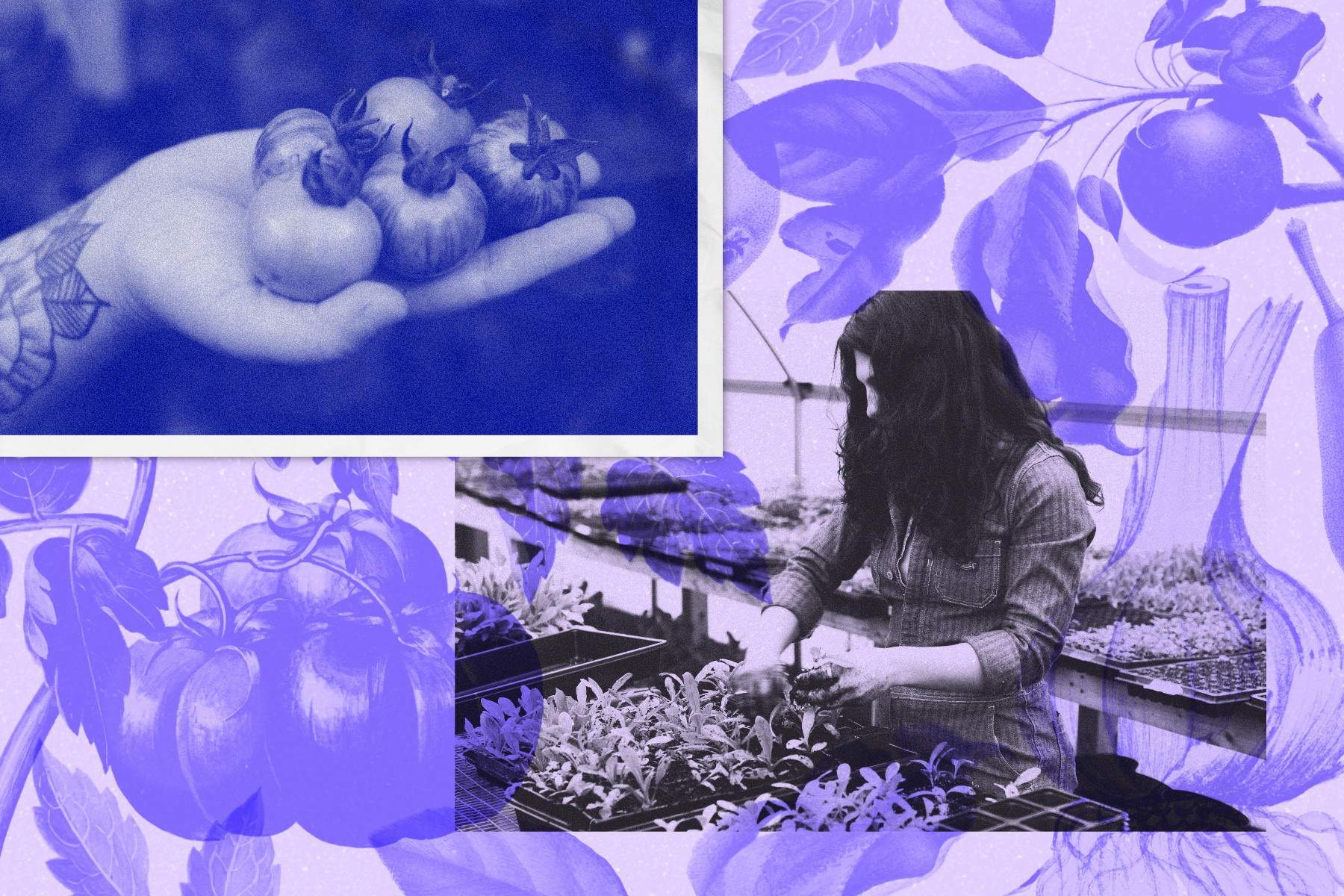
Before they were ever knee-deep in compost, Ardeo Mann and their friends would huddle over crinkled paper to draw maps to imaginary gold. Their quest for buried riches faded, but the drawings didn’t disappear.
“After our treasure map phase, we got into drawing our ideal farm,” Mann says.
Today, they run Rake and Radish in Victoria, B.C., a six-year-old, half-acre farm. A bold red banner atop its website reads: “Fresh veggies from your local queer farmer.”
“I thought, ‘If I’m gonna do this, I may as well be really open about who I am,’” they say.
Advertisement
For generations, queer people have fled their rural hometowns in search of community, belonging and glamour in the big city. So the idea of any gay, non-binary or trans person choosing to work on a farm may seem counterintuitive. But according to almost a dozen queer and trans farmers, the face of farming is changing. And as a result, farming itself is being transformed, with queer growers favouring small-scale, community-supported, environmentally-sustainable practices.
Women-run to queer-run
Rake and Radish sprouted beside a pocket of small farms on Vancouver Island that’s home to a long line of queer growers. The now-inactive LGBTQ2S+ farmer group Rainbow Chard Collective made its debut in 2009 at Victoria Pride. “All the clean gays with tight bodies and corporate floats were about to get a taste of filthy, dirty working queers of all shapes and genders,” wrote Larkin Schmiedl, a founder of the collective, in This Magazine in 2014. He wore a shirt printed with “gender modified, not genetically modified” as the group trundled a wheelbarrow through the parade.
Mel Sylvestre, who now runs the farm Grounded Acres with their partner on B.C.’s Sunshine Coast, was another one of Rainbow Chard Collective’s founding members. “I came out, got my first girlfriend and started a job on the farm all at the same time,” Sylvestre says, sounding almost surprised at their luck. “I think it’s the first time I’ve said it out loud.”
Their first fateful job in B.C. was on a Vancouver Island co-op farm run by three straight women. “But there was definitely a trend of seeing women and, almost by default, queer people being attracted to small-scale, by hand, organic, ecological farming,” Sylvestre explains.
Where there are women-led farms—still a minority, but a growing phenomenon—queer-run farms seem to follow soon after. Although there are no federal statistics on LGBTQ2S+ farmers in Canada, according to the latest numbers available in the 2021 Census of Agriculture, Canada’s female farm operators make up a little more than a third of the country’s total, with B.C. commanding the highest share of this demographic. And women are more likely than men to work on small farms that report less than $50,000 in revenue. In a 2022 Globe and Mail article on celebrating pride in agriculture, a queer farmer in Vermont, U.S., explains “there’s definitely this unspoken understanding that [it’s] going to be a much more compassionate and inclusive environment when it’s women-owned.” The farmers Xtra interviewed agreed with that sentiment, crediting female farm operators for paving the way for queer, trans and non-binary workers in the industry.
Most small farms rely on selling directly to individuals, rather than industrial processors or wholesalers. So community-supported agriculture (CSA) is a popular model at these farms. In this alternative to industrial agriculture, community members commit to supporting a local farm for a season, often paying up front to receive regular boxes of veggies.
All the queer farmers Xtra spoke to are current or former workers or owners on small CSA farms.
Felix Pozojevic is a queer and trans field manager at Fertile Grounds, a CSA farm in Neustadt, Ontario, a town 2.5 hours north of Toronto. They say that due to the relationship between nearby residents and small farms—which tend to be located around the fringes of cities, instead of deeply rural areas—CSA farms tend to be more progressive.
To rely on support from your community, you have to be welcoming of all types of customers, says Pozojevic. “Cash-croppers can drop their dry corn at a mill. You don’t need a relationship with those you are feeding, so you can have a really narrow scope of who you want in your community,” they say. “If you have a CSA but you’re homophobic, the business model and the morals don’t line up, and it’s not going to work.”
A 2016 University of Guelph study revealed that a full 100 percent of the CSA farms surveyed engage in at least some organic farming practices (though only a third go through the stringent and expensive process of getting organic certification). These farmers may rotate crops, avoid synthetic pesticides and genetically engineered plants and use compost and manure to nourish their fields.
In addition to using organic practices, some CSA farms share reading lists about Indigenous land rights with their customers; others prioritize decent working conditions for staff (Rake and Radish, for example, doesn’t use unpaid interns). Agroecology, per the National Farmers Union’s (NFU) definition, is “a holistic approach to food production that … promote[s] food sovereignty, social justice, economic sustainability and healthy agricultural ecosystems.” In other words, most LGBTQ2S+ growers in Canada engage with a type of farming that is inherently political.
Buried gold
Elena Potter, who started farming in 2020 in Ontario after growing restless at her arts administration desk job, offers another explanation for why the LGBTQ2S+ agriculture community is concentrated on small farms: money, or lack thereof. Potter, who is queer and has worked across various farms in Ontario, is starting a florist business this year.
You can grow many types of vegetables, fruits and flowers with little equipment on a small patch of land. Keeping livestock or growing cash crops requires more start-up capital, heavy machinery and land, she says. “Who has access to capital? Who can buy land [and] equipment?” Potter questions.
NFU member and agricultural policy advocate Ari Westhaver echoes Potter’s analysis about why queer farmers remain a small slice of the industry, and are even rarer in cash-cropping.
“It’s quite impossible for us to get into those fields because that is a field that has been passed down generation by generation. Queerness is a political entity and impacted by our sociopolitical systems, which are designed to dispossess people who do not play into capitalist extraction,” Westhaver says.
“Add racialized identity, and you get even greater levels of socioeconomic insecurity, so that translates into farming being so white,” Westhaver says. Indigenous and racialized people make up fewer than five percent of the country’s farm operators, and as a farm’s revenue increases, its operators become less and less diverse, per Statistics Canada’s 2021 report.
Farming is notoriously difficult work. Farmworkers are typically excluded from some provincial labour code provisions like stat holidays and overtime pay, and due to the seasonal nature of the work, most don’t get health benefits or paid sick days.
The NFU, a progressive farmer’s association, has resolved to lobby the federal government for a guaranteed annual income of $50,000 for farmers. “We need new farmers, but many new or future farmers are facing obstacles: the price of land, if there is any available, the cost of equipment and all the inputs required for a farm to operate,” Rita Jackson, the director of the NFU’s District 1, Region 1, wrote in a 2025 op-ed.
Despite the barriers to entry and low pay, for the queer farmers that Xtra did speak to, farming is more than just a job.
“A different type of person is drawn to organic farming and permaculture because you’re never gonna be rich in terms of money,” says Stone Stewart, who works with Cedar Down Farm in Neustadt. “But you could have the richness of a life of having a variety of foods, this sensualness to the day where you’re up with the sun, in the soil, seeing the storms and there’s this attunement to sensory pleasures.”
Between toil and magic
Despite the intense manual labour, every farmer interviewed says that working on the land is simply meditative.
For Stewart, who left their job working at a steel factory for agriculture in 2013, farming affirmed their gender. “The second year that I was working at a draft horse farm, I was living in this very small shack with no mirror. Not visually seeing my body every day, but just feeling its capabilities, was the first time I felt so good and opened myself to my transness,” they say.
“There’s a lot of magic in pursuing something so interesting and bizarre. It feels like queerness sometimes.”
Fresh out of university, Kiana Simmons had started an urban planning job in Ottawa before switching careers to join a growing co-op in eastern Ontario. “Writing emails and reports didn’t feel tangible,” they say. Now, when their friends visit from the city, Simmons can show them “22 varieties of rare heirloom beans and 15 varieties of tomatoes that I traded seeds for with a family from Italy,” they say.
View this post on InstagramAdvertisement
“There’s a lot of magic in pursuing something so interesting and bizarre. It feels like queerness sometimes,” Simmons says.
These oddball veggies and exotic beans are the fruit of farmers who have the freedom to experiment: They’ve got adventurous CSA customers, a commitment to rotating crops to keep soils healthy and a small enough yield that it’s safe to try a new crop that might fail. They farm not just for the money, but for a deeper relationship with the land, their communities and their own bodies.
“Queer people often see rural spaces as antagonistic, but there’s also a lot of joy to be had,” Westhaver stresses. “I just wanna say to other queer people that you have a right to not just live in rural spaces, but thrive and have chosen family and do projects and be in solidarity with one another.”
This story is published with support from the 2025-26 Ken Popert Media Fellowship program.
 Why you can trust Xtra