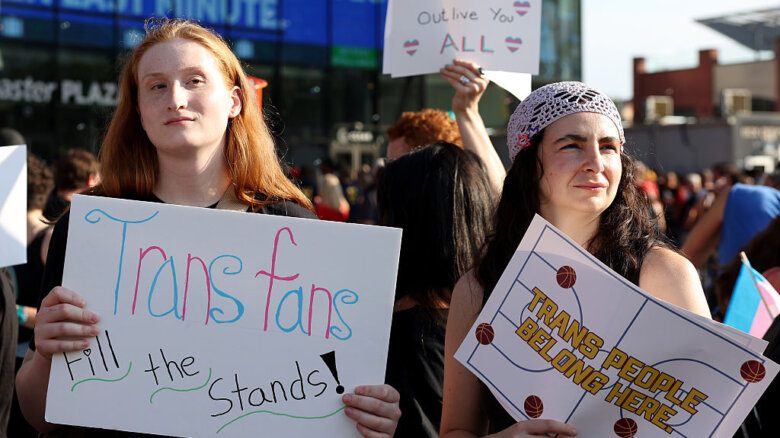
In January 2025, I got accepted to the Trans Youth Mentorship Program at The 519, an LGBTQ2S+ community centre in Toronto. I had freshly graduated from a journalism program, and I had immigrated to Toronto from Colombia three years and five months prior. The 18-week program promised to be an affirming space to learn skills and meet other young trans and non-binary people. But, most importantly, I thought it would help me get a job, because it promised a paid work placement at the end.
We had sessions on cover letter and resume writing, talks with trans professionals and access to mental health services—which were great. But near the end of the program, the program coordinator announced that some of The 519’s funding had fallen through, and none of us would get work placements.
My heart dropped. I was counting on this program to advance my career in journalism, communications or hospitality.
I wasn’t the only one. Fer G. Camacho, another program participant, told me they felt disappointed. Camacho is a non-binary dancer who immigrated to Toronto from Querétaro, Mexico, in 2017, and has been working gigs from teaching to bartending to pay their bills.
“I understand the grant system, and that is not something that The 519 controls, but it was definitely disappointing. I was really interested in a career with LCBO or IKEA since big companies like them have the possibility to give employees benefits,” Camacho says.
The problem of finding work is an intractable one for trans immigrants like myself and Camacho. The stats show that trans people already face low pay, harassment and discrimination, as well as job rejection and termination. For immigrants, add to that language barriers, a lack of Canadian work experience and racism. While there are programs designed to support trans immigrant workers, there’s not enough funding to go around. Some of that funding comes through grants available to nonprofits. Grants across Canadian sectors are generally short-term and support highly targeted activities, which means relying on them to fund programs that are crucially needed for people to get established and find jobs adds to the overall precarity LGBTQ2S+ newcomers experience.
Following the money
I decided to find out where the funding had gone.
The funding was supposed to be provided by Pathway to Possibilities, an employment organization that itself is funded by the City of Toronto, Government of Ontario and Government of Canada.
In the organization’s 2024 annual report, there’s a glowing testimonial from Bernardo Morais, coordinator of The 519’s 2STNB (Two-Spirit, trans and non-binary) youth programs, about the “early success” of their collaboration with The 519 . (Pathway to Possibilities’ 2025 annual report has not yet been released.)
Morais didn’t respond to emails about why the funding disappeared in 2025. But I was able to talk to Barbara McFater, the organization’s CEO of adult learning and employment programs.
“The funding didn’t exactly ‘fall through,’” she says. After three years of running successful programs funded by the Government of Ontario’s Skills Development Fund, Pathway to Possibilities’ proposal to continue those programs was denied.
No explanation was given to McFater as to why, she says. The Ministry of Labour told me that “application assessment details are confidential” and “the ministry is unable to provide individual feedback on submissions.”
McFater said funding is now arriving from a different program, newly launched by the Government of Ontario this year. She said Pathway to Possibilities would like to resume their collaboration with The 519 in the coming years, but it hasn’t happened yet.
Going beyond the barriers
Between getting foreign credentials recognized, weaving through visa and work permit rules, dodging discriminatory hiring managers and not doing it in your first language, job hunting for LGBTQ2S+ immigrants can feel like a maze.
So for trans immigrants, employment programs like the one at The 519 can make the difference between being endlessly ghosted by hiring managers and landing a great job.
Latoya Nugent, head of engagement at the LGBTQ2S+ refugee non-profit Rainbow Railroad, says there are three main barriers queer and trans immigrants and refugees face when looking for jobs in Canada.
First, there are language barriers: “Not everyone who arrives in Canada has proficiency in English or in French.”
Next, she says, “you can also imagine that LGBTQ2S+ refugees would not have expansive professional networks in Canada. And we know that sometimes, it’s through those networks that you are able to secure job opportunities.”
Perhaps most importantly, “a lot of employers in Canada are hesitant, sometimes reluctant, to accept foreign credentials or foreign experience.”
Across Canada, courts have ruled it’s illegal to discriminate against someone for not having Canadian work experience (with some exceptions for legitimate job requirements). Regardless, Nugent says, “a number of refugees have reported that this is what happens to them when they’re seeking employment.”
And legislation alone can’t undo a widespread culture of suspicion toward foreign experience, she says.
The numbers back her up: A 2021 ACCES Employment survey on barriers to employment for newcomers and racialized people found that the most common challenge they faced was not having enough Canadian job experience.
In response, Rainbow Railroad designed the Queer Refugee Internship Program to solve the catch-22 of needing Canadian job experience to get a job in Canada.
The paid 12-week part-time placement at Rainbow Railroad or another local non-profit hires people based on their work experience, regardless of whether that experience was in another country.
“So once they get that [Canadian] work experience the hope is that they can then leverage that to secure more long-term or permanent employment,” Nugent explains.
Luz Amparo Martinez is originally from the Dominican Republic, and is in the process of getting her citizenship after living in Canada for over 15 years. She interned in the Rainbow Railroad program in the spring of 2025, working as an event coordinator.
“It gives you an opportunity to excel and to believe in yourself,” she says. “So you don’t feel like, ‘Oh, I’m behind,’ because I can be in the front line.”
Her internship has since turned into a full-time job working for Rainbow Railroad as an administrative assistant.
YWCA Metro Vancouver is another organization supporting queer and trans immigrant job-seekers. As part of the organization’s free and ongoing Believe program, participants get unlimited career coaching and referrals to partner organizations like IKEA and Langara College that often hire from within the program.
Souvik Ray, the program’s manager, says it’s important to invite the partner organizations to meet the participants in order to get a sense of who they are beyond their resumes.
“Maybe there was just one typo in their resume, and then the employer is like, ‘No, I don’t want this person,’” Ray says. “So we’re still encouraging our employer partners to look beyond that and understand where these newcomers are coming from.”
A YWCA Believe participant who asked to only be identified by their initials, B.A., says the program played a major role in helping them get their first job in Canada. It also helped them figure out they wanted to enroll in studies to be a health care assistant.
Money, money, money
The system that delivers employment support for trans immigrants is far from stable.
It’s “under-resourced and often not designed with queer and trans refugees in mind,” says Curran Stikuts, director of advocacy and strategic communications at The 519. “There is also a major gap in long-term support. Many programs focus on initial settlement, but integration is a multi-year process.”
The 519’s refugee program has stopped accepting new applicants since last year, because there’s not enough staff capacity.
“We are also not able to secure additional government funding, as funding availability is limited and there is a clear shortfall,” adds Stikuts.
The Believe program gets funding from Immigration, Refugees and Citizenship Canada (IRCC). “We have received less funding for this contract compared to the funding received from IRCC for our previous contract,” Ray says. “Our current program is only funded for three years, compared to five years in the last cycle.”
Mary Rose Sabater, a communications advisor at IRCC, says the department’s shorter funding cycles are designed to remain responsive to changes in immigration levels, government-wide spending decisions and newcomer needs.
Ray says with more stable funding for the Believe program, the organization could do a lot more—like hiring someone to bring new companies into the partnership program, and offer them a wage subsidy for hiring LGBTQ2S+ newcomers.
He says he wants to see LGBTQ2S+ immigrant employment programs explicitly written into federal and provincial funding streams. Nugent agrees with this sentiment, adding that governments could encourage employers to hire queer and trans immigrants through tax benefits. Additionally, Ray thinks companies can pitch in to fund programs.
With any luck, The 519 will once again be able to promise the trans youth in their program a paid job placement. The new government funding that Pathway to Possibilities is getting includes money for training and employer incentives, says McFater.
She’s optimistic about the future: “We expect to be in a stronger position to re-engage The 519 by next year,” she says.
This story is published with support from the 2025-26 Ken Popert Media Fellowship program.

 Why you can trust Xtra