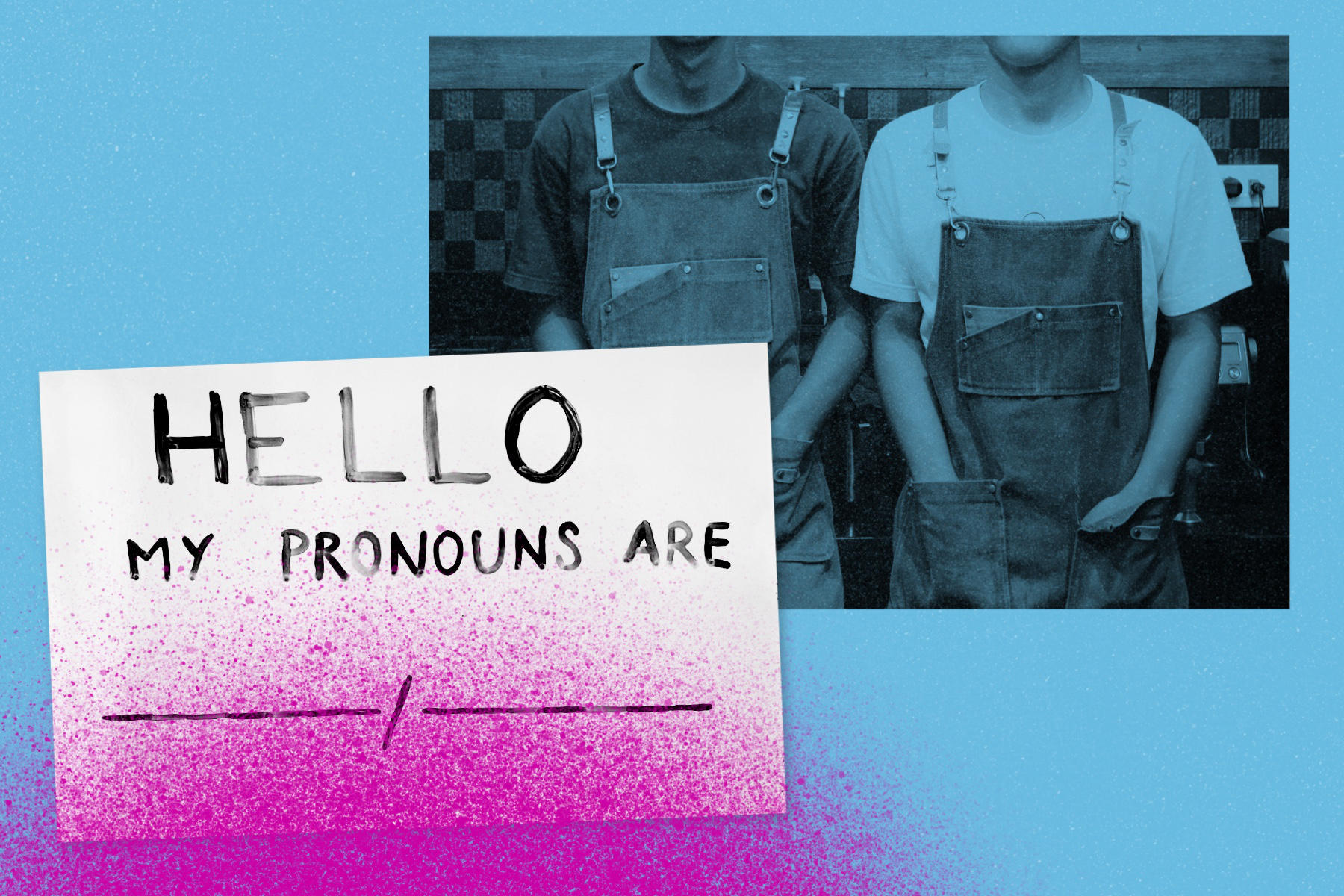
The meme says: they/them off, job on. It’s a joke, but it’s also a confession. The phrase started as a joke passed between non-binary service workers online—shared in Instagram Stories, screenshotted and dropped into group chats of baristas, servers and retail workers killing time between customers. As it spread beyond those spaces, it became something else; a shorthand for the quiet negotiations many non-binary people make at work, where survival, politeness and uniformity come before selfhood.
For many non-binary people working customer-facing jobs, pronouns are not just personal identifiers. They are workplace tools, negotiated daily in environments that demand speed, politeness and uniformity above all else. In these spaces, where the customer holds power and ambiguity is treated as inefficiency, some workers are forced to choose to temporarily switch off their non-binary identities.
When I was 16, I started using they/them pronouns. My teenage years were when I was arguably the most visibly queer: I had cropped, bright-pink hair, multiple facial piercings and I went to art school. Honestly, I was surprised when I was hired at McDonald’s. I was less surprised when they put me in the back, flipping burgers. I worked there for three months, but I never shared the pronouns I used in my personal life with my co-workers. It wasn’t that I stopped being non-binary during my shifts. It was that explaining myself felt like more labour than the job already demanded.
Service jobs leave little room for complexity. Workers are expected to be friendly, neutral and efficient at the same time. No one is supposed to stand out. Gender ambiguity disrupts that flow. Correcting someone takes time. It invites questions, creates conflict—and—for the many workers whose income depends on tips, hours or managerial goodwill—that risk can be too high.
Ash Salokhiddinova, who works as a server in Toronto, says they made a conscious choice to use binary pronouns at work early on. “I feel like coming out to my co-workers would just end up making me feel kind of humiliated and embarrassed,” they say. “I don’t like feeling that way about who I am, so I would rather just not share it with people that wouldn’t respect it.” Introducing themself as non-binary felt like inviting scrutiny they didn’t have the energy to manage, especially in an environment where being easy to work with often translates into being treated fairly by management and their peers.
Pronoun pins are often cited as a solution for trans workers in customer-facing jobs, but in practice, the non-binary workers I spoke to say that’s not an option for them. “We’re not allowed to wear any accessories on the uniform itself, so it never really occurred to me,” says Salokhiddinova, who works at a small, independently owned restaurant.
Even when pins are provided by the employer, as they are at Starbucks, wearing one can feel like an invitation for stares, questions and comments. “It’s a visual reminder,” says Seph Lagman, a thrift-store worker in Vaughan, Ontario. “It can mark someone as different in a space that rewards sameness, especially when only one person on the team is wearing them.”
This kind of visibility raises safety concerns, particularly as anti-trans violence is increasing in North America. Being read as trans at work can be dangerous, especially in a public workplace where you have no control over who walks through the door.
Outside of work, Lagman says they present very femininely, letting their long hair flow over form-fitting tops and skirts. While on the clock, they usually don a more masculine persona. “I really don’t see my work self as anything close to how I actually present myself,” they say. “There’s a lot of filtering going on. There are different people in these spaces and I just feel like the chances of me experiencing something scary are lessened if I’m not presenting how I usually do.”
Tahlia Santagato is a transmasculine, non-binary barista working in Newmarket, Ontario. They use they/he pronouns and, despite wearing a pronoun pin at work, they often get misgendered. They say they rarely correct customers about their pronouns—not because it doesn’t matter but because those interactions are fleeting. “A random customer is not worth the hassle [of correcting] because I’m just there to give them a coffee, not an education,” they say. The bigger frustration, Santagato says, comes from the co-workers who continue to misgender them despite knowing better.
Customers are strangers. Co-workers are not. When they get it wrong, or don’t try to get it right, it can feel less like a misunderstanding and more like a lack of respect. Several workers told Xtra about the weight of managing not only customer expectations but also the silence of co-workers who witness them being misgendered and say nothing.
Santagato, who says they present masculine both at work and in their personal life, also says, “My co-workers and my supervisors can be a little bit disappointing.” When managers or peers don’t intervene, the burden of correction falls back on the non-binary worker, reinforcing the idea that continuously having to ask for respect is part of the job description.
Sphynx Church, who has worked in the service industry in Montreal and Toronto, says that they started occasionally code-switching to conform to the hypermasculine, bro-culture attitude exhibited by some of their co-workers. “I have this very masculine persona when I’m working with cisgender men,” they say. “It removes some of the friction from my job when men just talk to me like a man.” This persona comes off with their uniform at the end of the day, when they can let their hair down and return to their more feminine, authentic self. While the switch is necessary, they say it also makes the stress of the job worse, which can be exhausting.
Lagman agrees, “It’s just harder. You have to deal with not only a shitty job and shitty pay but you also have to deal with the fact that you know you look different, and that people are thinking about it.”
This kind of code-switching is rarely acknowledged as labour for trans people. But it requires constant calculation of presentation, tone, language and safety. Over time, that compartmentalization takes a toll. Research on minority stress published in 2024 in the journal BJPsych Open shows that chronic misgendering and identity suppression are linked to increased anxiety, burnout and depressive symptoms among trans and non-binary people. In 2022, Trans PULSE Canada found that 59 percent of non-binary people are misgendered every day.
Church, who has worked in service for eight years, is proof that this line of work isn’t just a temporary stopgap for many queer and trans people. Discrimination in hiring and limited protections in professional fields often funnel LGBTQ2S+ workers into low-wage, customer-facing jobs. According to the Canadian government’s 2SLGBTQI+ Action Plan Survey, 74 percent of trans respondents said that they felt sharing their gender identity during the hiring process would reduce their chances of being hired at an establishment they don’t know to be LGBTQ2S+ friendly.
On paper, non-binary workers in Canada do have protections. Gender identity and expression are protected grounds under the Canadian Human Rights Code and in provincial rights codes, meaning workers cannot legally be fired or denied employment for being trans. In unionized jobs across the country, collective agreements often also include language prohibiting harassment and discrimination, and promoting respectful workplaces.
But these protections often rely on workers being willing and able to file complaints. In low-wage service jobs with high turnovers, few workers have the time, resources or job security to pursue formal action. Policies can mandate respect, but they can’t force cultural change on a floor where managers don’t intervene, co-workers are ill informed and customers are treated as sacrosanct.
Still, within these same workplaces, trans workers are finding ways to care for each other. For many non-binary people in service jobs, the safest space on the floor isn’t created by policy, it’s created by other LGBTQ2S+ co-workers who understand what it means to code-switch, to be misgendered and to keep going despite it all.
“I think there are lots of work environments that could really like you for who you are,” Salokhiddinova says. “Working at [my last job], there were a lot of queer people at work. A lot of the customers were queer. It was a super-safe and friendly environment.”
Santagato says there are small acts of solidarity that make a difference: a co-worker quietly correcting a customer, someone checking in after a bad interaction, a shared eye-roll behind the counter. “I just feel bad for correcting people, so I don’t—but I do have a few nice co-workers to do that for me,” they say. These moments don’t erase the stress of the job, but they can make it feel less isolating.
In an environment that demands assimilation, queer and trans workers often build their own pockets of recognition. This is proof that even when you have to leave parts of yourself at the door, someone else inside will know who you really are.
This story is published with support from the 2025-26 Ken Popert Media Fellowship program.

 Why you can trust Xtra