There’s a running joke online that gay people just make better coffee. It usually boils down to someone crossing their fingers that their barista has they/them pronouns, so their cold brew is actually drinkable. “I’ve definitely heard the joke and there’s a lot of truth to it,” says Kent Collins, owner of the Flying M Coffeehouse in Boise, Idaho. “Queer people are a huge part of coffeehouse culture—they always have been.”
At the intersection of Halsey Street and Malcolm X Boulevard in Bedford-Stuyvesant, Brooklyn, passersby are greeted by a hot pink sign welcoming them into Soft Butch, a trans-owned café. Antæus Mathieu, a co-owner, says that “ on the surface, it’s a funny, cute meme about how all your baristas are gay,” but there’s more to be said about job accessibility within the coffee industry. “It’s one of those skilled jobs that are both accessible to queer people and people who are [otherwise] marginalized because you can start on so many different levels.”
@velvetbby #stitch with @patty 💕 how do yall keep finding me #foryou #fyp #starbucksbarista #starbucks ♬ original sound – bee <3
Whether or not you buy into the playful stereotype, what’s certainly true is that the LGBTQ2S+ community has long-standing ties to the coffee industry. Coffee and tea have long been a way of creating community at a low-cost buy-in, according to Dr. Alex Ketchum, an associate professor at the Institute for Gender, Sexuality, and Feminist Studies at McGill University in Montreal who’s also the author of Ingredients for Revolution: A History of American Feminist Restaurants, Cafes, and Coffeehouses—which, she says, were primarily run by lesbians and queer women. She points to the “women’s music musicians”—a code word for lesbian artists at the time—who would work at Brick Hut Cafe, which was a lesbian-feminist establishment founded in the seventies in Berkeley, California, during off time between touring or recording. “ Not that all queer people are creative—I don’t want to generalize us—but there is this kind of tie [between the] artist community and cafés,” Ketchum explains.
Working in a LGBTQ2S+-friendly café can also lead queer people to form a chosen family with accepting co-workers, Ketchum says. That can be a major draw for those whose biological family shunned them due to their identity.
Visible queerness on the job
Lilith Taylor began working for Starbucks before she transitioned. She felt the space’s diversity created a “safe place to test the waters” with her gender expression. The store shift supervisor attributes that to the “cozy” nature of barista work. “ It’s intimate and safe as opposed to working at a bar where it’s more rowdy or working in a more conservative office environment,” she adds.
While it may appear that there are more queer and trans people working in coffee shops compared to other public-facing industries, that’s not necessarily true. It could look that way because many cafés have lax dress codes, potentially leading workers to be more visibly queer due to personal styling choices. “It might be easier to identify your non-binary baristas than you would at a corporate job,” Ketchum says.
In some cases, that is very intentional. “Even with being in Boise, we definitely don’t shy away from visibility,” says Collins. He proudly flies the Pride and trans flags year-round to ensure queer customers know they’re in a safe space. Plus, their gift shop stocks its shelves with 30 percent queer merchandise, including stickers, books, apparel and fans. “We’re definitely a gay destination in conservative Idaho,” Collins says. “I know it probably loses us business from some people, but it’s so important to me to represent our community.”
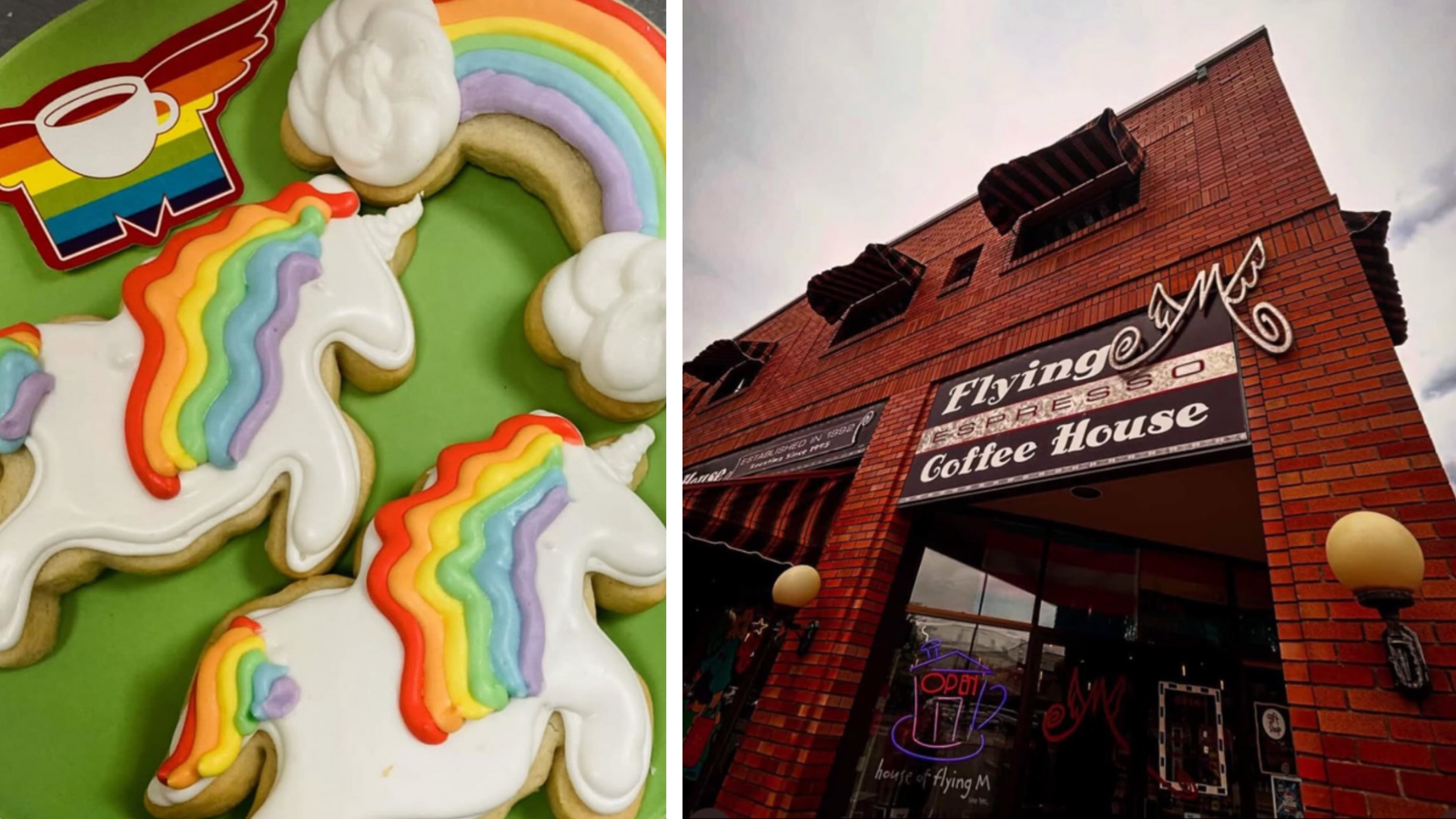
The Flying M Coffeehouse Credit: Kent Collins
But across the coffee industry, queer visibility is far from universally celebrated: at Starbucks, opportunities for self-expression are now being limited. Taylor, who is a rank-and-file member of Starbucks Worker United, a union made up of workers at over 640 Starbucks locations, has noticed that the dress code has become more strict since Brian Niccol took over as CEO in 2024. “ None of the managers ever really cared in the past,” Taylor says. “Now there are much more extreme punishments, or if you’re out of dress code.” The current Starbucks U.S. dress code policy states that employees “who come to work in violation of the dress code will not be permitted to start their shifts. Failure to adhere to the dress code may result in corrective action, including separation from employment.”
The corporatization of Starbucks employees leads to a more sterile environment for baristas and customers alike—a move that workers say is at odds with the chain’s brand, which has long been built on being an artsy, inclusive space. The union is currently fighting for a contract, and part of their demands include protection from discrimination over the presentation of employees, “which does seem to disproportionately affect queer people,” according to Taylor.
In 2022, before the chain’s union wave really took off, Starbucks changed the way gender-affirming care was covered in healthcare plans for eligible employees. “Procedures that used to be fully covered under the supplemental policy were now covered by a primary plan,” employee Neha Cremin wrote for USA Today in 2023. “This meant that workers were now unable to see their previous providers, and were instead being told to find surgeons in their state who were considered in-network. If not, workers were expected to pay the full cost of surgery upfront—a massive sum of money for what Starbucks previously covered.” Xtra emailed Starbucks to see if they made any changes to this policy, which they have not, but they wrote in 2023 that “[a]t no time has Starbucks taken away—or threatened to take away—benefits currently provided to any partner.”
“It’s one of those skilled jobs that are both accessible to queer people and people who are [otherwise] marginalized because you can start on so many different levels.”
To Taylor, it feels like management is nitpicking by focusing on certain forms of expression, like having piercings, and using it as an excuse to get rid of unionized employees. “Which does really alarm those of us at union stores, we feel like we’re under a lot of scrutiny,” Taylor says. The U.S. dress code policy says employees are only allowed one small facial piercing, no larger than a dime, and earrings and ear gauges must not be larger than a quarter. Facial gauges and “body adornments” including tongue piercings are not allowed. Canada’s dress code policies include that no employees in Quebec are allowed to wear any jewellery, including earrings and facial piercings.
Serving up sober spaces
Emmett Soldati, owner of the Totally Tea+Coffee cafés in New Hampshire, stresses the importance of queer cafés as sober spaces, especially for a community that has higher rates of substance use disorder than the general population. Coming of age in the ’90s, Soldati found that “ access to gay social circles was always convened and mediated through bars and alcohol.” In 2011, around the time he became sober, he launched his café with sobriety and queerness as its founding principles. He sees this as especially important to the under-21 crowd who want to explore their identities. “ I think cafés have really articulated themselves as this nuanced third space that put community as a primary driver rather than just intoxication,” Soldati says.
Hosting events is key to expanding these cafés’ impact. The Flying M sponsors Boise Pridefest every year, and sets up a booth at the festival. Soft Butch hosts events like queer reading clubs, trans clothing swaps and a leather political education series that gets into the ethics of the subculture. They also invite in Butch Monthly, a social gathering for butches. Totally Tea+Coffee puts on drag shows and queer speed dating. “ We’ve done a bunch of drag story hours,” Soldati says. “We got a little bit of attention a couple years ago because we attracted the attention of neo-Nazis. We’ve seen what it means to be very visible and explicit in your values through your programming.”
Mathieu says that it’s “a privilege to feel safe enough to” visibly own a queer coffee shop—even in a LGBTQ2S+ safe haven like Brooklyn—while feeling “a hammer come down on people with our identity.” At the same time, he believes fascism “is here” and that makes him more dedicated than ever to sustain the space for others. “ It fortifies me personally to keep trying to keep it open and really support the community for as long and as hard as we can—hopefully forever.”
 Why you can trust Xtra