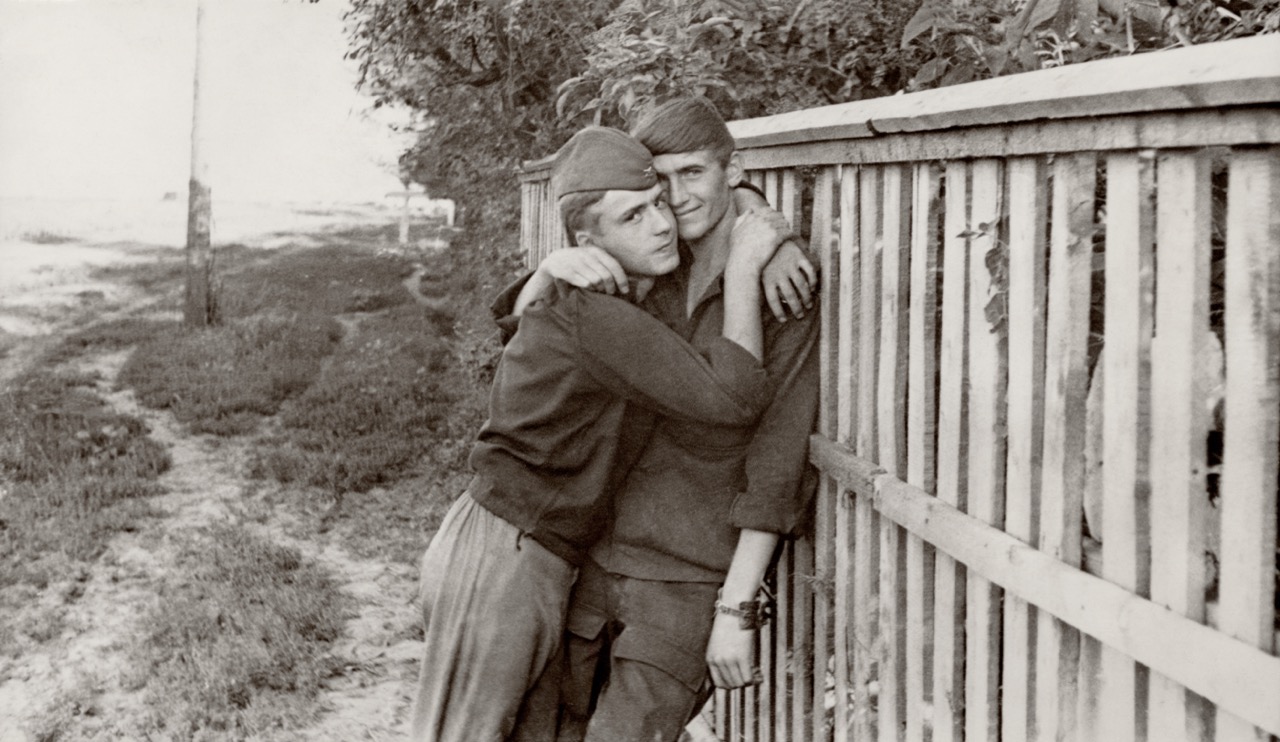
Five years after their first photo book, LOVING, broke ground by unveiling the lives of men who appeared to be in love from the earliest days of photography, Hugh Nini and Neal Treadwell are back with a follow-up, LOVING II: More Photographic History of Men in Love, 1850s-1950s.
The new volume expands on the original with more enigmatic photos of men from different contexts, classes and corners of the world, across a century not known for tolerance or diversity.
Xtra spoke with Nini and Treadwell about what’s new in this volume, what’s surprising about the lives of queer men in that era and what’s left to discover about queer history.
How did you start collecting these pictures?
Neal Treadwell: We found the first photograph about 25 years ago. We were just messing around on a Sunday afternoon in an antiques mall and I found the first one mixed in with a bunch of photographs of homes.
It was a really sweet photo. Two guys embracing each other, one from behind, standing in front of a home. We thought it was probably the only one that we would ever see. I think it was about 70 years old.
Every time we would find one, which wasn’t very often in the beginning, we would keep it. It wasn’t until about three, four, 500 into it that we realized we were actually collecting something.
Hugh Nini: When we would come across one, we were so surprised that it had ever been taken in the first place. This little piece of paper had lasted sometimes 100 years or more. We felt like we were in sort of a preservation mode, making sure these photographs didn’t fall into obscurity for any longer.
Has anything changed in terms of how you collect these photos since the first book came out?
NT: The price of these photos has gone up substantially because everyone wants their own. Some people have come to us, but we already had really good connections that are out there. We always saw that someone else would have a collection like ours.
Usually, they’re collecting what they would consider a cute gay man in a photo.
Credit: Hugh Nini and Neal Treadwell
Do you have a sense of who took these pictures?
HN: Out of a collection of over 4,000 photographs, we have only one story.
It’s from World War II. Two soldiers who are in our first book: Johnny and Dariel. So these two guys, they’re both from Texas, like Neal and I are. They met at basic training camp in Oklahoma in 1942. They belonged to, of all ironically named divisions in the U.S. Army, the Rainbow Division.
Johnny was diagnosed with muscular dystrophy at the end of the war and lived his life in a wheelchair with his mother, next door to his sister and her sons. In 1992, he invited his nephew, who was 17 at the time, over to the house and said, “I’ve got something for you and you can’t tell Grandma and you can’t tell your mom about it. It’s this shoebox—please keep it safe after I’m gone.” For a long time, the nephew never looked in the box, didn’t know what was in there. It was 20 years later that he, out of curiosity, opened it up and found all of these photographs of his uncle and the other man.
What’s different about LOVING II compared to the first book?
HN: In book two, we did four things.
NT: One was the versos [writing on the back of the photos]. Some of the better ones, we put in there. One is, “My dandy Uncle Declan and his boy homosexual.” We think a niece probably wrote it on the photo. There’s one of two guys; one’s pushing the other in a wheelbarrow with a little girl, and it says, “My boyfriend pushing Shirley and I.”
HN: The other thing we did was we included people who apparently identify as female. We have about four photographs, I think.
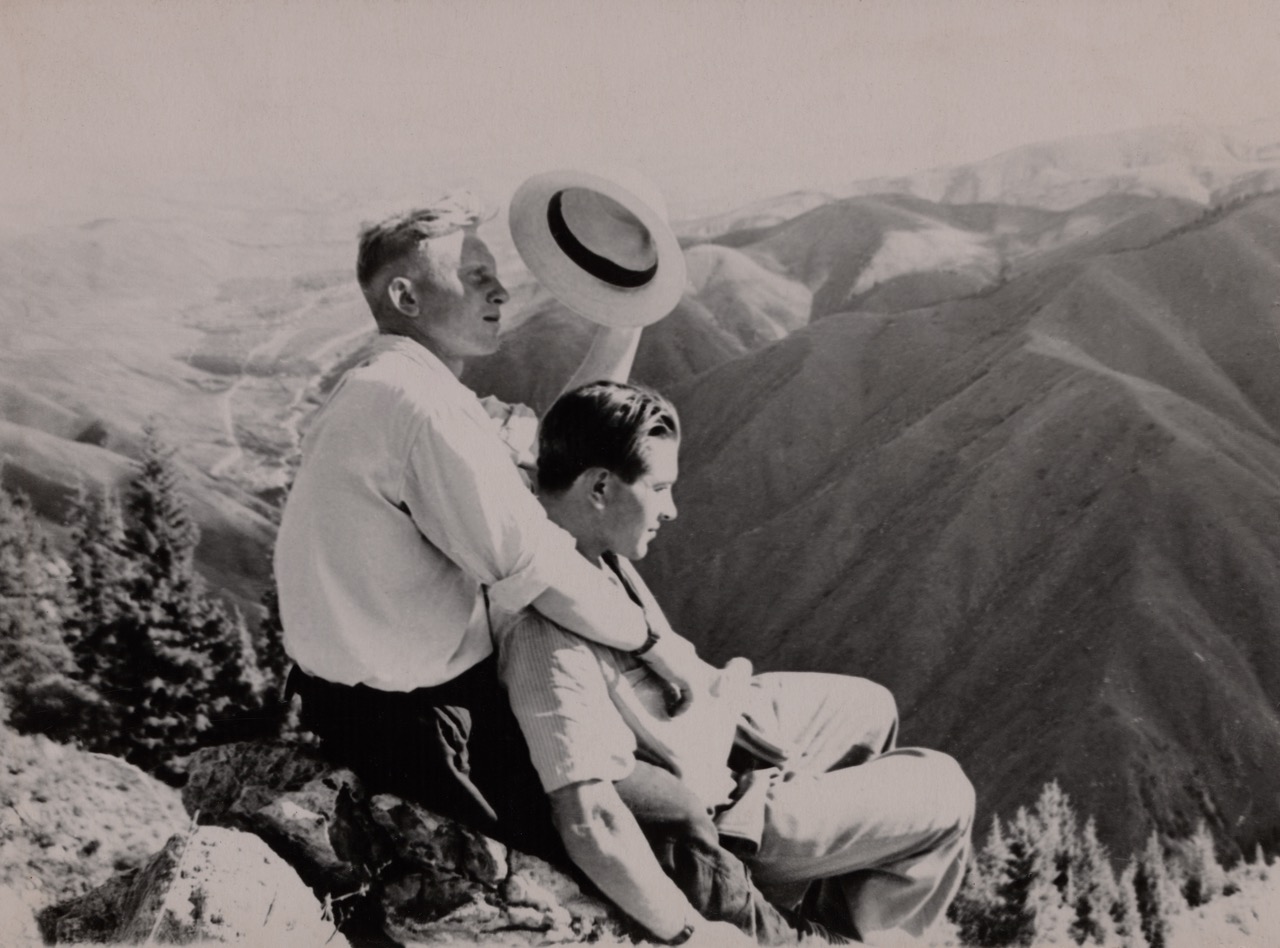
And then the third thing: we started to notice a pattern. At first, we thought we were getting photographs that weren’t taken very well, the guys would be looking away from the camera or something like that. And then we realized that was actually intentional on their part. They were taking photographs of themselves as a couple, but they were doing it in the safest way possible by not looking into the camera and showing their faces.
And the fourth category is that we included some photos that we would consider a little bit frisky. Not by any means porn or soft porn or anything like that, but they display some sexual energy, whereas we focused more on romantic energy before.
Do you have a sense of what people were taking these photos for, or what people were doing with them? Were they storing them? Were they displaying them?
NT: We can only guess based on the condition of some photos that obviously look like they were kept in a wallet or something and were taken out so they’re a little damaged. Others are pristine and they do have a mark around the edge, so it looks like they were kept in a frame. We have one beautiful cabinet card that’s probably from the 1870s. [A cabinet card is a style of photo popular in the late 1800s that was mounted on cardstock for display.]
HN: Most of them probably needed to be hidden, we would think.
NT: The fact that they had to go through several hands, some over 150 years, to make it to us …
HN: We used to say to ourselves, “It was so much worse back then.” But for these guys, that’s not really true. And I think that people overstate how terrible it was back then, but they also overstate how wonderful it is today.
Back during those days, a gay couple was not a sermon in a church, a gay couple wasn’t a political argument.
And our collection seems to say that there was a period between the 1890s and the 1920s where there was a relative abundance of freedom and joy that didn’t exist, at least we can’t see that it existed, before that.
Credit: Hugh Nini and Neal Treadwell
What about the material conditions of actually taking these photos? Because certainly in the 1850s and early 1900s, cameras weren’t as common as they are today. You’d need someone to take and develop pictures, not to mention the cost. Do these pictures give you a sense of who had access to that?
HN: You might be surprised to know that you could take a selfie as early as 1902. There was a device that was invented called a Faries Shutter Tripper. It’s a hose that connects to the shutter of a camera, and at the other end is a squeeze ball. You squeeze it and it takes a picture. We have a photograph of what we call the first romantic male couple in a selfie taken around that time.
Photography was rare back then and when you took a photograph, it might be only one of a handful that you would take during your entire lifetime.
When you have these powerful feelings, when you meet somebody and you fall in love with them, like everybody else, you want to preserve that somehow with a photograph. It’s a normal human impulse. These guys, since they’re normal humans, had the same impulse, and therefore did the same thing that everybody else did.
NT: There was a period between around 1860 up to 1900, where there were photographs on pieces of tin. If you’d go to the county fair, there was always someone there who was taking photos that way. There’s no negative. So if you did a quick sleight of hand or something, or there was a cute photo with your boyfriend, there’s only one of them.
One of the interesting things about the LOVING series is that it’s locating a history that a lot of us assumed didn’t exist or wasn’t recorded. Do you think there are gaps that are still to be filled in the record?
HN: Well, it’s interesting. All of those other things, homosexuality, cross-dressing, drag, whatever you want to call that, criminality. Those have all been covered extensively in books and been out in the open. It was this one thing, this romantic aspect that, you know, was a little too real for most people to handle, and that’s the one that was kept hidden.
You have a few photos of Black couples, but the book does feel overwhelmingly white.
HN: Money always gives you more access to everything, doesn’t it? Between the 1850s and the 1950s, African-Americans had the least amount of money, the least amount of resources, the least amount of everything. Neil and I have collected every single photograph we have found of Black or biracial/interracial couples, and the number out of 4,000 is about 20. The photographs are not out there. We would have seen them if they were.
But if a Black couple or an interracial couple had that look of romance and love in their eyes, we grabbed it, and those photographs are often very expensive because they’re so rare.

Credit: Hugh Nini and Neal Treadwell
Has anyone approached you about preserving your collection in an archive or a museum or anything like that?
HN: It’s been in the conversation.
Our collection has been exhibited in Switzerland and will open in Australia this month. It is at a museum there and it’s going to tour Australia for about probably a year or two and we hope then it will come to the United States.
I think in our dreams we could imagine the collection or parts of it in the MoMA or something like that on a permanent basis.
Where does this go from here? Is there going to be a LOVING III? Are you still collecting these photos?
NT: Yeah, we still have our eye out all the time.
HN: We have plenty of photos for a Loving III.
This interview has been edited for length and clarity.

 Why you can trust Xtra