For most, getting ready for a night out at The Rocky Horror Picture Show might involve a trip to the dollar store for toilet paper, toast and playing cards, or a few last-minute costume and makeup flourishes. For some disabled fans, it also involves a thorough investigation of the venue.
Will theatre staff and audience members be wearing masks? Will the house lights be on, off or dimmed during the show? How many stairs are there between the theatre and the bathrooms? Is there a working elevator? Have the event organizers bought or borrowed a HEPA filter in order to make sure the air is as clean as possible? Will the performance be amplified, or captioned or have live interpretation?
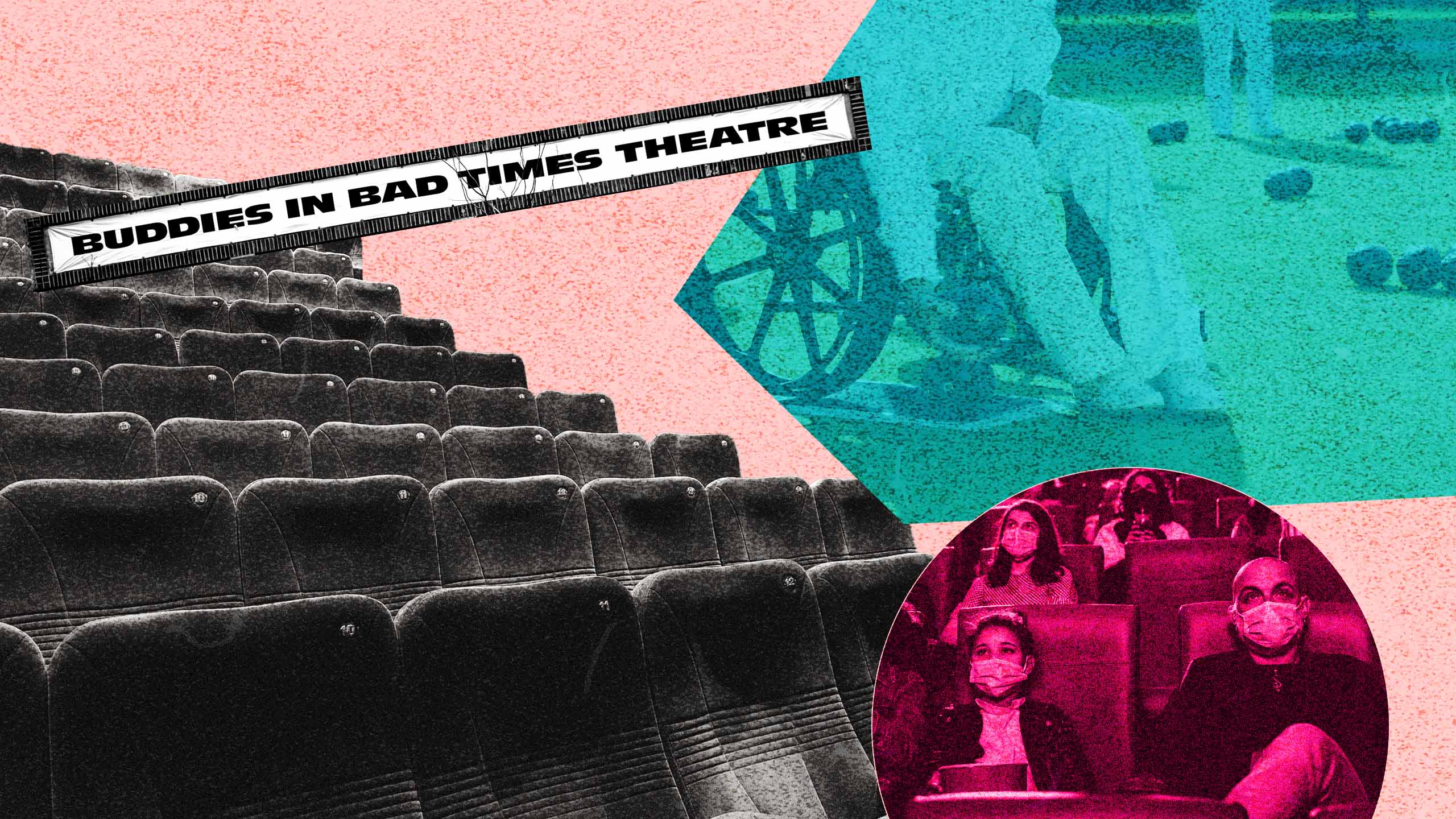
For Keat Welsh, a queer and disabled activist and educator based in Toronto, these were some of the questions on their mind as they got ready to head out to a Deaf shadow cast screening and live performance of Rocky Horror at Buddies in Bad Times Theatre last October, hosted by local arts organization the Disability Collective.
The event “was a really cool mixture of disability and queerness—I was blown away,” recalls Welsh. “Not only was it a very iconic queer culture thing and a Deaf shadow cast, and they put the money into Deaf performers, but it was also a masked event. They had financially accessible tickets, as well as reserved seating for people who needed seats where there were no stairs. The Disability Collective also made little videos showing how to get into Buddies in Bad Times, so you could view what it was like and how to get around if you had never been there.
“As disabled folks, we know that going to any place requires prep work, and they did all this prep work for you, and one hundred percent that made a difference for me being able to be in this space.”
Whether we’re getting together for a night at the theatre, a picnic in the park, a walk downtown or a crafting meet-up at a makerspace, queer communities can grow, thrive and put down deeper roots when we are able to connect and find each other in all sorts of places.
But when there are few options for what these gathering spaces can be, or when these spaces are all set up and organized along similar lines, “community” becomes as small as “whoever is able to get through the door and up the stairs to the local gay bar” … or, say, “whoever is able to comfortably spend hours outdoors in the middle of a big crowd, in the summer heat, with few places to sit down and loudspeakers blasting different music around every corner at the Pride parade.”
Heather McCain is the executive director of Live Educate Transform Society (LET’S), a disability advocacy and education-focused organization based in British Columbia.
They say that making queer third spaces more accessible to disabled people is both a recognition of the full spectrum of our community, and an act of love and solidarity.
“As queer people, we have fought to have visibility and access and recognition,” says McCain. “It’s hypocritical of us to say ‘Oh, well, it’s too difficult to make these spaces accessible to disabled people.’ And unfortunately, what happens is that disabled people are forced to put their bodies, minds and senses into dangerous positions or push themselves beyond their limits or make their own health worse by going into inaccessible spaces. Or, we are leaving people out of our community who want to be an active part of it. And that is not something that I want to see continued.”
McCain says venues and organizations can “start to make accessibility in smaller ways”— offering low-sensory spaces, scheduling some events where masks are required, making plain-language versions of info sheets, for example—“that still make a significant impact for people.”
“We don’t want to leave out community members who have already been pushed to the margins and had their experiences be ignored and gaslit and treated horribly by the systems they’re having to navigate—I don’t want them to feel that from our community,” says McCain, “and that is part of why I believe that imperfect accessibility is still better than no accessibility.”
In Saskatoon, Saskatchewan, Shannon Mallory is navigating some of these same questions as they bring their dream of building a communal makerspace to life.
“I used to think that my hobby was collecting other hobbies,” says Mallory. “And then my therapist was like, ‘So, there’s a diagnosis for that,’ and it turns out I had ADHD. I was diagnosed with that and found out I was on the autism spectrum too.
“And because I dabbled in a lot of things, I acquired a lot of different skills and tools and materials, and I knew I couldn’t be the only one; there’s no way in hell. A lot of my friends are the same way.”
At the Nefelibata craft lab, people can come together and work on their art and crafting projects, try out new tools and materials without having to spend a lot of money or simply hang out and exist around other artsy, creative people. When Mallory took ownership of the space in 2024, accessibility was top of mind.
“The Venn diagram of ‘people who are artsy and craftsy’ and ‘people who are queer’ and ‘people who are disabled’ all have a lot of overlap—that’s just how things tend to be,” they say. “The ‘queer’ part is just showing up as myself, and therefore that is inherently what this is.
“And I feel so strongly that, for a large portion of society, when it comes to accessibility and making things accessible, the bar is on the floor—though don’t put bars on floors, because that’s not accessible,” adds Mallory, who is also a standup comedian.
When it comes to making spaces more accessible to more people, Mallory says some problems are harder to solve—their space is in a hundred-year-old building and its doors aren’t wide enough for most people who use power wheelchairs—but there is also plenty of low-hanging fruit, like having folding chairs and pop-up tables for people to sit down if they want or need to.
“I’m always thinking of what else I could do. Should I offer sensory-friendly hours? I hate being in the big light sometimes too, so that’s doable. When should I have the music on, or turn it down? How can I make it easier for you to be here? [There are] so many simple things that cost you nothing and gain you everything.”
Welsh, who also leads training and workshops around disability and accessibility, says organizers need to keep in mind that there is no single tool, change or adaptation that will make your space accessible—“similar to gender, disability is not binary,” they say, and that some people’s access needs won’t mesh well together or simply can’t coexist in the same space at the same time.
A classic example of this situation—often described as “conflicting access needs,” “competing access needs” or “access friction”—would be if somebody with a service dog and somebody with a severe allergy to dogs both want to go to the same event.
Rather than ticking off items on a checklist, Welsh says, real accessibility is about expanding the options for what kinds of access exist or could exist in your space, and being as open and up front as possible about what you can and can’t do.
“Oftentimes, when we think of disability, there is a very narrow idea of what disability is: We often think of it in terms of, say, ‘people who use wheelchairs.’ And I happen to be one of those people who uses a wheelchair sometimes—I mostly use a walker—but what is really important to me in this work is actually expanding definitions of disability,” they say.
“[And] when we talk about queerness and disability, something that is really important to me is: just like queerness, where we’re inviting people in, maybe disability can be similar. Everyone is welcome. Everyone is welcome to be on this big spectrum of disability.”
No one space can offer every access option at every moment of the day, Welsh says—the lights can’t be both on and off at the same time—and some spaces can’t offer some options at all, such as older buildings with narrow hallways, steep staircases and no elevator.
But when people make the effort to lay out all their accessibility options so others can make an informed choice about when and whether to attend, and keep trying to expand the menu of what options are available in that space, Welsh says that is “more than half the work” already done.
“It tells me that I’m welcome,” they say. “It tells me that they want me there; that they want people like me, that I am thought of intentionally. They value that I exist. They think I am a valuable part of community.
“And it goes both ways: Intentionality around disability from queer spaces, and also intentionality from disabled spaces around queerness. Having gender-neutral bathrooms, saying your name and pronouns, and things like that is a form of access, right?
“When disabled spaces do that, it also signals to me that ‘your intersections are welcome here.’”
When Heather McCain talks to queer venue owners, organizers and event planners about accessibility improvements, they don’t shy away from the labour involved—“it does require work”—but they say the impact of these changes is worth the effort.
“Last year at Victoria Pride, we had a low-sensory space,” McCain says, as one example. “And the very first person who came into the tent was someone who was having an anxiety attack all the way to Pride because it was their first time being out and at a public Pride event, and their best friend. And as soon as they walked into the low-sensory space, they burst into tears and said, ‘Oh, they do want me here.’
“Because they saw that this space had been made for them, and their attendance and identity had been thought of in advance and planned for, and their needs had been met.”
 Why you can trust Xtra