So much of queer culture happens at night.
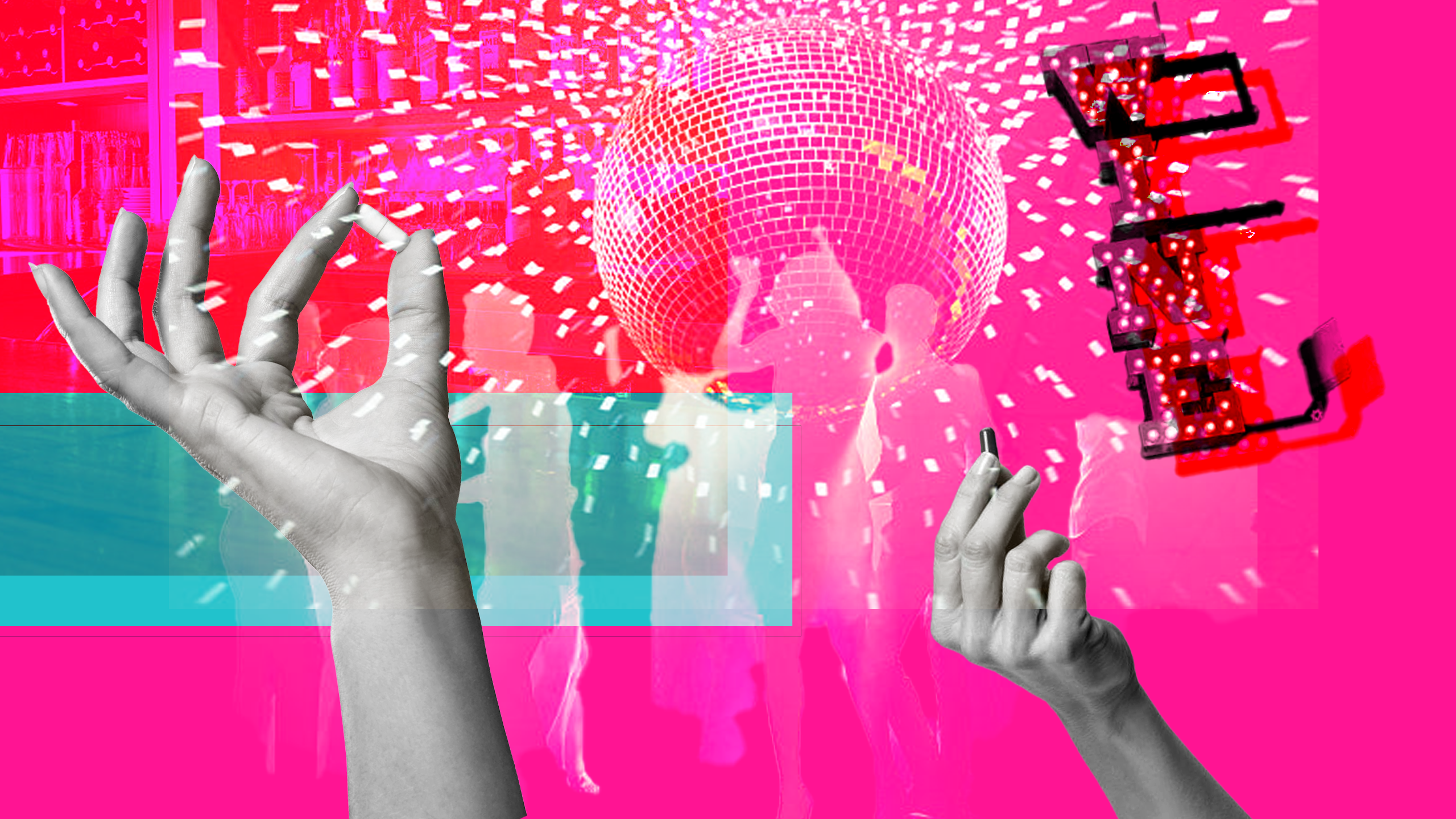
It’s bodies—sweaty, glittered, exposed—writhing under disco lights. It’s cruising at half-lit bars, sending eyes at someone across a sticky panelled floor. It’s queer bowling teams, T4T speed dating, “gaymer” nights. Even daytime socializing—run clubs and sports leagues—comes with the promise, or rather incentive, of rubbing elbows when the sun goes down.
The spaces these events happen in—bars, clubs, converted warehouses—have a close association with drugs and alcohol. It’s access that we’re certainly taking advantage of. According to the national non-profit Community-Based Research Centre’s Sex Now survey, the largest health survey of queer and trans people in Canada, more than three quarters of 2024 respondents say they’ve engaged with substances in the past six months.
But to get a real sense of the prevalence of substances in the queer and trans community, only hold it up against their straight cis peers. Comparing Sex Now to 2023 Statistics Canada data from a 12-month period, LGBTQ2S+ people are more than twice as likely to binge drink, four times as likely to use cocaine, six times for ecstasy use and 12 times for meth use. These figures may be even higher, as Stats Canada tracks a full year vs. six months.
This overlap between queerness and substance use is a Western phenomenon more than a Canadian one. Three in five gay, lesbian and bi Americans struggle with illicit drugs and two-thirds struggle with alcohol use, notes 2020 data from the U.S. government’s agency for substance use and mental health. That’s compared to only five percent and 12 percent of the general U.S. population for drugs and alcohol, respectively. Likewise, a 2023 U.K. study found that queer and bi adults were four times more likely to take drugs than straight people.
Beyond the statistics, this excessive use is felt in the community. Invitations to socialize often come with questions about “pres” and “afters”—places to drink and take drugs before and after the actual night out. Lines for bathroom stalls grow as keys and bags change hands. Dealers are as likely to make drop-offs as Uber drivers.
It’s part of why there’s a concerted effort to create more sober spaces for queer and trans people—whether you’re in addiction recovery, struggling with cutting down or one of the growing number of “sober-curious” people interested in saving money, getting better sleep and being healthier. But finding LGBTQ2S+ sober events can be tricky. For Dave Becker, a Boston-based gay man in his fifth year of sobriety, fostering sober connections can feel like hitting a reset button on how you form relationships.
“The beginnings of a lot of people’s gay social life is a bar or a club, because for years and years that’s the only safe spaces people had,” says Becker. “Coming out and alcohol and drugs are all intertwined—so it’s tough for LGBT people to start over; you have to relearn how to be a social person without it.”
Becker is the host of Sober Gay Sunday, a podcast inspired by his efforts to build a sober community in the Boston gay scene. It’s a challenge, he says. For starters, it can be hard to find inexpensive things to do. Axe-throwing or rock-climbing, while great, are more costly than a bar with a low or no cover charge. But the greater hurdle is people cancelling at the last minute, caught up in their own nerves about being in a social space while sober. Still, that shouldn’t deter people from trying and potentially bringing a friend to feel more comfortable, says Becker.
Of course, if you’re not able to attend a sober queer event, the presumed recourse would be going to a non-sober queer event and abstaining from drugs or alcohol. However, this too is fraught, explains Thomas Day, chair of the New York-based substance abuse recovery group Gay & Sober.
“Just being in that environment, hearing loud music or having the smell of the alcohol from a bar can be a trigger and cause them to go down a dark path where their friends and family may not see them for the next week,” says Day.
This is especially relevant during Pride celebrations, when the number of parties explodes and people are eager to let loose. In addition to smaller events and recovery meetings, every year, during New York’s Pride weekend, Gay & Sober hosts a large-scale event with wellness workshops, keynote speakers, social events and music performances that draws more than 500 attendees.
“There are a lot of people that want to have fun during Pride, but are scared to take that step because if they go out with friends that are not in recovery, they may end up slipping and relapsing,” Day says.
Though its roots and name stem from gay men’s desire to do Pride sober, Gay & Sober recently began to welcome all members of the LGBTQ2S+ community—recognizing that substances have become tied up with many of our social spaces, not just those for men. And with Pride being so busy, it can create tensions between sober and non-sober folks.
“If I go to a bar and I’m just ordering Red Bulls, waters or sodas, you have the other gays that are behind me pissed off because I’m not getting alcohol and I’m standing in their way, blocking their space,” says Day. “That’s why we like to create different parties that allow you to just be free, present and not get judged in those ways.” This pressure extends to Day’s own social circle. Even though he’s been sober for six years, friends will still sometimes offer to buy him a shot while at the bar—something that Day doesn’t let get him down. “I know I am powerless over everyone and everything except my own actions and feelings. If I begin to feel bad or have an urge, I can leave.”
But in spite of these pressures, Day encourages folks to remember what they gain with sobriety and resist external temptations.
“You gain more self-control, your self-esteem gets lifted up, you’re connecting with people you may not have thought are on your level. If you put your heart and mind to it, you can succeed in ways that you never thought you could before.”
But is going sober too much of a whiplash from the current state of queer and trans socializing? After all, it’s not as though there’s some biologically predetermined connection between queerness, transness and substances. Rather, our social spaces are configured these ways because that’s how we’ve built them.
It’s a historical context that culture and events producer Salman Jaberi appreciates and sees himself part of. Raving since he was 15 in London, U.K., Jaberi moved to the U.S. and became immersed in the underground electronic dance music scene.
“Electronic dance was founded in the 1970s and ’80s by the BIPOC and LGBTQ community as a survival code and an underground resistance driven by music, but mostly a space for marginalized communities to seek refuge and for safety,” says Jaberi. “Drug culture was woven into the fabric of these movements—not out of recklessness, but often out of necessity for experimentation, exploration, community and ritual.”
As part of this nightlife tradition, Jaberi launched Rave Scout Cookies—a platform that provides information and tools for raves, including resources on how to use drugs more safely.
His reading of drugs as ritual is very different from the more hedonistic one that dominates popular discourse. If you believe movies and TV, drug-fuelled nights are all about shedding inhibitions, making mistakes and hooking up. But as a community ritual, taking drugs is about more than pleasure, says Jaberi. It’s about bonding with your queer and trans siblings—a tool for tapping a vein into kinship and intimacy.
“Our dance floors have been long among the few spaces where people could show up as their full, authentic selves,” says Jaberi. “Part of a broader ecosystem of joy, music, freedom and chosen family. So substances aren’t really the focus, it’s the experience of belonging that is.”
Perspectives like these reorient drug use as a not solely negative presence in our community.
“A common misconception is that people think those who use drugs don’t care about themselves, and I feel like that is absolutely not the case,” says Kristin Karas, COO of DanceSafe—a non-profit that uses social justice principles to empower and keep rave attendees safer. DanceSafe members set up booths at events across the U.S. to share information about hearing loss, consent and, of course, harm reduction when taking drugs.
Karas says that while drugs get a lot of negative attention, they ultimately are a pathway for changing perception—in the same way that meditation or watching TV can be. This perception shift can be used for escape, like mindlessly bingeing a show to forget the day, or to engage in a new way of thinking and understanding.
“Drugs of many kinds have the ability to help people have a shift in perspective, and can help people to see themselves and connect with others—so they are very powerful tools, when used within the proper containments.”
It’s that last piece—the guardrails of taking drugs—that organizations like DanceSafe are trying to help people with, testing drugs at events and handing out clean tools for use.
Still, risks do exist in spaces with drugs compared to sober ones. Overdosing from excessive use is a common concern, but there are others. Many drugs on the market are mixed or tainted with harmful substances like fentanyl. Sharing needles, pipes and straws can pass on blood-borne infections like hepatitis C. Organizations like the Trip! Project in Toronto have been telling people at raves about these risks for the past 30 years—getting a unique historical context along the way.
“Harm reduction goes hand in hand with queer and trans liberation because of its deep-seated roots that go back to the AIDS crisis and beyond,” says Tito Duran, a peer outreach worker with Trip! As part of her role, she speaks with partygoers about testing their drugs as well as handing out clean supplies and other literature on safer use.
“Queer people, sex workers and people who inject drugs were abandoned by their government systems and left to care for each other—so they did, and that’s where formal harm reduction movements emerged,” says Duran.
The queer and trans folks who make up these groups, however, weren’t the only ones to champion early forms of harm reduction, Duran explains. Trip! also integrates Indigenous understandings of safer drug use. For instance, while most of today’s harm reduction approaches are based on principles like prevention and treatment, Indigenous-led frameworks also include priorities like self-determination and sovereignty.
In other words, there’s a deeper emphasis on listening to people who use drugs, following their lead and giving them what they want—not what you think is best. “At the end of the day, we just need to meet people where they’re at instead of isolating people,” Duran says.
Such an approach in queer spaces can help people enjoy drugs in a way that’s more aligned with why we have those social spaces to begin with—to connect, relax, have fun and become more attuned with our bodies.
That’s really at the heart of what many of the event organizers, community workers and ravers Xtra spoke with said—it’s all an individual assessment. For some members of our queer and trans community, sober spaces are a lifeline and should be supported, not judged. For others, sober events limit their desire to transcend the self, and rather than finger-wag, we should provide the spaces and tools to engage with altering substances appropriately.
Like Jaberi and Duran say, LGBTQ2S+ people are historically good at creating spaces customized to our specific needs. In a time when queer and trans social spaces are closing—sober or not—that’s a legacy we should lean upon.

 Why you can trust Xtra