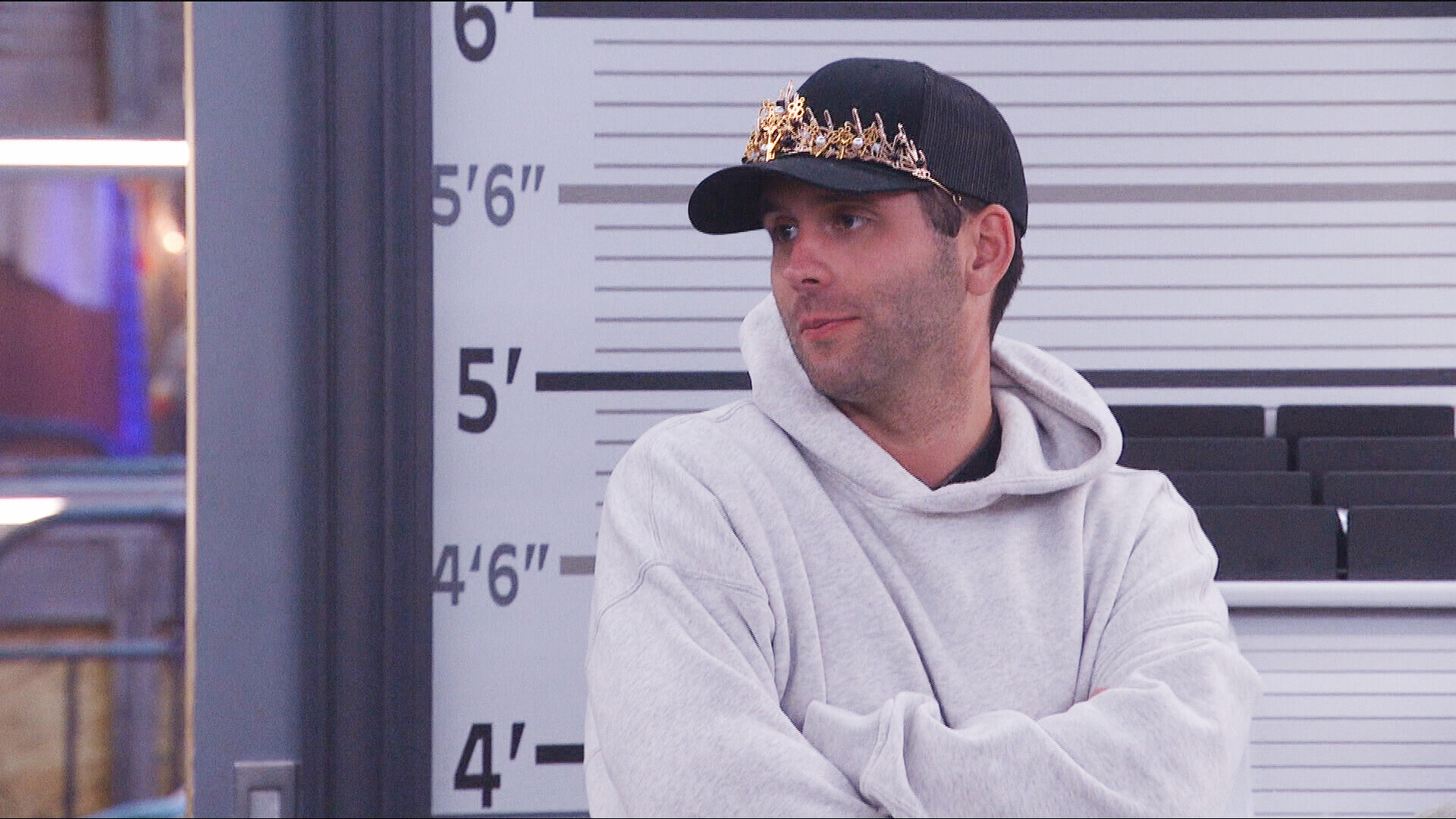
Jimmy Heagerty is bringing gay villainy back to the Big Brother house. He’s starting drama and picking fights. He’s running his Head of Household reign with a clear understanding that he is in the spotlight—Main Character Energy out the wazoo. He’s got all kinds of Drag Race and Real Housewives quotes in his speeches (though he could probably stand to cite his sources more). He’s being praised for being a throwback kind of gay character by the only out gay male winner of Big Brother, Andy Herren, on X.
Point being: Jimmy is making for good TV. And for the many queers who watch Big Brother every summer, being captivated by not just three episodes of TV a week, but also the 24/7 live feeds, it’s great to have some truly fun LGBTQ2S+ representation on TV. Unfortunately, Jimmy is also one of the only out queer houseguests on this season—a position that gay, lesbian, bisexual and trans players on Big Brother find themselves in all too often.
For the uninitiated to the months-long game of Big Brother, every summer, roughly 16 houseguests (17 this year) move into a house and aim to be the last one standing. Every week, they battle for power in Head of Household competitions for safety and the ability to nominate two of their fellow players to be eliminated or“evicted,” in the show’s parlance. Other competitions like the Power of Veto and BB Block Buster battles can help players survive, but at the end of each week, two are left vulnerable and their fellow houseguests vote for one to go. This happens weekly until just two remain, and a jury of eliminated houseguests vote to determine which will win a cool $750,000 grand prize.
Like fellow CBS strategy reality show Survivor, Big Brother has grown a significant queer fan base over time. Unlike Survivor, however, we haven’t really seen a change in casting to reflect that. While sexuality and identity are amorphous and often-changing things, making any kind of accounting of how many LGBTQ2S+ contestants are on any given season difficult, there are very few examples of seasons with more than one or two members of our community.
This season, along with Jimmy, there’s Ava Pearl, who has identified as bisexual. Last season, there was only Kimo Apaka as an out gay man and Leah Peters as a bisexual woman. In most cases, like in these ones, if there are multiple LGBTQ2S+ contestants cast, they are romantically and/or sexually incompatible, either because of their differing identities (gay man Hisam Goueli and lesbian Izzy Gleicher from Big Brother 25) or because they’re in exclusive relationships (gay man Michael Bruner and bisexual Matt Turner from Big Brother 24).
These factors combine to produce a couple of different truths for LGBTQ2S+ houseguests on Big Brother: they are often in very limited company as queers, and the potential for queer “showmances”—the show’s term for romances during the season—is slim to none. As a result, by very virtue of their sexuality, queer houseguests cannot have the same experience as their straight competitors.
For their part, Jimmy and Ava have not been struggling to assimilate to a largely heterosexual house. While Jimmy has allied more closely with the women in the house—a well-worn trope of shows like this—he has many straight male allies and gets along with them regardless of differences. However, as queer people, we understand that there’s a comfort and ease that comes with being around other queer people. There’s no need to code switch, or explain things. It’s a natural understanding that can’t be quantified, but can easily be noticed. (For a great example of this, I highly recommend MTV’s Are You the One? Season 8: Come One, Come All, an all-sexually-fluid season of that usually hetero dating show that spent little time explaining queer concepts to straight audiences—because the contestants themselves didn’t need to explain to each other.)
Consider it the queer version of straight men having enough fellow dudes to bro down with, or a house having enough Black houseguests in it so that those players aren’t forced to constantly code switch. We can’t say definitively that Jimmy would be acting differently if there were more gay men in the house—because we haven’t seen Jimmy around other gay men. We don’t even have the option, nor does he. Similarly, while Ava is earning new fans left and right online for her excitable, eccentric behaviour on the live feeds, might she be even funnier with other queer women to bond with?
The showmance element is another beast entirely. In American Big Brother history, there has been exactly one gay showmance: Frankie Grande and Zach Rance in Big Brother 16, aka Zankie. On the show, Zankie was played for laughs, as Zach identified as straight. It wasn’t until years later that Zach came out as bisexual and admitted that, yes, after the show, the two had hooked up. That’s our one queer showmance in 25 years. (The late, great Big Brother Canada was much better about this, featuring two separate winners who had queer showmances during their seasons.)
While, yes, there’s a simple desire just to see some queer romance on our favourite show—we’re only human!—there’s also a strategic downside to showmances not being an option for queer houseguests. Put simply: a showmance can be a major advantage to one’s success in the game of Big Brother, and that strategic option does not exist for queer people in the current state of casting.
Think of it this way: Will Kirby, Lisa Donahue, Drew Daniel, Mike “Boogie” Malin, Jordan Lloyd, Hayden Moss, Rachel Reilly, Nicole Franzel, Jackson Michie and Taylor Hale were all featured in significant showmances during their seasons—and they all won. Hell, Big Brother 4 winner Jun Song had an IRL ex in the house! That’s 11 winners out of 26, many of whom can directly credit their partner for major progress in the game. Again, that’s just not an option available to most queer houseguests. The only instance outside of Zankie that I can remember where casting made it even possible for a queer showmance to happen during the show was Big Brother 9, with Joshuah Welch and Neil Garcia. However, that was quashed when Neil quit the show just one week in.
This all gets even worse when you consider trans representation on the show. The one and only out trans person to be cast on Big Brother in the U.S. was Audrey Middleton in Big Brother 17. That’s it. A decade has passed, with all kinds of progress for trans people in America, and there have been no other trans houseguests. (Interestingly enough, Big Brother 17 was something of a watershed moment for the show, as the cast featured three LGBTQ2S+ people: Audrey plus a gay man [Jason Roy] and a lesbian [Vanessa Rousso]. By my accounting, that has only happened one more time since: Big Brother 23, with gay man Derek Frazier and bisexual women Claire Rehfuss and Sarah Beth Steagall.)
All of this stands in such stark contrast to the audience of Big Brother itself. Look on any social media platform and you’ll find a flood of LGBTQ2S+ fans eagerly posting about the show. Routinely, fans look for signs that houseguests might be secretly queer—usually not out of malice, but a true desire to see more people like them on the show. (The speculation around one houseguest this season, first-boot Zae Frederich, got so large that Zae himself commented on it to dispute the rumour.) Once in a while, you’ll even see a spam post announcing Big Mother, a possible-but-ultimately-fake version of the show with an all-drag queen cast. While the primary desire for that would be to see the big personalities from RuPaul’s Drag Race hamming it up in a different format, it would also be nice just to see an all-LGBTQ2S+ cast.
I don’t want to dismiss the value of having the queer representation we do have in an otherwise straight cast. In times where it can feel like acceptance of LGBTQ2S+ people is regressing, there is something genuinely heartwarming about a Christian baseball player like Zach Cornell eagerly welcoming Jimmy giving him a lap dance. That’s a situation that not all that long ago likely would’ve triggered gay panic and hurt feelings—so I do want to celebrate progress where progress is made.
But I’d like to think we can have it all: have Jimmy be able to mix it up with the bros, but also have a cute gay guy he can flirt with, or a non-binary pal to kiki with about the other houseguests. Ava’s in a relationship outside the house, so a showmance isn’t possible, but I’m sure she’d flourish with at least one other queer woman as a friend and ally. LGBTQ2S+ contestants aren’t always going to work together, or even get along. But it would be nice to even allow for the possibility.
As part of a twist this week, Big Brother 20 champion Kaycee Clark, the first and only out gay woman to win the show in the U.S., came in to play the Power of Veto competition with the current cast. Since Head of Household Jimmy and picked player Ava were both in the competition, for one brief moment, Big Brother 27 featured queer people as exactly half of the six who were competing for the Veto. It was a peek into a different kind of casting world—and oh, what a world it could be!

 Why you can trust Xtra