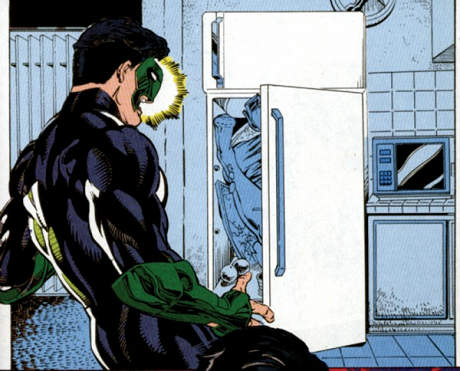
In the parlance of comics, the “Woman in Refrigerator” is roughly as creepy and literal as it sounds: it’s a term for a female character (usually a love interest of the male character) who is killed, raped, brutalized or otherwised stripped of her power for the sake of creating a catalyst for the protagonist to move the plot along. The name originates from Green Lantern #54, in which Green Lantern Kyle Rayner returns home to find his girlfriend Alex DeWitt killed and stuffed in the fridge by one of his nemeses. Generally speaking, the “Woman in Refrigerator” bit is a lazy and rather misogynistic plot device.
In one of those oddly full-circle moments that comes only from a carefully plotted out narrative arc, it seems the newly out-and-proudly gay Green Lantern, Alan Scott, is getting his own proverbial WiR, as a preview of Earth 2 issue #3 shows that Alan Scott’s new fiancé is set to be offed via exploding train. Admittedly, I’m not too keen on the development, but at least “exploding train” is original, I guess.
When we last left the alternate reality of DC Comics’ Earth 2, wealthy jet-setter Alan Scott’s proposal to his boyfriend Sam literally blew up in his face. Their train erupted in flame, tumbling wildly off course. Amidst the confusion, Alan is certain that some of that fire is an otherworldly green. But how could that be possible? The Apokolips War is long ended, and life is supposed to be returning to normal. What caused this horrific explosion? Did anyone make it out alive?
With this preview of next week’s Earth 2 #3, it appears that Alan is the sole survivor of the explosion. Sam is gone. (From iFanboy)
Look, I have no problem with writers inflicting devastating life events on a character for the sake of creating dramatic tension and writing a better story. That’s fine; what I’m less hot on is a writer essentially dicking their character over and killing off supporting players because they couldn’t think of anything else. Think of it this way: remember when Buffy’s mom died? That storyline was gradually built up to, and when it finally happened, the writers were smart enough to know how to handle it properly. The WiR is the exact opposite of that: it fetishizes pain and dehumanization, and the aftermath is usually handled ham-fistedly. All I’m saying is, this doesn’t sound like it’s going to end well.
 Why you can trust Xtra