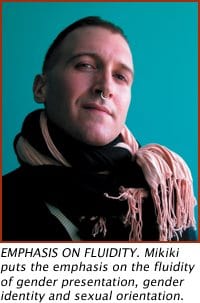
“I present in a plurality of modes,” says Mikiki, asking specifically to be referred to as “they” rather than “he” or “she.” “They” are co-hosting Transgress along with Ivan E. Coyote, and their presence means the audience is in for a few surprises.
Although now living in Montreal, Mikiki are well known in the nation’s capital. “People in Ottawa would probably be familiar with me shoving a champagne bottle up my ass on stage at SAW gallery,” they say.
Mikiki’s beginnings were, nonetheless, quite humble. They hail from Newfoundland and have a background in the visual arts, which strongly influences their performance and presentation. They have also been a drag queen for about 12 years, having started young doing benefit shows in Newfoundland’s punk scene. But even with humble hinterland origins, Mikiki have never shied away from exploring the complexities of sexual orientation, gender identity and gender expression.
“I did this project in 2001 for a show in Newfoundland where I spent the government’s money to get plastic surgery,” they say. “So I had these giant Angelina Jolie-like, clown, cocksucking lips and they were ridiculous and fantastic. I had them for four months. It felt more like how I want to publicly present than I do in the body I was given, but I’m also comfortable accessing the privilege I get as a man.”
Mikiki identify as both trans and genderqueer, and their performance aesthetic is grounded in the work of radical queer performance artists like Leigh Bowery. Still, they are hard to pin down.
“I am whatever I say I am,” they say, “just like my gender presentation, gender identity, sexual orientation is whatever I say it is. Because these are fluid things.”
Mikiki should feel right at home co-hosting a literary event. Reading is something they take seriously because they recognize the power of literature.
“Visual art is what I do but I’ve rarely been brought to tears by performance art or anything I’ve seen in galleries,” they explain. “It’s books — like reading Stone Butch Blues and sobbing on the bus and trying to not let people see me cry while I’m reading this. But also connecting with this story and knowing that there might be someone on the bus that would connect the same way. I’m able to share that with this book, like you’re connecting with the author but also with the experience of isolation and like a lived history for our community.”
Nevertheless, we’re unlikely to see any crying at Transgress. Asked what the Ottawa audience can expect from them as co-host, Mikiki are coy at first, taking a more academic line by emphasizing a desire to bring sex positivity and pro-choice philosophy to performance. Ultimately, they say they’ll simply put themselves on the line and see how it goes. Still, they couldn’t resist dropping a teaser about a past performance piece they couldn’t quite go through with.
“There was a project that I was thinking I was going to take free range eggs and mix them with my shit and put them in little plastic moulds, like foetus-shaped moulds and then freeze them and then put them in my butt and then shit them all out and give birth to this little army. But I couldn’t do it, maybe there’s even a point where it’s too transgressive, even for me. Maybe.”
 Why you can trust Xtra