“In matters of grave importance, style, not sincerity, is the vital thing,” says Gwendolyn in the third act of The Importance of Being Earnest. The current Stratford production of Oscar Wilde’s infamous comedy is low on consistent style and high on solemn sincerity.
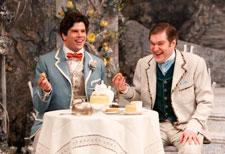
Director Brian Bedford feels that the dialogue must be delivered with a serious edge in order to do the comedy justice. This approach is seen clearly in the choices he makes performing the role of Lady Bracknell. Although he describes her as a “gorgon” of a character his interpretation is far too reserved. His makeup appears to be a simple coat of foundation with little rouge, lashes or eyeliner that might have accented the extremely hilarious politicized comedy this character spouts from beginning to end. Most of the cast follows Bedford’s lead, with the exception of Mike Shara as Algernon. His magnificent head of hair and his wildly effeminate posturing is perfect for the character and should have infused, by degree, all of the other half-crazed creatures that populate this very effeminate play.
In act two Gwendolyn remarks that, “Once a man begins to neglect his domestic duties he becomes painfully effeminate, does he not? And I don’t like that. It makes men so very attractive.” Her comic claims reveal the playwright’s acute awareness of the demands placed upon men and women in Victorian society regarding proper gender behaviour. Devoted to his wife and children yet fatally drawn into the pathologized homosexuality of the time, Wilde was driven to both ends of the sexual spectrum. Dazzled by the allure of the feminine, in both men and women, he plays with complex notions of the gendered body throughout the play. This provides the perfect vehicle for a domineering matriarch sporting butch and femme qualities. But Bedford’s Bracknell, although highly proficient, lacks the slightly ridiculous tone that would make the comedy suitably high spirited and hilarious. A matinee audience seemed amused but not enthused.
Sara Topham’s Gwendolyn rises to Algernon’s comic heights late in the play, but for the most part, succumbs to the overly sincere pose of the other cast members. Stephen Ouimette has some fine moments as Reverend Chasuble, and Bedford does manage a few grand moments in the climactic third act. Gorgeous painted sets by Desmond Heeley look like a decaying Victorian ruin. But they seem at odds with sharply defined costumes and furniture (also by Healey) that have found themselves lounging precariously in all the wrong rooms.
Bedford has suggested that Earnest should be seen alongside his one-man virtuoso performance in Ever Yours, Oscar, also at Stratford. However Peter Wylde’s selection of Wilde’s letters provide very little in the way of creative insight into the connection between Earnest and the playwright. His brief transitions from one letter to the text might have punctuated the presentation with possibility, rather than providing sincere yet pedestrian bridges for Bedford to cross from one passage to another. There is a very powerful yet somewhat disconnected section dominated by a discussion of the treatment of children in London prisons, something Wilde became well acquainted with during his own imprisonment.
There’s also a comically touching ending describing his demise in a badly decorated hotel in Paris. Unfortunately the letters are read within a rather sombre and reserved theatrical environment, appearing to be more of a lovely little lecture than a wild ride through Wildean autobiography.
Both Earnest and Ever Yours, Oscar are beautifully rendered and extremely professional-looking productions fit for audiences seeking a pleasant evening out. But neither play is terribly “out” in the gay sense. They both sport what appear to be the director’s preoccupation with polite innuendo rather than a scathing approach to Wildean wit. Worth the price of admission for yet another look at Oscar’s genius — not to mention Bedford’s swift move from drag to debonair — but, alas, they are not quite queer enough or caustic enough for this delightfully embittered constant critic who found them far too Earnest for his own good.
 Why you can trust Xtra