Brian Dedora is blessed with an alchemical touch. When not writing he’s gilding in his studio, dusting and draping things in gold. It’s like Ali Baba’s cave, only under construction. The studio sits in the garden of his house, the only brick structure in a sea of wooden ones. Because I’m lucky enough to count Dedora as a personal friend, I also know that the kids in the neighbourhood worry that he’s a wizard.
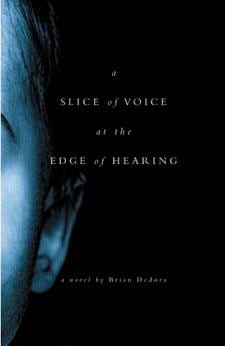
Dedora’s latest book, A Slice of Voice at the Edge of Hearing, makes his magical disposition obvious and interprets the making of a modern queer literary shaman.
Though called a novel, it’s an autobiographical collage of narratives and blips with the broad scope of a writer coming to terms with his personal coming-of-age.
Born in 1946, Dedora grew up in the Okanagan — the stage for the beginning of our hero’s quest. Dedora’s Lake Okanagan is inhabited by a monster where friends drown and shamans find them. His Catholic school is, to me, a relic of tyranny that my generation was spared. Here Dedora is subjected to the sexual discipline and desperation of the monsignor. After, Deodora runs to hide in the woods and we’re offered the candid workings of a child’s mind: What amounts to a vomitous 176-word sentence that ends in “fuck ’em.”
The book is a collection of reflective stories and a showcase of jolting prose to remind you that our narrator is also a writer. It is about sex, guilt and Catholicity, asking: What is gay and who am I in it?
“In the bushes under the bay window soft white underwear slides to the ground. Nuns told us, nuns with black habits,” Deodora writes. “Making him kneel in front of the class. Black strap pounding on his outstretched palms head shoulders. God knows. God watches. God sees your impure white body. Underwear on the ground. Fingers on the it. God watching. Doing it for Him.”
In the tradition of the hero, Dedora’s story begins almost when he accepts a quest. He realizes his queerness and, as a teenager, we watch Dedora land in Victoria where he is equipped through the sexual tutelage of a lover. This is the foundation for his passage to young adulthood when our unnamed hero binges on the big gay grime of Toronto.
In his Globe and Mail review Jim Bartley (who also reviews books in Xtra) wrote, “Dedora’s slice from this lost demimonde is flawlessly animated. It’s a time-warp back to a community bound together and torn apart by one intractable curse, the label ‘deviant.’”
He must have been there to say so because the queer world that I’ve inherited has been sterilized by comparison. Dedora’s vision of 1970s Toronto is ripe with conflict, politics and triumphant sexual innuendo, while totally unapologetic in its sincerity. It’s full of dark corners and constant perils seen from the perspective of an out, adventurous fellah with a sharp eye and an appetite.
The accounts of the Parkside and St Charles taverns, once Toronto queer institutions and now turned into fast-food restaurants, are treasures. I hope that Dedora exploits this subject in future writing because Canada has been starved for these stories. Having been largely fed US queer histories, I would love to devour an entire novel of Dedora’s memories of burgeoning gay Toronto.
“The corner of my eye saw a bad-boy who was wearing experience free from emotional commitments,” goes one scene. “With T-shirt sleeves rolled up so you could see the cigarettes, biceps and a tattoo. Police uncovered some of the offenders. Admitted this was true. Laws relating to are bound to operate unevenly. Offenders in the hallways. Offenders in the stalls. Arrest and conviction when they call for a clean-up… ‘How long have you been here…?’ ‘How’d you know I was?’”
Dedora is a rising figure in Canada’s queer art and lit scene. He has published three books and his works have been included in numerous special editions and anthologies. He is also an accomplished and captivating performance artist.
Our shared history is rarely documented and, when it is, it’s rarely this eloquent. The heroes who brought our community through its rites of passage ought to speak up more frequently and, more importantly, we should all listen when they do.
 Why you can trust Xtra