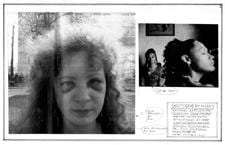
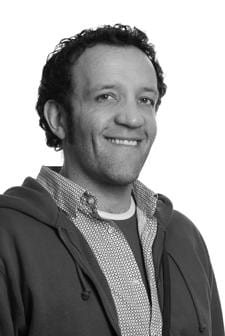
Ron Kennell, pictured here alongside a concept drawing from designer Eo Sharp for his costume and other inspiration for the feel of the play. Credit: Courtesy of CanStage
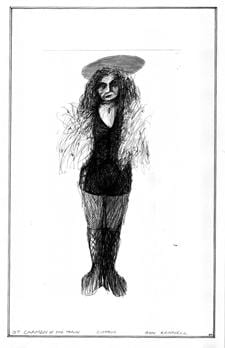
Credit: Courtesy of CanStage
Ron Kennell is perfecting his runway sashay. It’s all part of a day’s work for the Stratford-born actor, who will don a pair of four-inch stilettos for his role in Michel Tremblay’s Saint Carmen of the Main. The play opens at the Bluma Appel Theatre this week under the direction of Peter Hinton, artistic director of English theatre at the National Arts Centre in Ottawa.
“We had a heel coach [Stephen Lawson of 2boys.tv fame] who came in the first day of rehearsal to teach us how to warm up, how to walk and how to fall,” Kennell says over pre-rehearsal coffee. “It’s kind of second nature to wear the heels now. It’s actually hard to rehearse without them, since the timing of the show is all based around them.”
Kennell plays one member of the raggedy chorus, based on the trans people and whores of Montreal’s notorious Rue Saint-Laurent (better known as The Main) back in the 1970s. Clad in costumes that could have been pulled from a Lady Gaga video, the posse provides a backdrop to the central action of the show.
Singing sensation Carmen Brassard has returned from a stint in Nashville where she’s been fine-tuning her voice. The denizens of the rundown strip have come to hear her first performance since her return; Carmen wants to empower them to change their lives with her songs. But Maurice, who owns most of the bars in the ’hood, doesn’t want to risk losing his clientele when they realize there’s more to life than sucking back cheap beer.
Carmen is one of a series of works penned by Tremblay that explore the various personalities of Montreal’s early gay village. First performed there in French in 1976, Tremblay intended the show as a wake-up call to Quebec, a few short years before the 1980 referendum on separation. Historically repressed by the anglo minority, Quebeckers were often forced to speak English if they wanted to work, effectively hiding their history and identities.
Director Hinton’s version keeps the work in the world of the 1970s but rethinks the relevance of the show’s message — that we must all learn to speak in our own voice, in today’s society.
“Tremblay never thought that the work would be performed again in English after it was presented for the first time in 1978,” Kennell says. “The play was originally written about a very specific time and place, but now it speaks to a very different world. But the central idea of whose voices are listened to in society and whose voices are disregarded is as relevant as it ever was.”
The role represents somewhat of a departure for Kennell, who, despite being gay, rarely plays gay parts.
“I typically play bad evil characters, like the strange neighbour building a bomb in the garage,” he laughs. “When I was in theatre school, one of my teachers wrote in a report that I would have a good future playing Frankenstein and other simple giants. Thankfully, my career has been a little more diverse than that.”
Though Kennell’s career has seen him tread the boards across the country, including five years at the Stratford Festival, having a chance to perform in a seminal work by one of the most important gay playwrights in Canadian history is a special moment.
“I feel very lucky to be able to be part of a work like this,” he says. “It’s such a bold, dense piece of theatre that still feels relevant almost 40 years after it was written.”

 Why you can trust Xtra