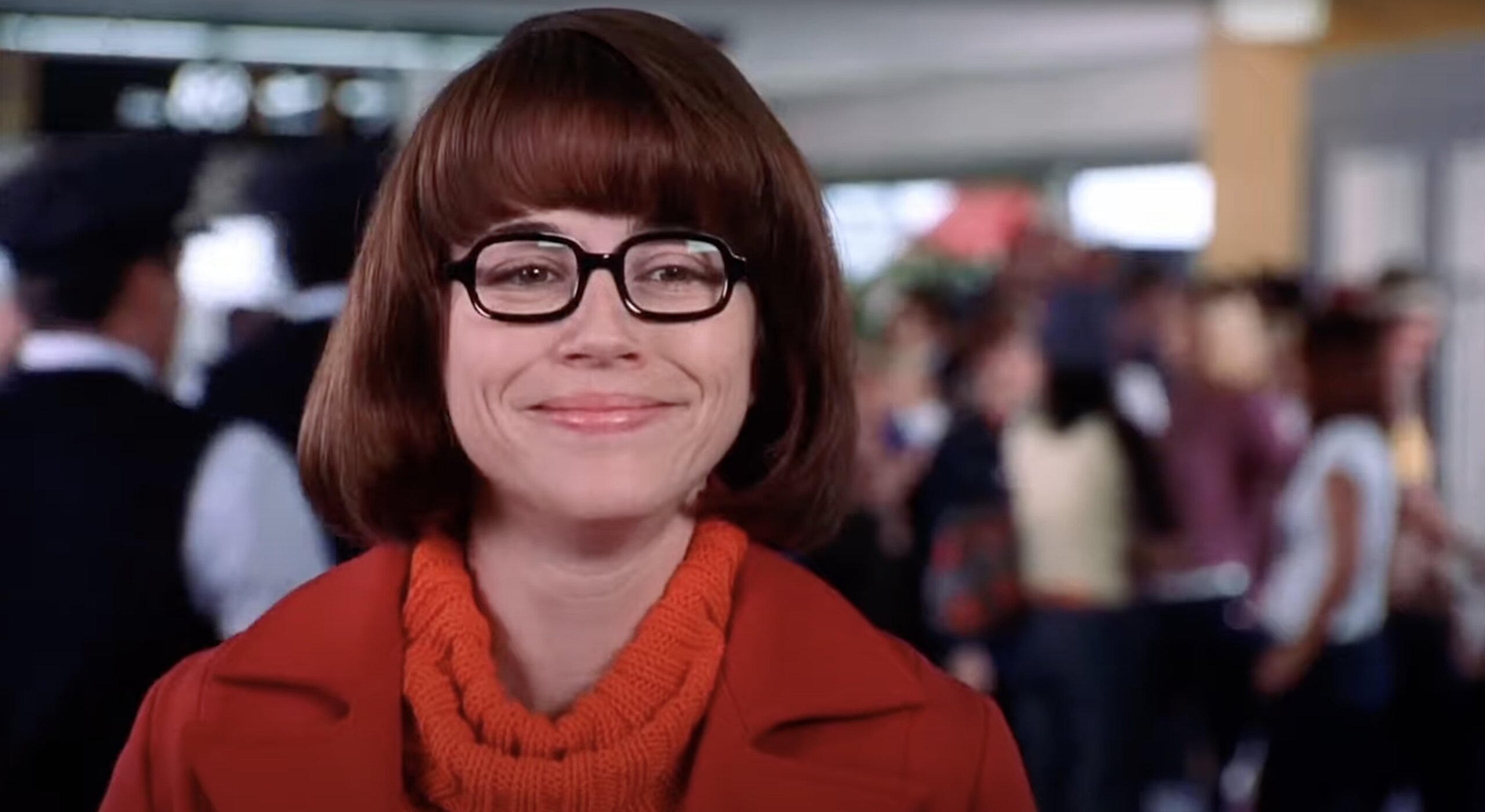
If you were a Scooby-Doo kid growing up, you might be queer now.
You know how (at least in the late ’90s and early ’00s) there were Hot Wheels kids or Disney Princess kids or horse kids? I was a Scooby-Doo kid through and through. For a good chunk of my childhood, the cartoon dog and his friends defined my life. I’m talking posters, movies, stuffed animals, pencils—you name it, I probably had the Scooby-Doo version of it. As a queer and trans person now, it makes sense when I look back at that time in my life: Scooby-Doo was the ultimate non-gendered franchise, not relegated to the realm of “for boys” or “for girls.” For a latent baby gay, it was the ideal middle ground.
I bring this up, because if you were queer and/or trans former Scooby-Doo kid and now an adult in 2022, the eating is good.
Velma’s a lesbian—like, for real this time. A new animated film, Trick or Treat Scooby Doo!, which comes out Oct. 14, will give us our first explicitly canonical lesbian Velma content in the form of her having a big ol’ longing gay crush on a hot indie girl. Because who among us hasn’t had that exact scenario be part of our gay awakening?
Scooby-Doo scribes have long hinted at and discussed Velma being queer, including Scooby-Doo! Mystery Incorporated series producer Tony Cervone in 2020. But this is the first time it’s canon in an official franchise property. And that’s a big deal. More openly queer characters in media directed at kids is a good thing, especially ones as iconic as Velma.
As queer singer Hayley Kiyoko, who played Velma in the franchise’s live-action 2009 TV movie, said, it’s been a long time coming.
On top of that, we can’t forget that this year marks the 20th anniversary of James Gunn’s 2002 live-action Scooby Doo film, which itself is a vital piece of queer canon. In fact, Gunn has said he tried to make Velma gay in the film, but was shut down.
“In 2001 Velma was explicitly gay in my initial script,” he wrote in a 2020 tweet. “But the studio just kept watering it down & watering it down, becoming ambiguous (the version shot), then nothing (the released version) & finally having a boyfriend (the sequel).”
But while Linda Cardellini’s Velma wasn’t explicitly queer in the film, Gunn’s intentions definitely connected at least with me and other budding queers—particularly via one bonus scene from the DVD version where she sings Frank Sinatra on a piano in a way that seems very pointed at Sarah Michelle Gellar’s Daphne.
But the film (and its excellently camp 2004 sequel Scooby-Doo 2: Monsters Unleashed, which does feature a scene of Shaggy turning into a woman) broadcasts its queerness in other ways. There’s the body-swapping scene, where members of the Scooby gang swap bodies and genders for a brief period. There’s Gellar, fresh off of queer icon status from Buffy the Vampire Slayer. And of course, there are the broader themes of being an outcast, coming together and chosen family.
Scooby-Doo’s super queer! And it’s finally canon with lesbian Velma. Now we just need Daphne to come out as the bisexual we all know she is, and my fanfiction dreams can come true.

 Why you can trust Xtra